The American Mountains You Can Reach By Train
A handful of American mountains carry passenger railways built to climb them, not trains that pass nearby on the way somewhere else. Each was engineered against a single slope, using a rack rail, a cable, or gears cut for grades no ordinary locomotive can hold. Cog rail climbs some of them, a cable hauls the incline that burned in 2024 and came back, and spruce and silver paid for the lines in West Virginia and Nevada long before anyone boarded for the view. Only one reaches the summit.
Pikes Peak, Colorado

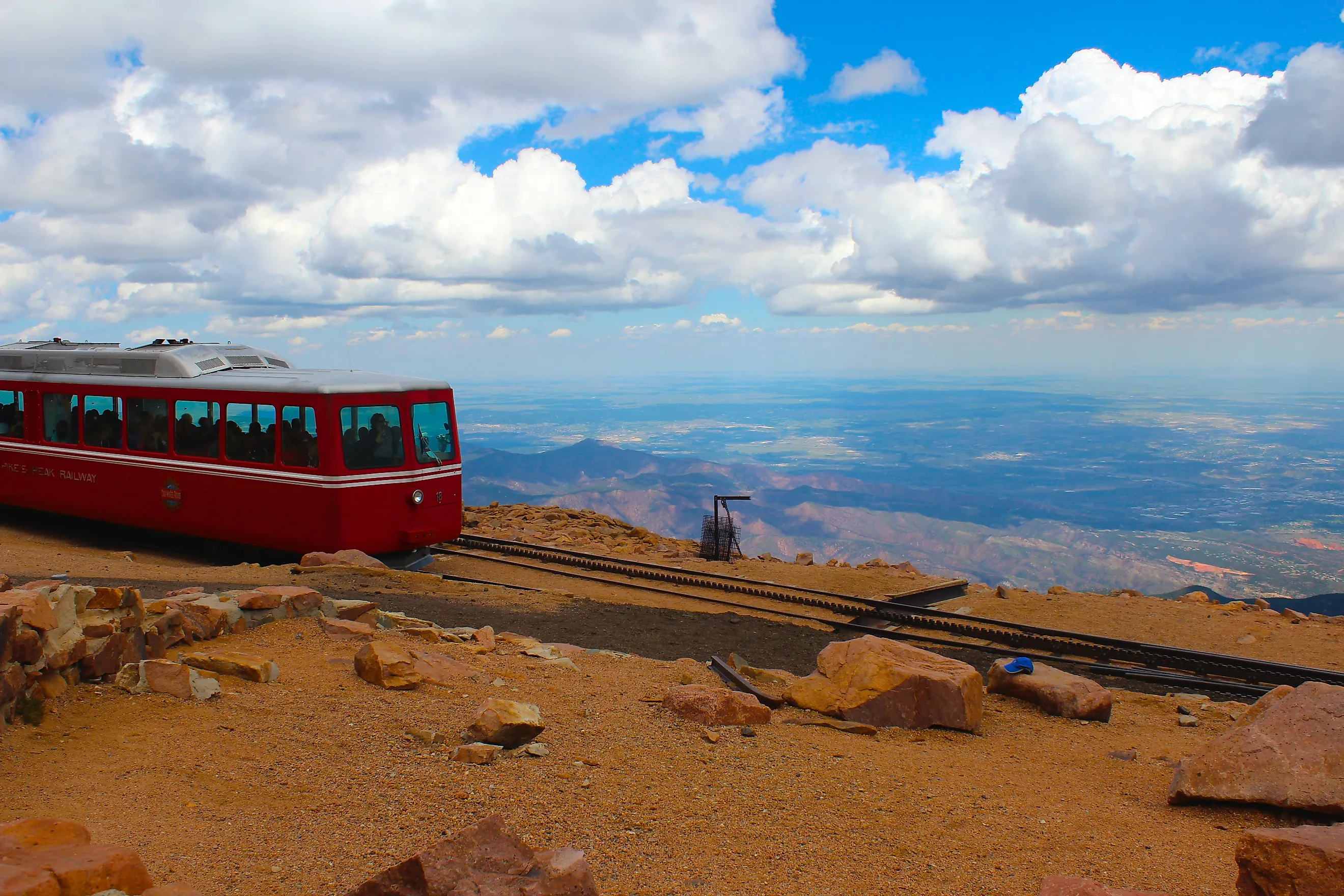
Pikes Peak carries a cog railway that ends at the summit itself, which none of the others here manage. The peak reaches 14,115 feet (4,302 m) in the Front Range of the Rocky Mountains and ranks 32nd in elevation among Colorado peaks. It sits inside Pike National Forest. Its top is a fairly level area of about 60 acres of Pikes Peak granite, pink with potassium feldspar, cooled underground roughly a billion years ago. The Ute called it Tava, Sun Mountain, because the dawn reached it first. The band living in its shadow took the name Tabeguache, the People of Sun Mountain.
Edwin James, J. Verplank, and Z. Wilson stood on top on July 14 and 15 of 1820, climbing with Stephen Harriman Long's expedition. No earlier ascent of any 14,000-foot American peak is on record. Zebulon Pike had turned back 14 years earlier, beaten by snow and thin clothing.
Zalmon Simmons founded the Manitou and Pike's Peak Railway Company in 1889, after two days on a mule convinced him there should be a better way up. A church choir rode the first train to the top on June 30, 1891. The Broadmoor Manitou and Pikes Peak Cog Railway closed after the 2017 season, then reopened in 2021 with a Strub rack and Swiss trainsets. The Barr Trail covers about 13 miles out of Manitou Springs and gains more than 6,000 feet. The Forest Service rates it more difficult. Walkers who arrive that way can buy a seat down.
Mount Davidson, Nevada

Mount Davidson owes its height to a plug of hard rock. The Nevada Bureau of Mines and Geology describes the peak as an intrusive body, a frozen magma chamber, ringed by softer volcanic rock that wore away faster around it. At 7,864 feet (2,397 m) it is the highest and most prominent summit in the Virginia Range. It is also the high point of Storey County. Mark Twain wrote about the flag flying on its crown in Roughing It.
That softer ground held the Comstock Lode, the first major silver strike in the country, made public in 1859 and named for the miner Henry Comstock. Virginia City grew on the eastern slope, directly above the ore body.
The Virginia and Truckee Railroad existed to serve those mines. Grading crews broke ground on February 18, 1869, and the first passenger train pulled into Virginia City on January 29, 1870. The route required seven tunnels and turned through 17 full circles in the 13.5 miles up from the river. A reconstructed section now runs a 24-mile round trip out of the Eastgate Depot in Carson City, behind steam on weekends from late May into October. The train still ends at Virginia City, more than 1,500 feet below the summit.
Mount Washington, New Hampshire

Sylvester Marsh was caught by a storm on Mount Washington in the early 1850s and spent years afterward arguing that a railway could do the job more safely. His Mount Washington Cog Railway was finished on July 3, 1869, the first mountain-climbing cog railway in the world. The track runs about 3 miles up the western slope on trestle, at average grades above 25% and a maximum near 37% at Jacob's Ladder. Biodiesel locomotives climb it in as little as 36 minutes. The two surviving coal-fired steam engines take closer to an hour. Their boilers are tilted forward so they sit level on the grade.
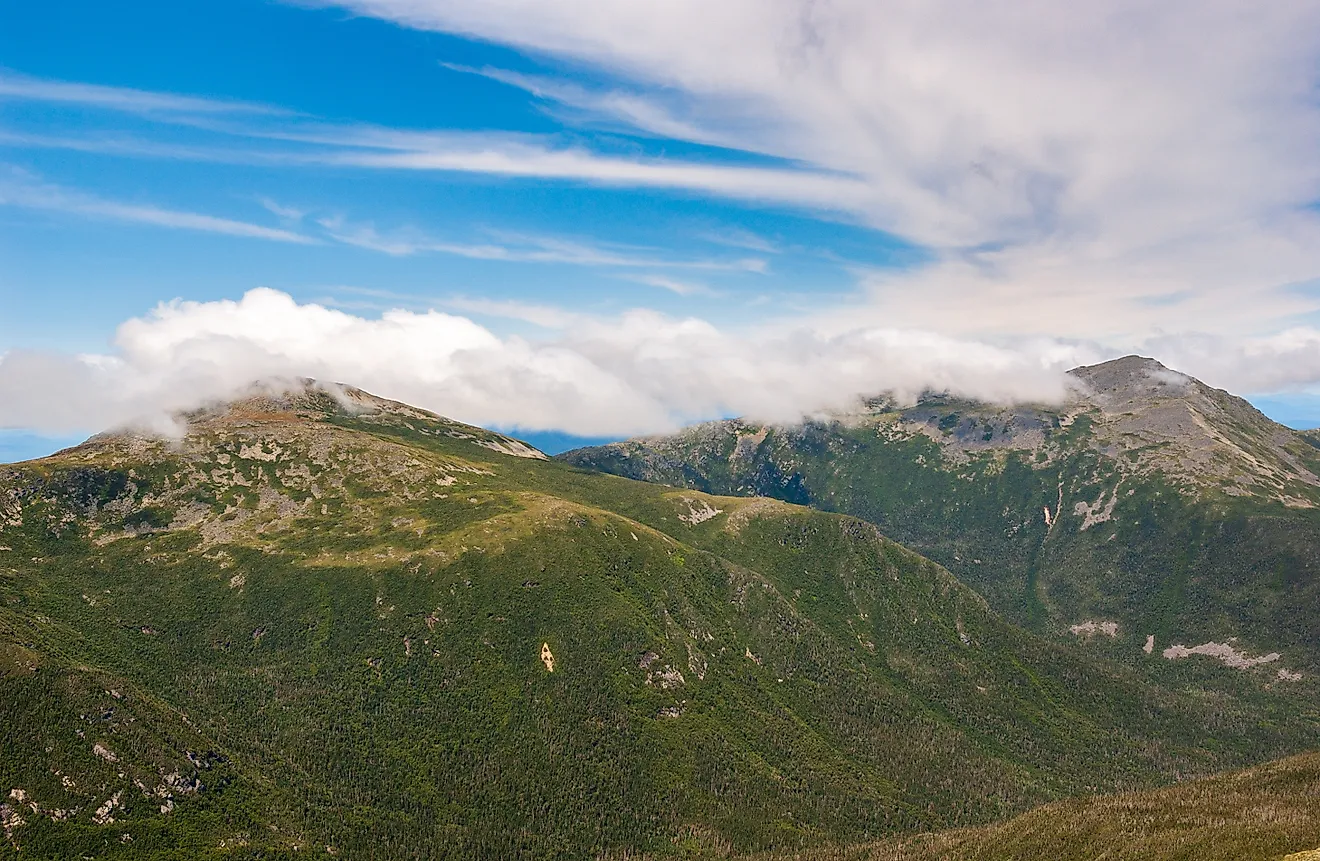
The mountain reaches 6,288 feet (1,917 m) and nothing in the Northeast is taller. Its rock is Littleton Formation schist interbedded with quartzite. New Hampshire protects the summit as a state park. Abenaki people call it Agiocochook and held its summit to be the home of a god. Darby Field is the earliest climber on record, going up in June 1642 with two Native guides. Governor John Winthrop entered the account in his journal.
On April 12, 1934 the Mount Washington Observatory measured a gust of 231 miles per hour. That figure is still the fastest wind ever recorded at a staffed weather station. The Cog ends among the summit buildings rather than on the true top. The Crawford Path, cut in 1819, covers 8.5 miles to the same place on foot.
Bald Knob, West Virginia

Bald Knob crowns Back Allegheny Mountain, a ridge of the Appalachians, at 4,842 feet (1,476 m), the third highest point in West Virginia. The West Virginia Pulp and Paper Company founded the town of Cass in 1901 and laid track the same year. The purpose was not passengers. It was bringing red spruce down to the mill at Cass on the Greenbrier River. The grades were far too steep for a conventional rod locomotive, so the company bought geared engines instead.
Mower Lumber Company bought the operation in June 1942 and shut it down in July 1960. West Virginia took the line into its park system the following year, and added the company town in 1977.
The Cass Scenic Railroad now climbs 2,390 vertical feet over 11 miles, a round trip of about four and a half hours. The National Register listed it in 1974 as a historic district covering the whole climb, and recorded Ephraim Shay, who patented the Shay locomotive, as its architect. The train halts at an overlook roughly a quarter mile north of the peak itself and some 110 feet below it. Red spruce grows there in a stand that resembles forest hundreds of miles farther north.
Lookout Mountain, Tennessee

Lookout Mountain burned on December 7, 2024. Freezing and thawing near the top loosened a large rockslide, the slide touched off a wildfire on the battlefield slopes, and the fire covered about 10 acres. It severed the cable of the Lookout Mountain Incline Railway, damaged rail and cross timbers, and closed a line that had run since 1895. Crews replaced cable, rail, and timber. The railway reopened in July of 2025.
The mountain is a ridge some 84 miles long at the southern end of the Cumberland Plateau, crossing Tennessee, Georgia, and Alabama. Its summit is called High Point. It tops out at 2,392 feet (729 m) in Walker County, Georgia, the highest ground in that county. A cap of resistant sandstone over softer limestone gives the ridge its cliff line. That sandstone weathered into the boulders at Rock City, and the limestone under it holds the caves at Ruby Falls. Union troops under Joseph Hooker took the heights on November 24, 1863, in fighting remembered as the Battle Above the Clouds. Point Park, part of Chickamauga and Chattanooga National Military Park, occupies the northern tip.
The Incline runs 1 mile on a single track with a passing loop at the midpoint, reaching a grade of 72.7%. The Chattanooga Area Regional Transportation Authority operates it as public transit, daily, with seasonal hours.
Bear Mountain, California

Bear Mountain reaches under 900 feet (275 m) above the redwoods of the Santa Cruz Mountains, the higher of two summits inside Henry Cowell Redwoods State Park. The pitch is the point, not the height. Ordinary railroads depend on friction between steel wheel and steel rail, which caps them near 10% at the outer limit. Roaring Camp Railroads works this line at grades its own history puts above 8%, with no rack rail to help. That is close to the physical limit of adhesion.
Geared locomotives are what make that possible. Shay engines, designed in 1872 for western logging, drive their wheels through a crankshaft and gearing rather than side rods, trading speed for pulling power on a slope. Roaring Camp keeps several Shays, a Heisler built in 1899, and a Climax. The American Society of Mechanical Engineers designated three of them a Historic Mechanical Engineering Landmark in 1988.
The 3.25-mile climb to the summit takes about 75 minutes round trip and crosses a switchback built after a 1976 fire destroyed a spiral loop. Joseph Warren Welch bought the grove below in 1867 to keep it from being logged, which is why old-growth redwood still stands beside the track.
The Grade Sets The Machine
These American mountain railways turn the train ride itself into a way of getting high into the mountains. The Cog Railway carries passengers into the summit complex of Pikes Peak, and other routes stop just short of a summit or reach a mountain town below it. These six routes put high-country landscapes within reach without requiring a long climb by road or trail. Two were originally built to haul silver and spruce, but today the scenery is the reason people climb aboard. The cargo has changed, but the mountains remain the destination.