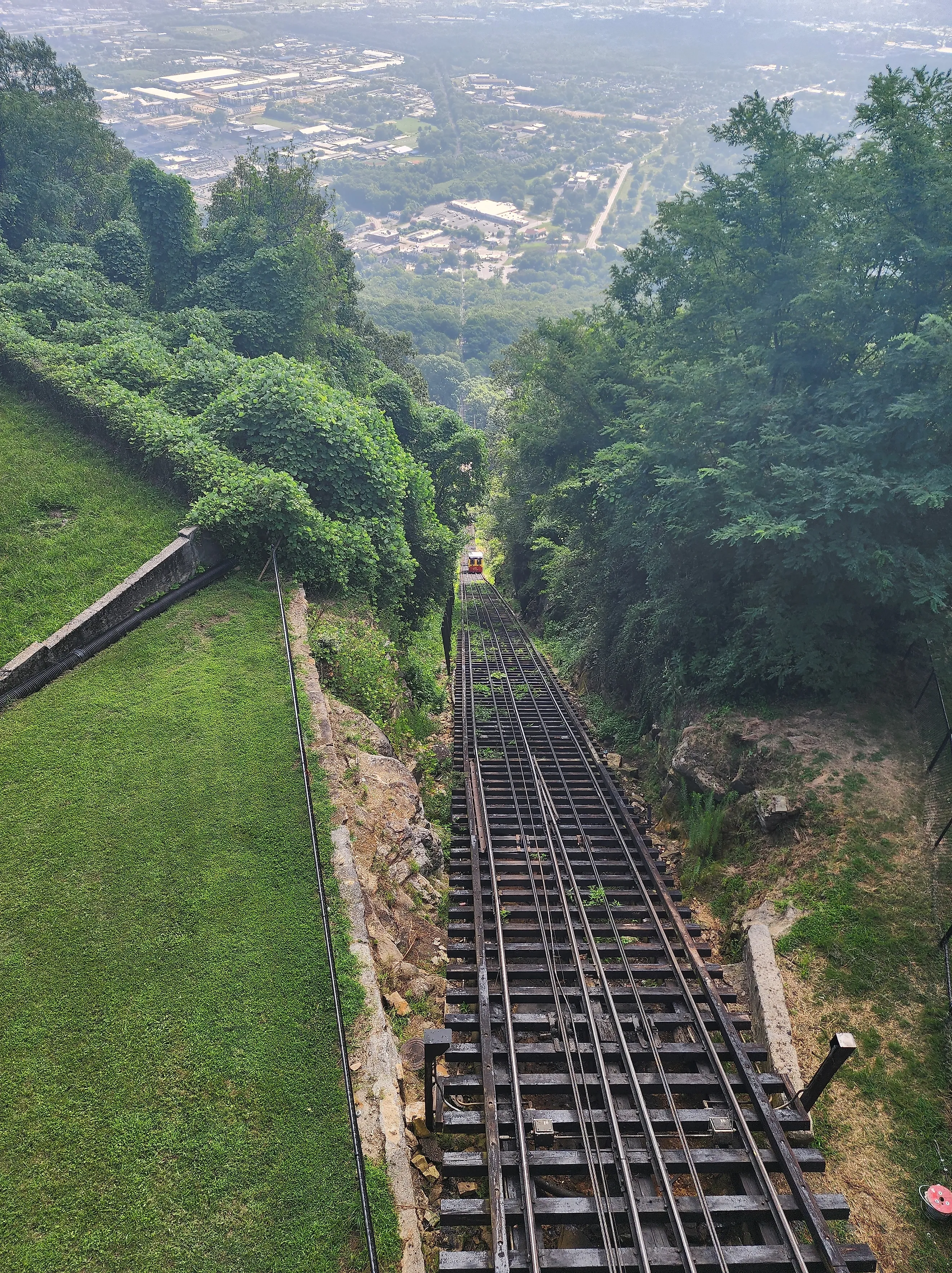
The Steepest Railway In North America
There are steep railways, and then there is a little cable car in Tennessee that scales a mountain at an angle that would make a billy goat nervous. The steepest railway in North America hauls ordinary passengers up a grade of 72.7 percent, which is a polite, mathematical way of saying "very nearly straight up." Ladies and gentlemen, buckle up for the Lookout Mountain Incline Railway.
The Answer: The Lookout Mountain Incline Railway

Perched in Chattanooga, Tennessee, and cheerfully nicknamed "America's Most Amazing Mile," the Lookout Mountain Incline Railway is widely billed as the steepest passenger railway on the continent, and frequently the steepest on the planet. It has been hauling people from the St. Elmo neighborhood at the base up to the top of Lookout Mountain since 1895, climbing about 1,450 feet over roughly a mile of track. Near the summit, the grade maxes out at a genuinely absurd 72.7 percent. It is so cleverly engineered that it was named a National Historic Landmark, and here is the kicker: it still runs today as part of the city's actual public transit system. You can ride the steepest railway in North America on a transit ticket.
Just How Steep Is 72.7 Percent?

A phrase like "72.7 percent grade" is hard to actually feel, so here is the translation: it is steeper than a typical household staircase. For every 100 feet the car rolls forward, it climbs nearly 73 feet upward, an angle of around 36 degrees. On the way up, you are tilted so far back that you are essentially reclining in a dentist's chair pointed at the sky, watching the whole valley drop away beneath your shoes. If you grab a seat at the lower end of the car, the passengers up front are not merely ahead of you, they are looming above you like the top row of a very aggressive bleacher. Do bring along a friend who is scared of heights, purely for the entertainment value.
It Is Basically a Cliff-Climbing Elevator

Technically, the Incline is a funicular, which is a fancy word for an extremely clever seesaw. Two cars are tied to opposite ends of a long cable that runs over a giant wheel at the summit, so as one car climbs, the other descends, each counterbalancing the other and sparing the motors most of the work. The single track splits into two lanes only at the midway point, just long enough for the cars to squeeze past each other, and the builders pulled off a slick trick to manage it: one car's wheels are flanged on the inside and the other's on the outside, so they slip past with no moving switches in the track at all. It ran on steam power back in 1895. Today, two fairly modest electric motors quietly do the climbing.
The Runner-Ups

The Incline does have some worthy challengers for the crown. Over in Pennsylvania, the Johnstown Inclined Plane climbs a hair less steeply, at about 71 percent, but it one-ups everyone by hauling entire automobiles up the hillside, earning the title of the world's steepest vehicular inclined plane. In New Hampshire, the Mount Washington Cog Railway grinds up the Northeast's tallest peak on a toothed "cog" rail, and its Jacob's Ladder trestle hits a 37 percent grade, making it the steepest railroad trestle anywhere on Earth. And in Colorado, the Pikes Peak Cog Railway wins on pure altitude, grinding its way to a summit above 14,000 feet, the highest railway on the continent.
Why Anyone Built These

Before switchbacked highways and dependable automobiles, getting people and freight up a steep mountain or river bluff was a real headache, and a straight-up cable railway was frequently the cleverest solution anyone could think of. Many were thrown up in the late 1800s to reach hilltop neighborhoods, breezy summer resorts, and, above all, tourist attractions. Lookout Mountain was a blockbuster of a destination, packed with Civil War history, the famous Rock City gardens, and the underground waterfall at Ruby Falls, and the Incline was the thrilling way to get up there. More than a century later, most of America's old inclines have vanished, but a stubborn, gravity-defying few, led by that impossible-looking mile in Chattanooga, are still faithfully climbing.