The 10 Tallest Mountains In The Sierra Nevada
The 10 tallest peaks in California's Sierra Nevada rise above 14,000 feet, forming a rugged landscape of granite summits, glacial valleys, and jagged ridgelines. Much of the range consists of granitic rock formed as magma cooled deep underground during the Mesozoic Era. Subsequent uplift, faulting, and glacial erosion shaped the mountains, leaving a steep eastern escarpment overlooking the Owens Valley and more gradual slopes extending westward. The range also influences regional weather, receiving heavy snowfall at higher elevations while contributing to the dry conditions east of the mountains. The towering peaks below have long had cultural significance for Indigenous peoples and attracted generations of explorers, surveyors, and mountaineers.
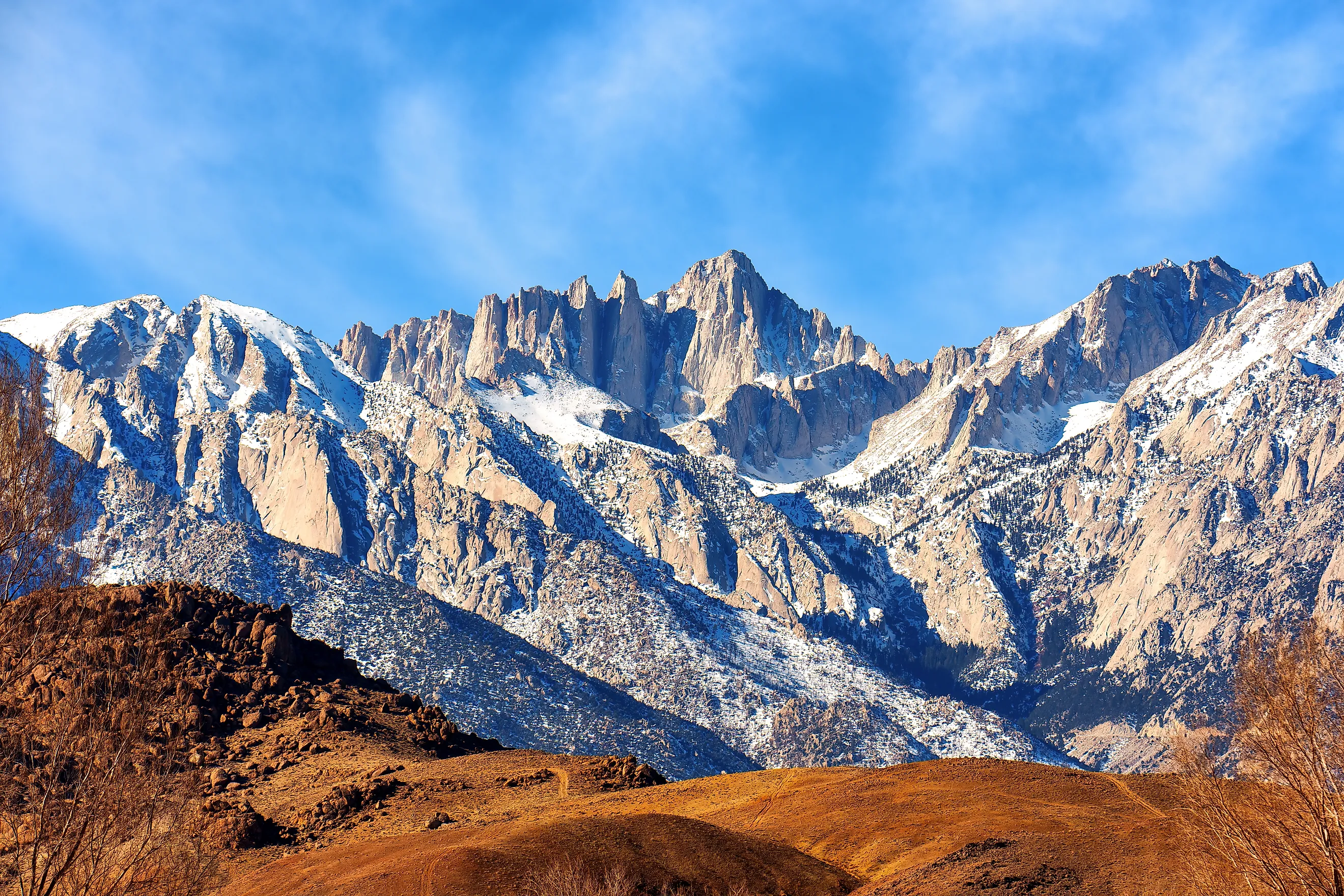
Mount Whitney - 14,501 feet (4,420 meters)

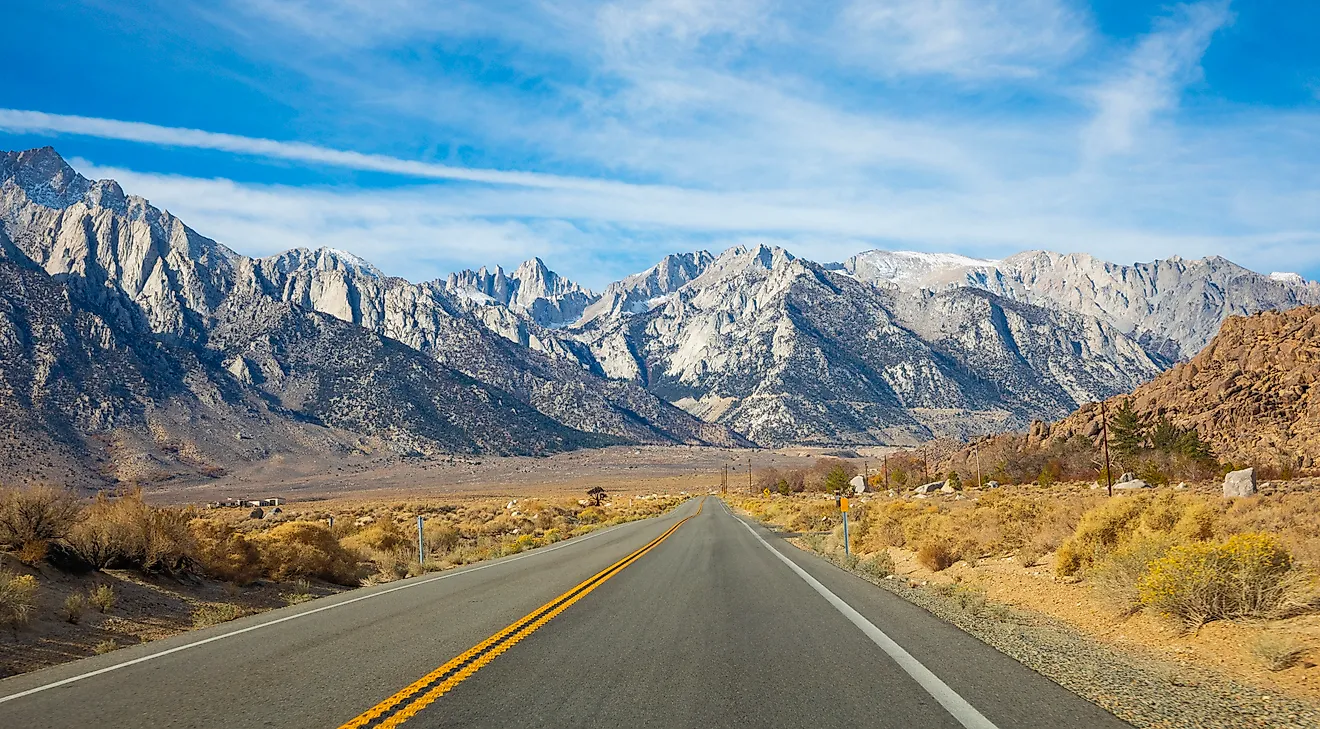
Mount Whitney is the tallest mountain in the Sierra Nevada and the contiguous United States. Historical accounts associate the mountain with the Paiute name Tumanguya and traditions concerning a powerful spiritual being, although the name's precise historical application remains uncertain. The mountain received its present name in 1864 in honor of Josiah Whitney, California's state geologist. Clarence King, a member of the California Geological Survey, mistakenly believed he had climbed Whitney in 1871 but had actually reached nearby Mount Langley.
The first recorded ascent of Whitney came on August 18, 1873, when Charles Begole, A.H. Johnson, and John Lucas reached the summit. The three men, residents of Lone Pine, called it Fisherman's Peak. In 1909, the Smithsonian Astrophysical Observatory constructed a stone shelter on the summit for scientific observations, particularly research involving solar radiation and atmospheric conditions.
Mount Williamson - 14,379 feet (4,383 meters)

Mount Williamson is the second-highest peak in the Sierra Nevada, rising prominently above the Owens Valley west of Independence. Unlike Mount Whitney, which has a well-established hiking trail to its summit, Williamson requires a lengthy wilderness approach. The route through Shepherd Pass involves roughly 30 miles of round-trip travel, substantial elevation gain, and challenging terrain.
Named for Lieutenant Robert Stockton Williamson, who conducted railroad surveys in California during the 1850s, the mountain was first recorded as climbed around 1884 by William L. Hunter and C. Mulholland. Its massive eastern face and remote summit make it one of the more physically demanding Sierra Nevada fourteeners.
North Palisade - 14,245 feet (4,342 meters)

North Palisade is the third-highest peak in the Sierra Nevada and the tallest summit in the Palisades, a rugged group of mountains along the Sierra crest. Its sheer granite faces, narrow ridges, and exposed climbing routes make it a prominent mountaineering destination. Below the mountain lies Palisade Glacier, the largest remaining glacier in the Sierra Nevada.
The glacier occupies a high basin beneath the Palisades and has retreated considerably over time. North Palisade was first climbed on July 25, 1903, by Joseph N. LeConte, James K. Moffitt, and James S. Hutchinson. Its imposing terrain and proximity to other major summits have made the Palisades an important area in California's mountaineering history.
Mount Sill - 14,154 feet (4,314 meters)

Mount Sill rises along the eastern side of the Palisades, offering expansive views of the surrounding Sierra Nevada and the glaciated basin below. Its position near Palisade Glacier offers a striking perspective on the region's rugged peaks and steep valleys. The mountain was named after Edward Rowland Sill, a California poet and educator.
Its first recorded ascent occurred on July 24, 1903, when Joseph N. LeConte, James K. Moffitt, James S. Hutchinson, and Robert D. Pike reached the summit. The ascent took place just one day before LeConte, Moffitt, and Hutchinson completed the first recorded climb of North Palisade. Mount Sill remains a popular objective for experienced climbers, with routes ranging from scrambling to technical rock climbing.
Mount Russell - 14,089 feet (4,294 meters)

Mount Russell stands immediately north of Mount Whitney but has a distinctly different profile. Its long, narrow summit ridge and steep granite faces contrast with Whitney's broader summit plateau. The mountain honors Israel Cook Russell, a geologist and explorer associated with the United States Geological Survey. Its early ascent history is less clearly documented than that of neighboring Mount Whitney.
The mountain's East Ridge is a well-known Class 3 climbing route that involves scrambling over exposed granite with considerable drops along portions of the ridge. Although the technical difficulty is moderate compared with some Sierra Nevada climbing routes, the exposure and remote alpine setting demand experience and careful route selection.
Split Mountain - 14,060 feet (4,285 meters)

Split Mountain takes its name from its distinctive double summit, divided by a prominent notch along the crest. The mountain was previously known as South Palisade and Southeast Palisade before mountaineer and artist Bolton Coit Brown introduced the name Split Mountain in 1895. Its contrasting rock formations and steep eastern slopes give it an unusual appearance among the Sierra Nevada fourteeners.
Although some routes cross loose rock and challenging terrain, its northern slopes provide a comparatively straightforward ascent. An earlier climb has been attributed to Frank Salque and companions in 1887, while the first well-documented ascent occurred on July 23, 1902, when Helen M. LeConte, Joseph N. LeConte, and Curtis M. Lindley reached the summit.
Middle Palisade -14,037 feet (4,278 meters)

Middle Palisade rises along the Sierra crest south of North Palisade, with steep granite walls overlooking glacially carved valleys. Its craggy faces and extensive fields of broken rock make the mountain a challenging destination despite its relatively modest elevation difference from neighboring fourteeners.
Middle Palisade was among the last major Sierra Nevada summits to receive a documented first ascent. On August 26, 1921, Francis P. Farquhar and Ansel F. Hall reached the summit, completing a significant achievement in the exploration of the Palisades. The mountain remains known for its strenuous approaches, difficult scrambling routes, and exposed alpine terrain.
Mount Langley - 14,033 feet (4,277 meters)

Mount Langley is the southernmost fourteener in the United States and one of the more accessible high summits in the Sierra Nevada. Unlike the granite towers of the Palisades, Langley has a broad summit area surrounded by extensive rocky slopes and high-altitude terrain. Its standard routes through the Cottonwood Lakes region and Army Pass involve long hikes but generally avoid the technical climbing required on many other fourteeners.
Clarence King and Paul Pinson made the first recorded ascent in July 1871, initially believing they had climbed Mount Whitney. The mountain was eventually named after Samuel Pierpont Langley, an American astronomer and physicist. Its high elevation and relatively approachable routes make it a popular destination for experienced hikers.
Mount Muir - 14,028 feet (4,276 meters)

Mount Muir rises along the Sierra crest south of Mount Whitney, with a compact, rocky summit overlooking the surrounding alpine terrain. Named in honor of naturalist and conservationist John Muir, the mountain is closely associated with the Mount Whitney Trail, which passes nearby. Although its summit stands only slightly above the surrounding ridge, the final approach requires scrambling over steep granite blocks.
Its relatively low topographic prominence has led to differing classifications of the mountain as an independent fourteener, but it appears on established lists of California's fourteeners. Unlike Mount Whitney, whose early climbing history is well documented, Mount Muir has no firmly established first-ascent record.
Mount Tyndall - 14,023 feet (4,274 meters)

Mount Tyndall occupies a prominent position along the Sierra Nevada crest north of Mount Whitney. Its sharp granite ridges and exposed summit offer wide views of the surrounding mountains and deep valleys. The peak was named after John Tyndall, an Irish physicist whose research included important studies of glaciers and atmospheric gases.
The mountain played an important role in the early exploration of the High Sierra when Clarence King and Richard Cotter completed its first recorded ascent in July 1864 while working with the California Geological Survey. King later described the expedition in his 1872 book, Mountaineering in the Sierra Nevada, which became an influential account of early mountaineering in California.
Natural Power And Human History
The Sierra Nevada's tallest peaks preserve evidence of millions of years of geological change and more than a century of documented mountaineering history. Mount Whitney's historic observatory and the granite ridges of the Palisades are part of that record, and each summit has its own place in California's landscape. Their cultural significance, demanding climbing routes, and dramatic topography continue to make these mountains among the most remarkable features of the American West.