What Happens If The Soo Locks Shut Down
The Soo Locks shut down every year on schedule, and almost nobody notices. Federal rules generally close the locks from January 15 to March 25 based on typical Great Lakes ice conditions, and the US Army Corps of Engineers uses the interval for critical maintenance. An unexpected shutdown of both operating US chambers, the Poe and MacArthur locks, however, would halt commercial traffic through the American lock complex between Lake Superior and the lower Great Lakes.
The greatest consequences would result from losing the Poe Lock, because ships carrying about 88% of the commercial cargo cannot pass through the MacArthur. The most detailed federal analysis examined a six-month Poe closure. Within hours, vessels would begin lining up along the St. Marys River. Within days, cargo schedules would unravel, and Lake Superior ports would start losing storage space. Within weeks, some steel mills could exhaust their iron ore reserves. A months-long closure could spread to vehicle, appliance, railcar, and heavy-equipment production.
The Locks Already Close Every Winter

Federal rules close the Soo Locks between January 15 and March 25 each year, with the dates set to align with typical Great Lakes ice conditions. Crews use the 10-week gap to dewater the Poe Lock and access machinery that remains underwater for the rest of the year. Work during the 2026 closure included an underfloor cleanout, a five-year periodic inspection, gate repairs, and an experimental ice-shedding coating.
The whole supply chain plans around those dates. Iron mines keep digging through the winter and pile pellets on the Lake Superior docks, which hold some 15 million tons when full. Steel mills spend the same weeks drawing down the stockpiles they built during the previous season. When the Poe reopens in late March, some mills carry only weeks of ore in reserve. That thin cushion is the difference between a closure everyone planned for and one nobody expected.
Why The Poe Lock Matters Most

The Poe Lock measures 1,200 feet (366 m) long, 110 feet (34 m) wide, and 32 feet (10 m) deep. Its neighbor, the MacArthur Lock, opened in 1943 and generally accepts vessels no longer than 730 feet (223 m) and no wider than 75 feet (23 m) under federal navigation rules.
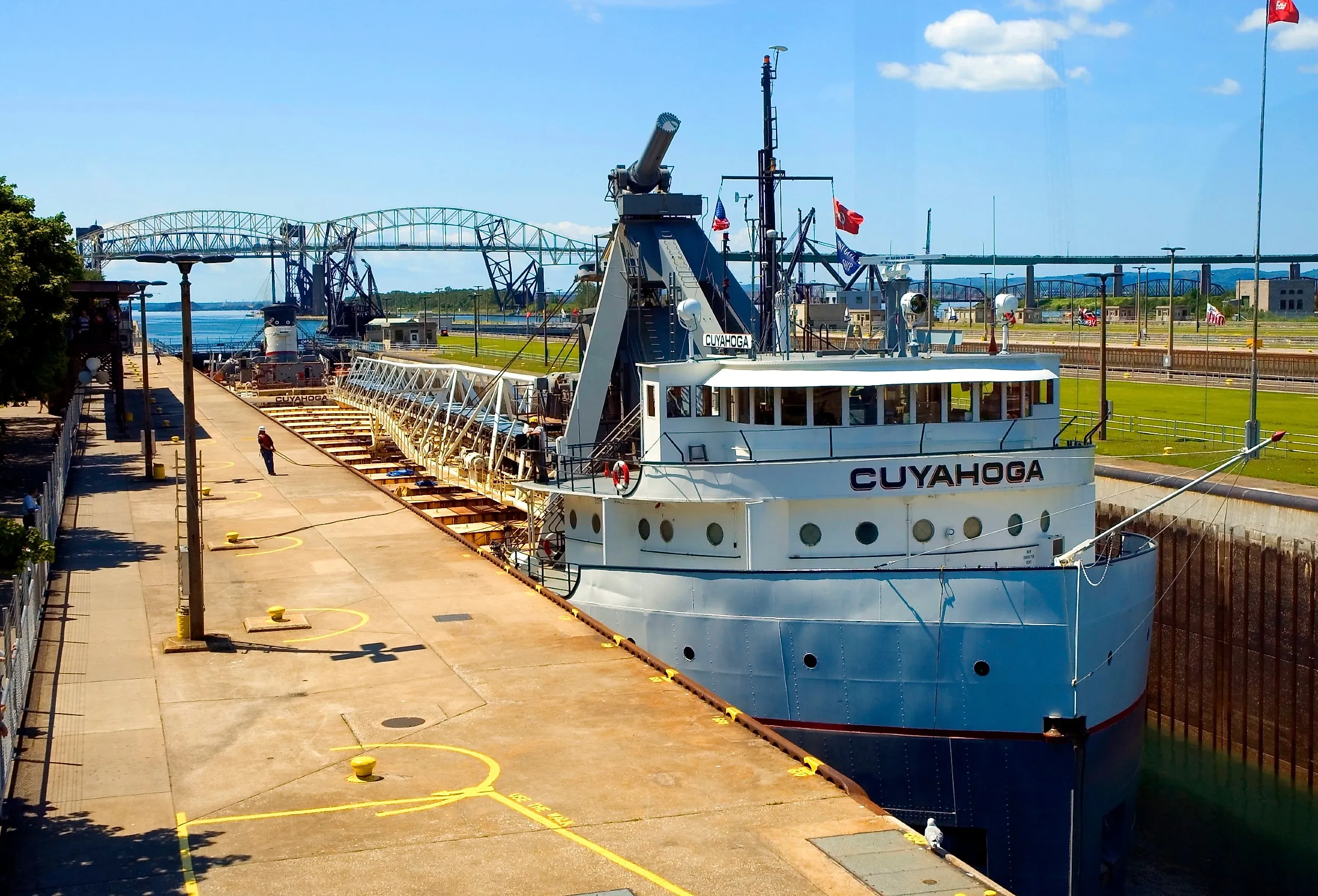
The largest American Great Lakes freighters run about 1,000 feet (305 m) long and 105 feet (32 m) wide. Those ships enter a chamber only 5 feet (1.5 m) wider than they are, and they do so under their own power without tugboats.
Two older chambers, the Davis Lock and the Sabin Lock, entered service about a century ago. The Davis has not been used since 2008, while the Sabin closed in 1989. Both were too shallow for modern bulk carriers. The Canadian lock across the river accommodates recreational vessels but is too small for the large commercial freighters using the American locks. That leaves the Corps of Engineers describing the Poe as the "Achilles' heel of the Great Lakes Navigation System."
What A Complete Shutdown Would Stop

If both operating US locks closed, smaller freighters that normally use the MacArthur would stop alongside the thousand-foot vessels restricted to the Poe. The Canadian recreational lock could not provide a meaningful commercial detour. Iron ore, coal, wheat, limestone, and other cargoes would begin accumulating at ports while vessels waited on both sides of the locks.
A full shutdown would therefore affect more traffic than the Poe-only scenario examined by Homeland Security. The iron ore and steel supply chain would remain the greatest national concern, but smaller-vessel cargo would also stop moving through the American locks.
The First Failure Is A Traffic Jam

A 1,000-foot freighter named the American Century accidentally dropped its anchor while entering the Poe Lock on April 29, 2026, at about 1 pm. A mechanical failure caused the incident, according to the Corps of Engineers. The ship retrieved the anchor and backed out of the chamber on its own. Crews closed the Poe while the Coast Guard investigated and inspectors checked for structural damage.
The lock reopened around 6 pm, five hours after the incident. Corps officials reported no significant infrastructure damage in the initial inspection and then deployed a remotely operated underwater vehicle to check for additional problems. The closure delayed 13 vessels.
That short disruption produced a queue because the Soo operates 24 hours a day, seven days a week, across a 42-week navigation season. Traffic does not disappear overnight, and the MacArthur cannot accept the vessels carrying most of the cargo tonnage.
Cargo Would Back Up On Both Sides

Iron ore would create the most serious industrial risk, but it would not be the only cargo affected by a complete shutdown. Coal, wheat, limestone, and other commodities would also stop passing between Lake Superior and the lower Great Lakes. The effects would vary because some shippers have alternative routes or storage capacity that the iron ore supply chain lacks.
Iron ore docks along Lake Superior largely run in one direction, which turns a lock outage into a storage problem. Railcars arrive loaded and dump pellets into storage. The storage then empties into freighters. Most docks were not equipped to reload pellets onto trains, although the 2015 Homeland Security report noted limited outbound rail-loading capacity at Duluth-Superior. Analysts concluded that pellets already delivered to Minnesota ports would largely become stranded if the Poe stopped working.
Terrain compounds the problem. The elevation near Duluth-Superior, Two Harbors, and Silver Bay changes by more than 500 feet (152 m) within a couple of miles of the water. Locomotives climbing away from the ports could pull only a small number of loaded cars at a time.
Ore would therefore accumulate in the wrong place on infrastructure designed to send it toward ships. Taconite is dense enough that mines load it into compact railcars called iron ore jennies. According to the 2015 Homeland Security report, each jenny carries about 85 short tons of pellets over an average trip of 70 miles (113 km).
Mills Would Run Dry Within Weeks

Steel mills downstream of those docks keep between two weeks and three months of iron ore on hand. Homeland Security estimated that a broader supply-chain breakdown could begin around 42 days after a Poe closure, though the report noted that industry executives had not reviewed that particular estimate. Depending on the time of year, approximately 75% of US integrated steel production was projected to cease within two to six weeks.
A real test arrived in April 2014. Ice from an extreme winter delayed effective navigation by about two weeks, even though the locks opened on schedule. Freighters that normally crossed Lake Superior in two and a half days spent nine days following icebreakers. Gary Works, the US Steel plant on the southern shore of Lake Michigan, curtailed production during the first week of April because it lacked iron ore.
Two weeks of ice caused that disruption in a system otherwise operating normally. The three largest integrated mills all sit around Gary, Indiana. Together, they accounted for about half of domestic integrated steel capacity when the Homeland Security analysis was written.
Trains And Trucks Cannot Take Over

A single thousand-foot freighter carries about 70,000 tons of taconite pellets. The 2015 analysis equated that load to seven trains with 100 railcars each or about 3,000 trucks. Great Lakes freighters can unload themselves at rates reaching 10,000 tons per hour. The report compared that with about 3,000 tons per hour at iron ore ports elsewhere in the world.
Land transportation cannot readily absorb the cargo because the problem extends beyond scheduling. Many Great Lakes steel mills were designed to receive ore by ship rather than rail. Mills built as late as the mid-1960s lacked the infrastructure needed to accept comparable iron ore deliveries by train.
The system was developed this way because water transportation became much cheaper than rail during industrial expansion around the Great Lakes. Vessel rates started near $3 per ton in 1856 and had fallen about 83% to $0.50 by 1897, while rail costs decreased much more slowly.
Although parallel chambers provided redundancy for smaller vessels, a second Poe-sized lock repeatedly failed to advance because earlier federal analyses found that its projected benefits did not justify its cost. A 2005 federal reevaluation rested partly on the assumption that existing rail infrastructure could absorb cargo displaced by a Poe closure.
Then Cars, Appliances, And Farm Equipment

Automakers order specific grades of steel from specific mills for specific parts, which is why a mill outage can travel downstream quickly. Executives told Homeland Security that approximately 1,500 steel recipes were in use when the report was prepared. Certifying one grade for one application could take a year because the approval covered the processing path as well as the chemistry.
A vehicle needs every required component. A shortage of one specialized part can therefore stop an assembly line even if most other parts remain available.
Electric-arc furnace mills now produce automotive sheet and advanced high-strength steel, but they could not immediately replace every specialized grade or the volume lost from affected integrated mills. The ability to substitute EAF steel would also vary among automakers and vehicle components.
Under the modeled Poe closure, nearly all North American automobile production was projected to halt. Appliance and railcar plants would follow, along with manufacturers of construction, farm, and mining equipment. Firms told the government that no contingency plan, stockpile, or offshore sourcing strategy could cover the projected loss.
Restarting Takes Longer Than The Closure

Blast furnaces punish long idleness, so reopening a lock does not immediately restart the supply chain. Operators can keep an unused furnace warm through a practice called hot idling, but the technique is generally not intended for extended periods. Prolonged hot idling can damage or destroy a furnace, with repair costs potentially exceeding $100 million.
The Homeland Security report concluded that coke batteries would be even more likely than blast furnaces to suffer damage if they were not properly hot-idled. These ovens convert coal into the coke used by integrated steel mills.
Timing makes recovery harder. In the report's March-to-September scenario, analysts estimated that mills would wait until mid-December to restart so they could accumulate enough ore to survive the next winter closure. Parts manufacturers would follow in mid-January. The first vehicles would not emerge from assembly plants until early April.
In that specific scenario, a six-month Poe closure was projected to disrupt automobile production for roughly 10 months.
What The Poe Lock Model Showed

The Department of Homeland Security modeled a six-month Poe Lock outage beginning March 25 and published the results in October 2015 under the title "The Perils of Efficiency." It did not model the simultaneous closure of both operating US locks. Sandia National Laboratories ran the economic simulation with the REMI forecasting model, using the report's industry assumptions.
The model projected about $1.1 trillion in lost gross domestic product, a decline of roughly 6%, and 10.9 million US jobs lost during the first year. These were model results based on the economy and industrial supply chains of 2015.
National unemployment in the model increased by 5.8 percentage points, reaching 11.3% against a 5.5% baseline. The US unemployment rate peaked at 10% in October 2009 during the last recession. Under the Poe scenario, Michigan reached 22.6%, and Indiana reached 22%. Michigan, Ohio, and Texas each lost more than 800,000 jobs.
Analysts described the event as a supply shock rather than a demand shock. Fiscal and monetary policies could support affected workers and businesses, but they could not immediately replace missing iron ore or specialized steel. There is no plan to close the Soo Locks, and they had no specific reason to expect such a closure. The document was written to expose a dependency, not forecast a failure.
A complete Soo Locks shutdown could affect additional vessels and cargoes beyond those included in the Poe model. Its economic effects cannot be calculated by simply applying the 2015 figures, as no comparable federal model has been published for that broader scenario.
A New Lock Will Reduce The Greatest Risk

Congress authorized a second Poe-sized lock in 1986, but it remained unbuilt for decades. The 2005 reevaluation calculated benefits below costs, resting partly on the rail assumption and partly on low estimated probabilities of component failure. A new economic validation in 2018 reversed the earlier conclusion. Congress reauthorized the project that year and again in 2022.
Construction is now underway. The New Lock at the Soo is rising in the footprint of the retired Sabin Lock. Its chamber will match the Poe at 1,200 feet long, 110 feet wide, and 32 feet deep. Contractors completed Sabin Lock demolition during the 2025 construction season before continuing bedrock excavation and work on the new lock walls. The Corps of Engineers still lists the project as on schedule for completion in the summer of 2030.
With a second Poe-sized chamber in service, American iron ore would no longer depend on one lock. The new chamber will provide an alternative during a Poe failure, but it cannot guarantee passage during a shutdown involving the entire facility, its approach channels, or shared infrastructure.
What A Soo Locks Shutdown Would Mean
If both operating US locks shut unexpectedly, vessel queues would form within hours, and commercial cargo would stop moving through the American complex. Lake Superior ports would begin filling while downstream steel mills consumed their remaining iron ore. Smaller freighters using the MacArthur would stop alongside the thousand-foot ships restricted to the Poe.
A closure lasting weeks could curtail integrated steel production. One lasting months could spread into automobile, appliance, railcar, and equipment manufacturing. Coal, wheat, limestone, and other cargoes would also face delays and storage problems.
The 2015 Homeland Security model demonstrates the scale of the Poe Lock vulnerability, but a complete Soo Locks shutdown would stop additional vessels and commodities that the study did not include. The duration and timing of the closure would ultimately determine whether the event remained a shipping delay or became a national industrial crisis.