The US Beaches With The Most Venomous Snakes
In September 2018, three eastern diamondback rattlesnakes turned up near Fort Pickens on Pensacola Beach, Florida in a single week. One was at a condominium, one was in the national seashore campground, and one was swimming in the surf of the Gulf of Mexico. That last detail is the one worth sitting with, because the largest venomous snake in the United States is a competent swimmer and the barrier islands off the Gulf and South Atlantic coasts are full of them. Add cottonmouths, which are the only semi-aquatic vipers on Earth and have colonized offshore islands. Add a genuine venomous sea snake that occasionally washes up on California sand. American shorelines are considerably snakier than the postcards suggest.
Here is where they actually are, which species, and why the bite statistics are far less alarming than the sentences above.
Pensacola Beach And The Florida Panhandle

The Gulf Islands National Seashore is the best-documented case in the country, largely because University of Florida extension staff have been tracking it.
Eastern diamondbacks are established on these barrier islands. They are not common encounters, which the researchers are careful to stress, but they are resident rather than accidental. Photographs exist of individual snakes swimming across Santa Rosa Sound toward the dunes of Pensacola Beach, and of another crossing the Intracoastal Waterway near Fort McRee.
The 2018 cluster of three in one week around Fort Pickens is the reason locals know about it. Two were on land where people were. One was in the water where people swim.
The Eastern Diamondback Is A Serious Animal

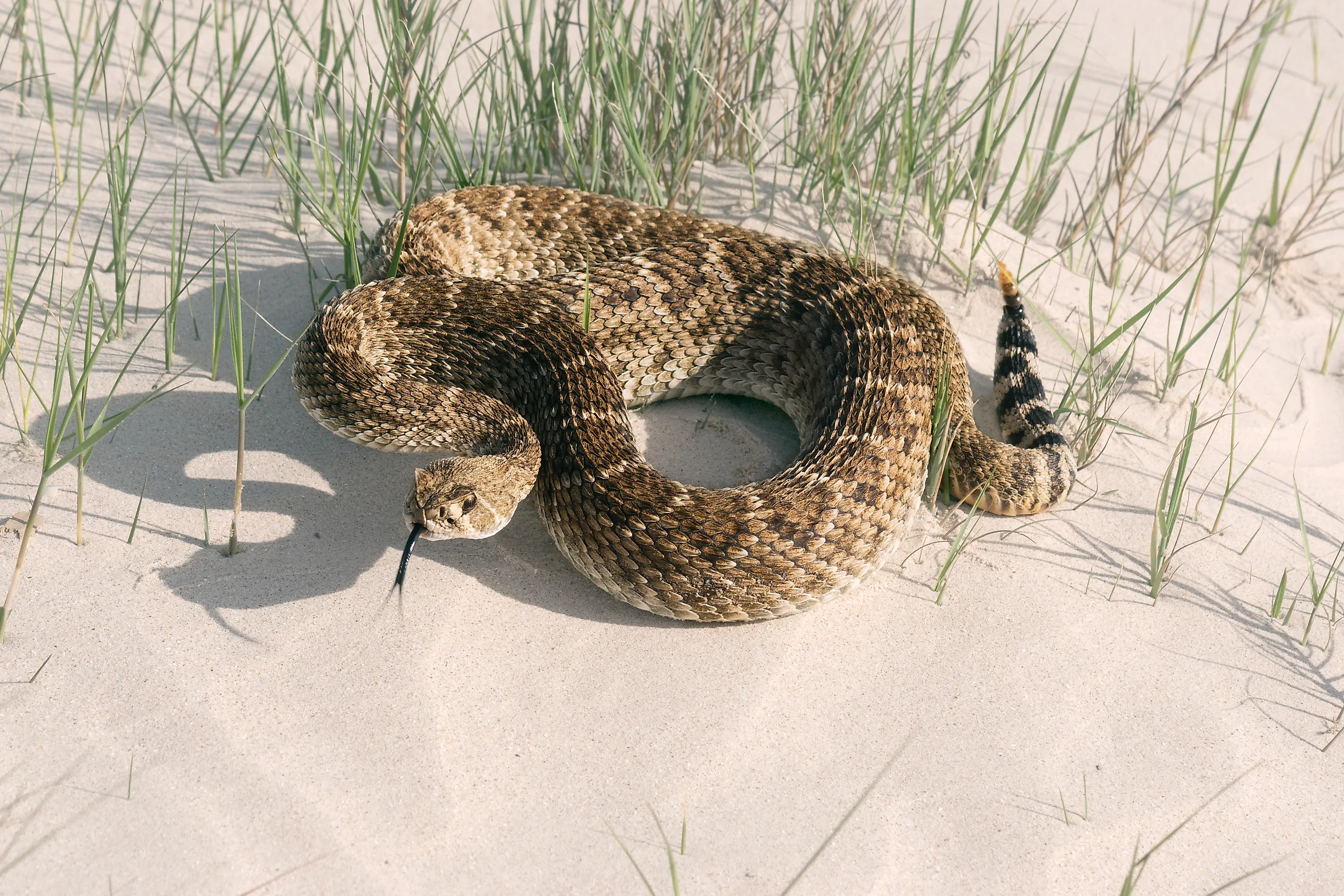
Worth being precise about what is on these islands, because it is the largest venomous snake in North America.
Eastern diamondbacks reach eight feet. The fangs approach a full inch. A single bite can deliver as much as 450 milligrams of venom, and under 150 milligrams can kill an adult. The strike range is roughly two thirds of body length, so a five-foot snake reaches over three feet. The rattle carries 20 to 30 feet.
The venom is a mix of hemotoxins and neurotoxins, and an untreated bite can be fatal inside 24 hours.
And then the number that reframes all of that: about one to two people die from this species a year in the entire United States.
Ninety-Five Percent Of Bites Are Self-Inflicted
This is the single most useful statistic on this page and it applies almost everywhere.
Of eastern diamondback bites on record, roughly 95 percent happened while the person was trying to catch or kill the snake. Most bites are on the hands. Most are on men.
The snake's own strategy is stillness. It lies motionless for long periods waiting for prey and would rather rattle than strike, which is what the rattle is for. Extension biologists describing the barrier island population put it plainly: the snakes are there, and they tend to avoid people.
Nearly all of the risk on this list is voluntary.
Georgia And South Carolina Barrier Islands
The same species occupies the sea islands further up the coast, and the habitat suits it well.
Eastern diamondbacks are animals of the lower coastal plain, and the maritime forest, dune scrub and palmetto thickets behind a barrier island beach are close to ideal. In the ACE Basin in South Carolina, they have been recorded swimming in saltwater between barrier islands, which is a thing most people assume rattlesnakes cannot do.
They can. They just have no particular reason to advertise it.
Cottonmouths Have Colonized Offshore Islands

The cottonmouth is the only semi-aquatic viper on the planet, and it treats the coast as habitat rather than a boundary.
They have been observed in saltwater and have established populations on near-offshore islands along the East Coast. On the Gulf side they are routine in coastal marsh, brackish creeks and the back sides of barrier islands, which is to say the water people paddle through to reach the beach rather than the beach itself.
Cottonmouths are also the species most likely to be reported when nothing venomous was present at all, which is the next section.
Most Reported Cottonmouths Are Harmless

The single biggest source of error in coastal snake sightings is the watersnake.
Nerodia species, including the banded, brown and plain-bellied watersnakes, are heavy-bodied, swim well, bask on the same logs, occupy the same marsh, and are entirely harmless. They are killed constantly on the assumption that they are cottonmouths.
The reliable tells are behavioral and structural. A swimming cottonmouth rides high with much of its body visible on the surface. A watersnake swims low with mostly just the head out. The cottonmouth has a blocky, angular head with a dark eye stripe and vertical pupils. And the white mouth lining that gives the species its name is a threat display, which means the snake is warning you rather than approaching you.
Cottonmouths do not chase people. That myth appears to come from snakes fleeing toward water and people happening to be standing between them and it.
Texas And The Western Gulf
The species mix shifts as the coast turns west.
Western diamondbacks replace easterns through Texas, and they are the species responsible for the second-most snakebite fatalities in the country, delivering more venom per bite than the eastern even though it is somewhat less potent. Cottonmouths persist along the upper Texas coast and the Louisiana marshes.
The pattern along the whole Gulf is the same: the snakes are behind the beach rather than on it, in the dunes, scrub and marsh, which is exactly where people walk to and from the sand.
California Has An Actual Sea Snake

This is the entry nobody expects, and it is real.
The yellow-bellied sea snake is a fully marine, highly venomous species that normally lives in the tropical Pacific and Indian Oceans. It is the most widely traveled sea snake on Earth, the only one to reach Hawaii, and it very occasionally reaches Southern California.
In 2015 one turned up at Silver Strand beach in Oxnard and another at Bolsa Chica State Beach. On January 12, 2016, a 20-inch specimen washed ashore at Coronado Dog Beach near San Diego. Lifeguards put it in a bucket. Like the others, it died shortly afterward.
The Natural History Museum of Los Angeles has said that in total only about six of these snakes have ever been documented north of the tip of Baja California.
It Only Shows Up During El Nino

The first California record was in 1972, and every appearance since has coincided with El Nino.
Warmer sea surface temperatures let warm-water species push further north than usual, and the sea snakes arrive alongside other displaced tropical animals. The same 2015 season brought sea hares onto East Bay beaches and thousands of tuna crabs onto Orange and San Diego county sand.
A stranded sea snake is almost always a sick or exhausted one. Healthy individuals stay offshore, can swim backwards and forwards, and can remain submerged for up to three hours.
The Sea Snake Is Less Dangerous Than It Sounds
Its venom is genuinely potent. Estimates put a potentially lethal human dose around 0.067 milligrams, with an average bite delivering roughly 4.0 milligrams.
There has never been a recorded fatality from one in the United States. The curator of herpetology at the Natural History Museum of Los Angeles has explained why: the venom, the fangs and the mouth are all built for small fish, and the animal is poorly equipped and poorly motivated to bite a person.
The museum's actual advice if you find one is to photograph it, email the photo to them, and not touch it. That is a reasonable summary of how to handle every snake on this page.
Where The Risk Actually Sits

Three patterns hold across every beach on this list.
The snakes are behind the beach, not on it. Open sand offers no cover, no prey and no shade. The animals live in the dunes, the maritime forest, the scrub and the marsh, which means the risk is on the boardwalk, the trail and the campground rather than the towel.
Dawn and dusk are when they move, because that is when the temperature suits them and when their prey is active.
And the encounters that go badly are overwhelmingly the ones people initiate. A snake that has been seen and left alone is a snake that has been survived.
The Honest Ranking

For sheer number of venomous species, the Gulf Coast barrier islands of Florida, Alabama and Mississippi win, with eastern diamondbacks resident and cottonmouths in every marsh behind the dune line.
For the best-documented population, it is Gulf Islands National Seashore around Pensacola, where the swimming rattlesnakes have actually been photographed.
For the strangest single entry, it is Southern California, which has no venomous land snakes on its beaches worth mentioning and occasionally receives a genuine sea serpent from the tropical Pacific instead.
And for the risk you should actually plan around: watch where you put your hands and feet in the dunes at dusk, and leave whatever you see alone. That covers roughly 95 percent of it, which is not a figure of speech.