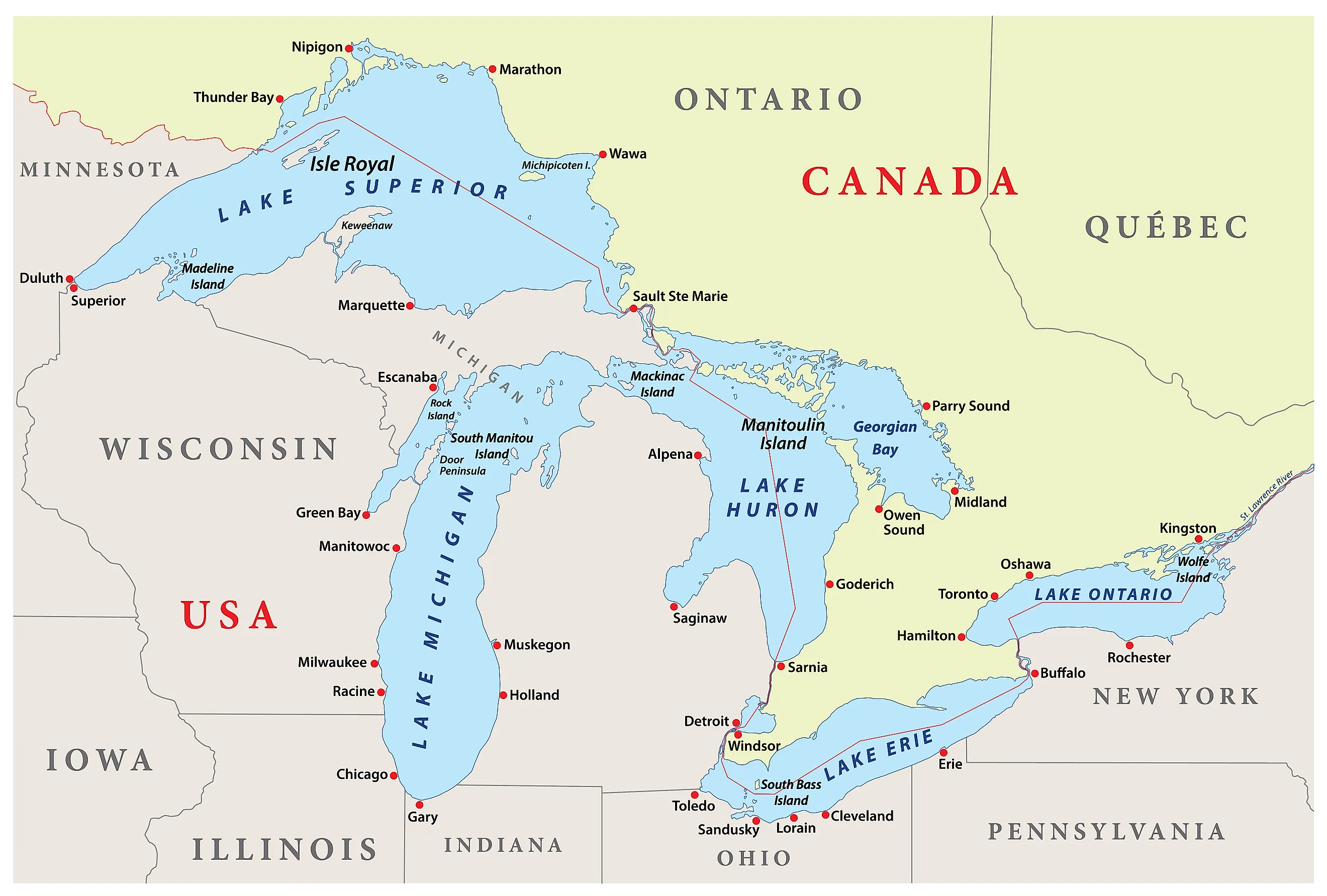
How Many Times The Great Lakes Could Fill The Grand Canyon
The Great Lakes cover more than 94,000 square miles (244,000 km²) and form a connected freshwater system shared by the US and Canada. The Grand Canyon stretches 278 miles (447 kilometers) along the Colorado River and reaches an average depth of about one mile (1.6 kilometers). The five Great Lakes contain about 5,439 cubic miles (22,671 km³) of water. By comparison, the Grand Canyon has an estimated volume of about 1,000 cubic miles (4,170 km³). Put the two measurements together, and the Great Lakes could fill the Grand Canyon nearly 5 and a half times. That figure is based on volume rather than surface area or depth, and the comparison shows just how much water is packed into the lakes' enormous basins.
How Much Water Do the Great Lakes Hold

The five Great Lakes contain an enormous amount of freshwater, but they are not equally large. Lake Superior alone accounts for about 2,900 cubic miles (12,100 km³), more water than Lakes Michigan, Ontario, Huron, and Erie combined. The remaining four hold about 2,539 cubic miles (10,584 km³). Lake Michigan contains about 1,180 cubic miles (4,920 km³), followed by Lake Huron at 850 cubic miles (3,540 km³). Lake Ontario holds about 393 cubic miles (1,640 km³), while Lake Erie, the shallowest of the five, contains about 116 cubic miles (484 km³).
Together, the lakes cover an area larger than many US states, but their volume comes from both their depth and their enormous surface area. Lake Superior averages 483 feet (147 m) deep and reaches a maximum depth of 1,332 feet (406 m). Lake Michigan reaches 925 feet (282 m), while Lake Huron reaches 750 feet (229 m). That depth is one reason a comparison based only on the lakes' surface area would dramatically underestimate how much water they contain. A lake can look relatively flat and shallow from shore while holding hundreds of cubic miles of water below the surface.
Lake Superior Alone Fills Nearly Three Grand Canyons

Lake Superior is the largest of the Great Lakes by volume, holding about 2,900 cubic miles (12,100 km³) of water. That is enough to fill the Grand Canyon roughly 2.9 times, based on the National Park Service's estimated canyon volume. The lake is also enormous in other dimensions. Its water surface covers about 31,700 square miles (82,100 km²), and its shoreline, including islands, stretches for about 2,726 miles (4,385 km). It is 350 miles (563 km) long and reaches a maximum width of about 160 miles (257 km).
Its water does not move through the system quickly, either. Lake Superior has a water retention time of about 191 years, meaning it takes that long on average for water entering the lake to be replaced by water leaving it. So even before adding the other four Great Lakes, the comparison is already measured in multiple Grand Canyons.
Lake Michigan Adds More Than One

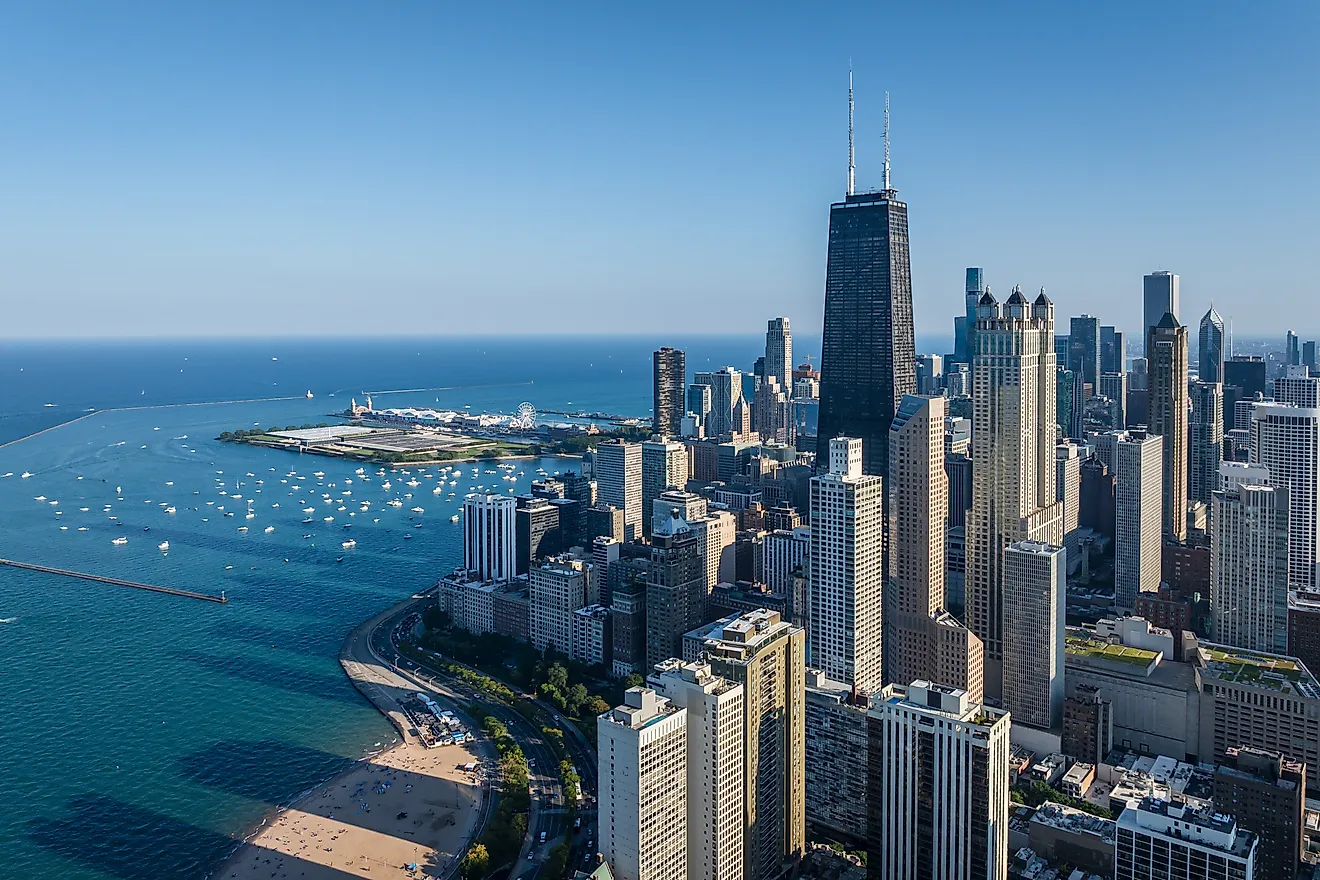
Lake Michigan contains about 1,180 cubic miles (4,920 km³) of water, making it the second-largest Great Lake by volume. That is enough to fill the Grand Canyon a little more than once. Unlike the other Great Lakes, Lake Michigan lies entirely within the US. Its shoreline touches four states, and its water surface covers about 22,300 square miles (57,800 km²). The lake reaches a maximum depth of 925 feet (282 m). Adding Lake Michigan to Lake Superior would bring the total volume to about 4,080 cubic miles (17,020 km³). In other words, those two lakes alone could fill the Grand Canyon about four times. The remaining three lakes push the total well beyond that.
Huron and Erie Close the Gap

Lake Huron contains about 850 cubic miles (3,540 km³) of water, enough to fill the Grand Canyon less than once, but still representing a substantial portion of the total Great Lakes volume. Its maximum depth is about 750 feet (229 m), and its water surface covers approximately 23,000 square miles (59,600 km²). Lake Erie is much shallower. Its average depth is only about 62 feet (19 m), and its maximum depth is 210 feet (64 m). Yet its enormous surface area still gives it a volume of about 116 cubic miles (484 km³).
Together, Lakes Huron and Erie contain roughly 966 cubic miles (4,024 km³) of water. That is almost another Grand Canyon by volume. Their contrast also shows why surface area alone is not enough for this comparison. Lake Erie has a larger surface area than Lake Ontario, but Lake Ontario contains more than three times as much water because it is considerably deeper.
Lake Ontario Brings the Total to 5.4

Lake Ontario is the smallest Great Lake by surface area and the second-smallest by volume, containing about 393 cubic miles (1,640 km³) of water. Yet its average depth of 283 feet (86 m) makes it substantially deeper than Lake Erie, and its maximum depth reaches 802 feet (244 m). Once Lake Ontario is added, the five lakes contain about 5,439 cubic miles (22,671 km³) of water. NOAA's physical characteristics for the Great Lakes use volumes measured at Low Water Datum, providing a consistent basis for comparing the five lakes.
The Grand Canyon's estimated volume is about 5.45 trillion cubic yards (4.17 trillion m³), according to the National Park Service. Converting the measurements to the same units puts the canyon at roughly 1,000 cubic miles (4,170 km³). Dividing the Great Lakes' total volume by the estimated volume of the Grand Canyon results in approximately 5.4. So, if the canyon could somehow hold water throughout its entire estimated volume, the Great Lakes would fill it five times and still have enough water left over for roughly another two-fifths of a canyon.
What the Comparison Really Means

The 5.4 figure is an approximation because both measurements represent enormous natural features whose dimensions are not perfectly fixed. Great Lakes water levels rise and fall, changing their volumes, while the Grand Canyon's estimated volume depends on how the canyon and its tributaries are measured. The Great Lakes volume figures used here are measured at Low Water Datum. Still, the comparison provides a useful way to understand the scale of the Great Lakes. Looking at a lake from its shoreline can make it difficult to grasp how much water lies beneath the surface. Looking across the Grand Canyon can create the opposite impression: the canyon appears enormous because of its depth and width, but its total volume is still substantially smaller than the combined volume of the five lakes.
The Great Lakes also contain an impressive amount of water. They form a connected freshwater system whose waters eventually drain through the St. Lawrence River toward the Atlantic Ocean. Their enormous water volumes influence regional ecosystems, weather, transportation, and communities throughout the basin. More than 30 million people rely on the Great Lakes for drinking water, making their volume significant far beyond the scale of the comparison itself.
The Grand Canyon and the Great Lakes demonstrate two very different kinds of geographic scale. One is a vast incision in the Earth's surface, stretching hundreds of miles through layers of rock. The other is a chain of enormous basins holding thousands of cubic miles of freshwater. Imagine emptying all five Great Lakes into the Grand Canyon. The canyon would fill five times, with enough water remaining to fill nearly half of it again. That is what 5.4 Grand Canyons of freshwater looks like.