What Happens When Two Oceans Meet
Maps divide Earth into five named oceans, yet all five are part of one connected ocean covering 71 percent of the planet. Even so, its water can sometimes look split by a ruler-straight line. Dark blue water may run beside a cloudy green plume when sediment, phytoplankton, or dissolved material changes how each side reflects light. The line is not an invisible wall. Water constantly crosses and mixes through it, although currents, seafloor topography, or freshwater runoff can keep the contrast visible. Learn what happens when two oceans meet, and why the boundary can look far sharper than it really is.
The Illusion of a Wall

One of the most striking sights where two oceans meet is a sharp, visible boundary between two bodies of water. Photographs and videos taken around the world often show one side of the ocean appearing dark blue while the other looks cloudy or green. From above, the contrast can be so dramatic that it looks as though the two bodies of water are walled off from each other.
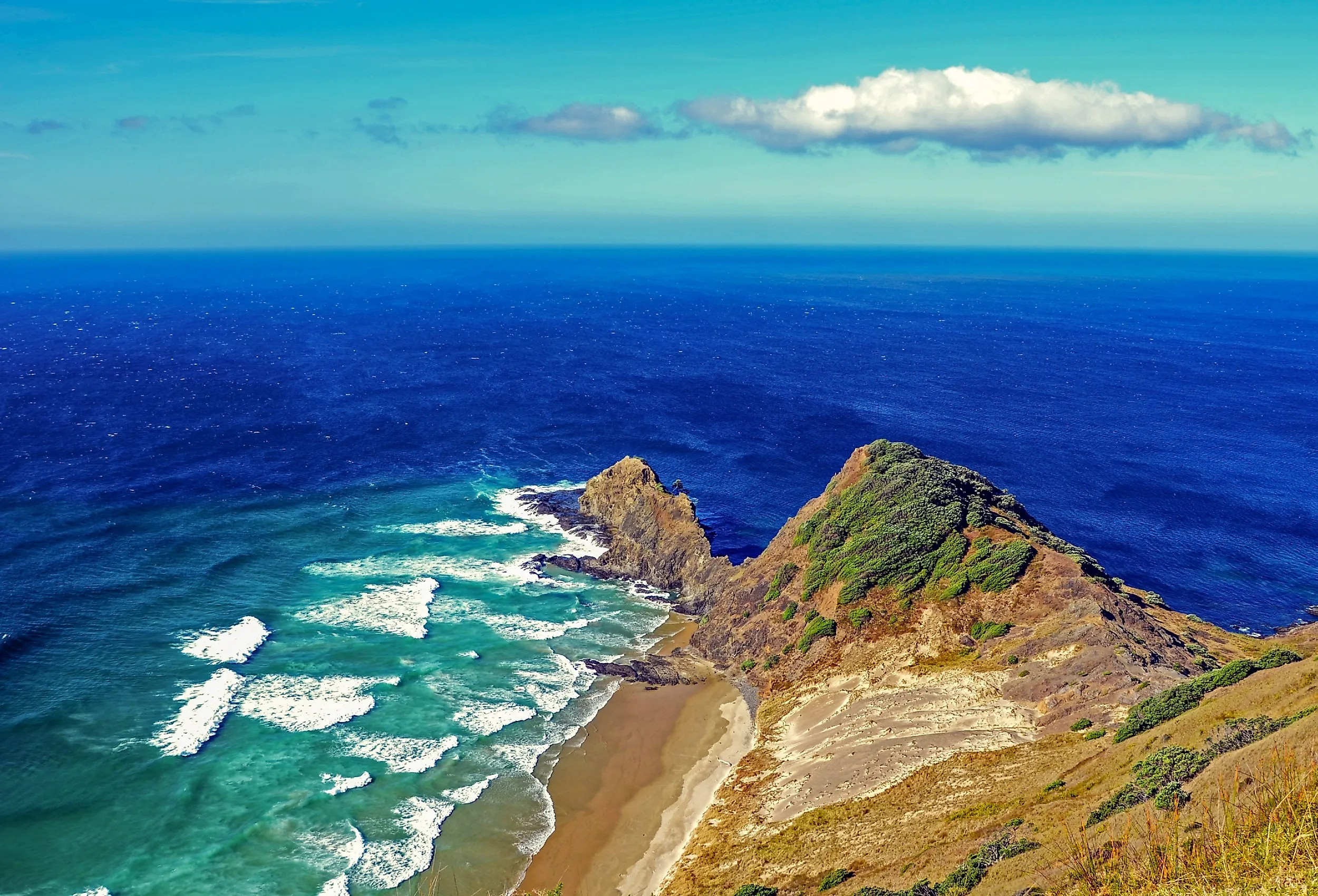
No physical barrier prevents the water from mixing. The line is simply a boundary between two water masses with different characteristics, and as those masses interact, the contrast usually becomes less distinct. At certain coastal locations, the meeting of different currents can also create intense waves and turbulent conditions. Off Cape Reinga, at the northern tip of New Zealand's North Island, tides moving between the Tasman Sea and the Pacific Ocean meet in a rough, churning race.
Gradual Mixing

Although the two water masses may initially appear separate, they are constantly interacting. Waves, tides, winds, and currents work on the boundary, gradually moving water from one side to the other. This process can take time, especially when the water masses have different densities or move in different directions.
Cream poured into a cup of coffee behaves much the same way. At first, it creates clearly visible swirls and patterns instead of blending in immediately. As the liquid moves and is disturbed, the cream gradually spreads throughout the cup. The comparison has a limit, though. An ocean front also moves, and currents, winds, tides, and freshwater inputs can keep reinforcing it.
Why Do Some Oceans Look Separate?

Differences in temperature and salinity change seawater density, which creates layers and fronts between water masses rather than keeping entire oceans separate. Seawater becomes denser when it is colder or carries more salt. Warmer or fresher seawater is generally less dense.
When two water masses of different densities meet, they do not mix evenly right away. Instead, the heavier water moves downward beneath the lighter water, which remains closer to the surface. Density differences can create vertical layers, while sharp horizontal changes in temperature or salinity form ocean fronts that are often detectable only with instruments or satellite data.
Scientists use the term thermocline for a zone where temperature changes rapidly with depth, and halocline for a zone where salt content changes rapidly. Thermoclines and haloclines help maintain vertical stratification, whereas a horizontal boundary at the surface is more accurately described as an ocean front or plume.
Sediment and Currents
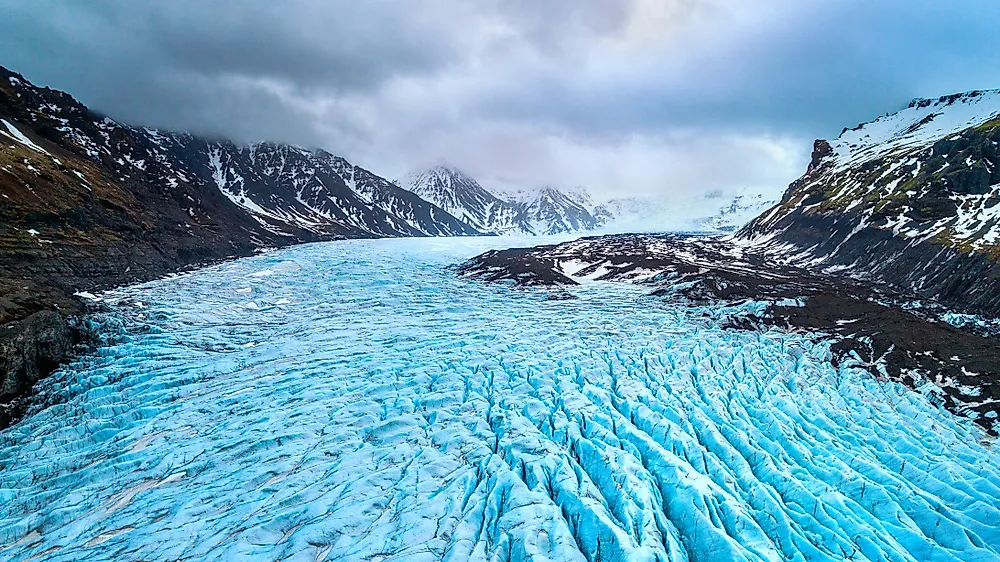
Not every boundary between two bodies of water is caused by temperature or salt levels. Color variation can also come from sediment, meaning tiny pieces of rock and minerals. Glaciers grind rock into a fine powder that meltwater carries into the ocean. In the Gulf of Alaska, rivers fed by melting glaciers deliver large amounts of this sediment, leaving the freshwater a cloudy gray or blue. Where that water meets the darker, clearer ocean water, the two can look completely different.
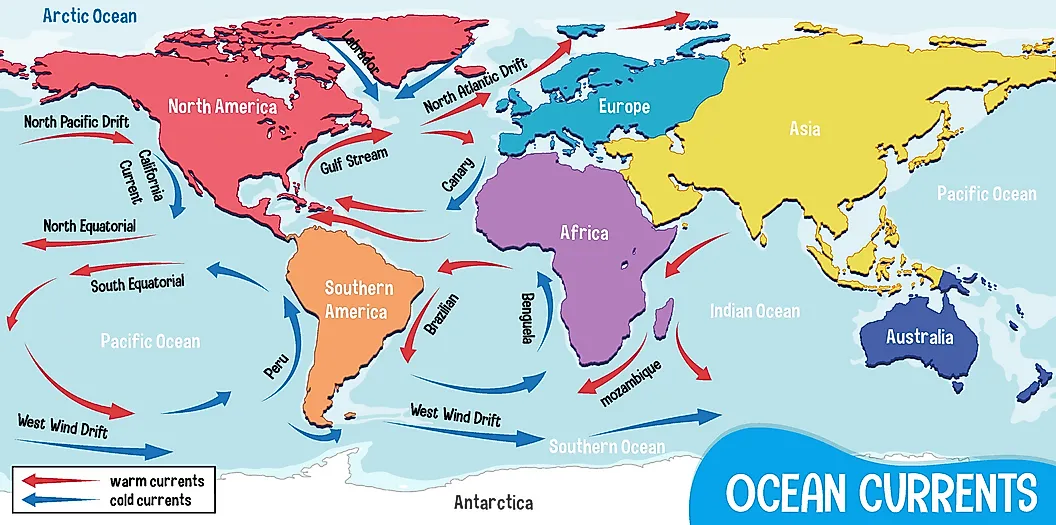
Ocean currents move huge amounts of water around the world, carrying heat, salt, and nutrients with them. When two currents meet, they may have contrasting temperatures, salt levels, and speeds, so they can travel side by side before gradually mixing. Ocean fronts can concentrate nutrients and phytoplankton, sometimes creating productive feeding areas for fish and other marine animals. The same boundary that looks dramatic from the air can matter a great deal to a marine ecosystem.
The Coriolis Effect

Earth's rotation also plays an important role in ocean water movement through the Coriolis effect, which causes moving objects and water to curve. As water travels across the planet, it curves rather than traveling in a straight line. Every latitude completes a rotation in the same amount of time, but Earth's surface has a greater eastward linear speed near the equator, contributing to the apparent rightward deflection of large-scale flow in the Northern Hemisphere and leftward deflection in the Southern Hemisphere. Earth's rotation is one influence among several. Winds, coastlines, and differences in water density also steer water along particular paths.
More than Meets the Eye
When contrasting water masses meet, their boundary may look like a line even though water crosses it, and the front may persist or recur. So many factors cause the water to move in different layers or directions. What may look like two oceans standing apart is actually a constantly changing process of nature bringing them together.
The next time you see a photograph showing two dramatically different colors of water meeting, it may appear to you like nature has drawn a line across the ocean. In reality, that line represents something much more fascinating. The boundary is dynamic, with water crossing it through stirring and turbulence, even as circulation or continuing runoff may preserve the contrast.