The Lakes With The Most Waterbird Species In North America
Some North American lakes become temporary bird cities during migration, drawing everything from tiny sandpipers to pelicans, grebes, geese, and vast flocks of ducks. Great Salt Lake alone can support as many as 10 million migratory birds in a year, while more than 400 bird species have been recorded around California’s Salton Sea. Other major lake systems, including Malheur Lake and the Great Lakes, provide breeding grounds, winter habitat, or critical refueling stops along continental flyways. Comparing them is not perfectly straightforward because bird surveys cover different areas and use different definitions of "waterbird." Still, records of waterfowl, shorebirds, colonial nesters, and other aquatic species reveal several lakes that stand out for extraordinary waterbird diversity.
Great Salt Lake, Utah

Utah reports that as many as 10 million migratory birds, representing 338 species, use the Great Salt Lake and its associated habitats each year. A Utah survey synopsis identifies 42 shorebird species, 38 waterfowl species, and 58 other waterbird species that rely on the Great Salt Lake, although these are survey-defined categories rather than a universal waterbird classification. Great Salt Lake in particular is an important stopover for shorebirds, as it is a critical stop for global or continental populations relying on the lake's abundant brine shrimp and brine flies. With other area lakes facing extreme ecological strain, the Great Salt Lake hosts substantial global populations. The three most notable shorebirds found around the Great Salt Lake are Wilson's phalaropes, representing over one-third of the entire global population; American avocets, where up to 250,000 individuals come to the shorelines annually, which is over half of the entire global population; and black-necked stilts, around 37% of the total North American population.
Those other waterbirds rely heavily on the lake's open brine waters, islands, and the fresh-to-brackish river bays. Grebes are the most ecologically dominant waterbirds on the lake, with as many as 5 million eared grebes staging there in autumn, at times more than half the North American population. Gulls and terns are also well-represented. Great Salt Lake supports the largest breeding population of California gulls anywhere, roughly 160,000 birds, including the largest single colony on record. Those gulls nest on the lake's islands, though falling water levels have opened land bridges that let coyotes reach sites once cut off, Gunnison Island among them. Millions of individual waterfowl use the Great Salt Lake ecosystem, including dabbling ducks, diving ducks, swans, and geese. There are also large populations of piscivorous, or fish-eating birds, such as pelicans, cormorants, and wading birds.
Salton Sea, California

The Salton Sea, a saline lake, has a large variety of waterbirds. More than 400 bird species have been recorded at the Salton Sea and the surrounding area, and until 2021, the national wildlife refuge at its south end held the most diverse bird list of any national wildlife refuge in the West. That importance is underscored by the enormous historical loss of California wetlands over the past decades. Significant to the Salton Sea and the surrounding area is that several ecological and geographic groups converge around the water. Historically, the Salton Sea supported exceptionally large populations of American white pelicans and double-crested cormorants, but fish-eating birds have declined sharply as rising salinity has degraded their food supply.
The Salton Sea is also important for its populations of snowy plovers, black terns, and black skimmers. It is a critical stop on the Pacific Flyway, the migration corridor running between Alaska and Patagonia. Waterfowl arrive in the widest variety, among them northern shovelers, ruddy ducks, snow geese, and Ross's geese. More than 124,000 shorebirds of at least 25 species stage here, including western sandpipers, American avocets, black-necked stilts, and long-billed dowitchers. Gulls, terns, and skimmers add another cluster of species. That group includes the black skimmer, the gull-billed tern, and wintering populations of ring-billed gulls and California gulls.
Malheur Lake, Oregon

More than 340 bird species have been recorded across Malheur National Wildlife Refuge, well over half of Oregon's total list. As part of the flyway, Malheur Lake is an important inland breeding and migratory stopover location, one of the most important in western North America. A large and shallow marsh lake, it is the central geographic feature of the Malheur National Wildlife Refuge in southeastern Oregon. The lake fluctuates in size based on snowmelt from Steens Mountain. Big snowpacks in the mid-1980s pushed it past 160 square miles (410 square kilometers) inside three years, well over double the roughly 67 square miles (170 square kilometers) it had covered before. The flooding damaged a rail branch. Drought in the early 1990s then reduced the lake to a few hundred acres. Its location and hydrological composition make it one of the most critical biological crossroads along the Pacific Flyway.
Thousands of migratory shorebirds and waders make use of the lake's exposed mudflats. Common species relying on the seasonal levels of the lakes include American avocets, sandhill cranes, herons, and various sandpipers. In good water years, colonial waterbirds build nesting colonies by the thousands along key areas like the Cole Island Dike. Refuge assessments have credited Malheur with as much as 20% of the world's white-faced ibis population. Waterfowl, ducks, geese, and swans use the lake for breeding grounds. Fourteen duck species nest here, and the refuge is one of the country's most productive waterfowl breeding areas, particularly for redheads. The lake is also home to trumpeter swans and Canada geese. The waterbird populations are heavily reliant on the lake's natural wet-and-dry cycles. Studies by the USFWS track water management efforts and invasive carp-control initiatives, and how this impacts migrating shorebirds and aquatic prey availability.
Lake Erie, Ontario, Michigan, Ohio, Pennsylvania, and New York

The warmest and shallowest of the Great Lakes, Lake Erie is an important stopover for migrating waterfowl and colonial waterbirds. That includes gulls, herons, and terns. The health of these populations is important for monitoring the lake's ecosystem, as Lake Erie continues to face invasive species, harmful algal blooms, and seasonal hypoxia. Excess nutrients fuel algal growth, while decomposition and summer stratification contribute to oxygen depletion in the central basin.
Lake Erie is an important staging area during spring and fall migrations. It hosts millions of individual waterbirds. This includes waterfowl, with over 30 species of ducks, geese, and swans, such as canvasbacks, redheads, mallards, and mergansers, found on the coastal wetlands. The binational decadal census of nesting colonial waterbirds tracks about a dozen species across the Great Lakes, and Erie's islands carry most of them, including the double-crested cormorant, great blue heron, great egret, and herring gull. The lake hosts shorebirds and marsh birds, such as specialized waders, rails, grebes, and coots, which utilize shallow bays during staging periods.
Lake Ontario, Ontario, and New York

Lake Ontario, the smallest Great Lake by surface area, has deep open water and sheltered coastal wetlands. This is ideal for waterfowl such as species of diving duck, dabbling duck, and sea duck. In total, there are around 300 bird species around Lake Ontario. Those include dozens of waterfowl species along with loons, grebes, herons, and gulls. The lake is heavily urbanized and industrialized, particularly on the Canadian side, which continues to impact on bird populations. Lake Ontario is also particularly vulnerable to invasive species, which can impact native aquatic species and, in turn, the well-being of the waterbird populations.
More than 30 waterfowl species use Lake Ontario, including dabbling ducks such as mallards and sea ducks such as long-tailed ducks. This number also includes geese and swans that frequent the open waters and bays. Colonial waterbirds nest in massive colonies on lake islands and protected peninsulas like Tommy Thompson Park in Toronto, where ring-billed gulls, terns, and double-crested cormorants crowd the spit. The shallow marshes and wetlands host herons, egrets, bitterns, and rails.
Lake Chapala, Jalisco and Michoacán

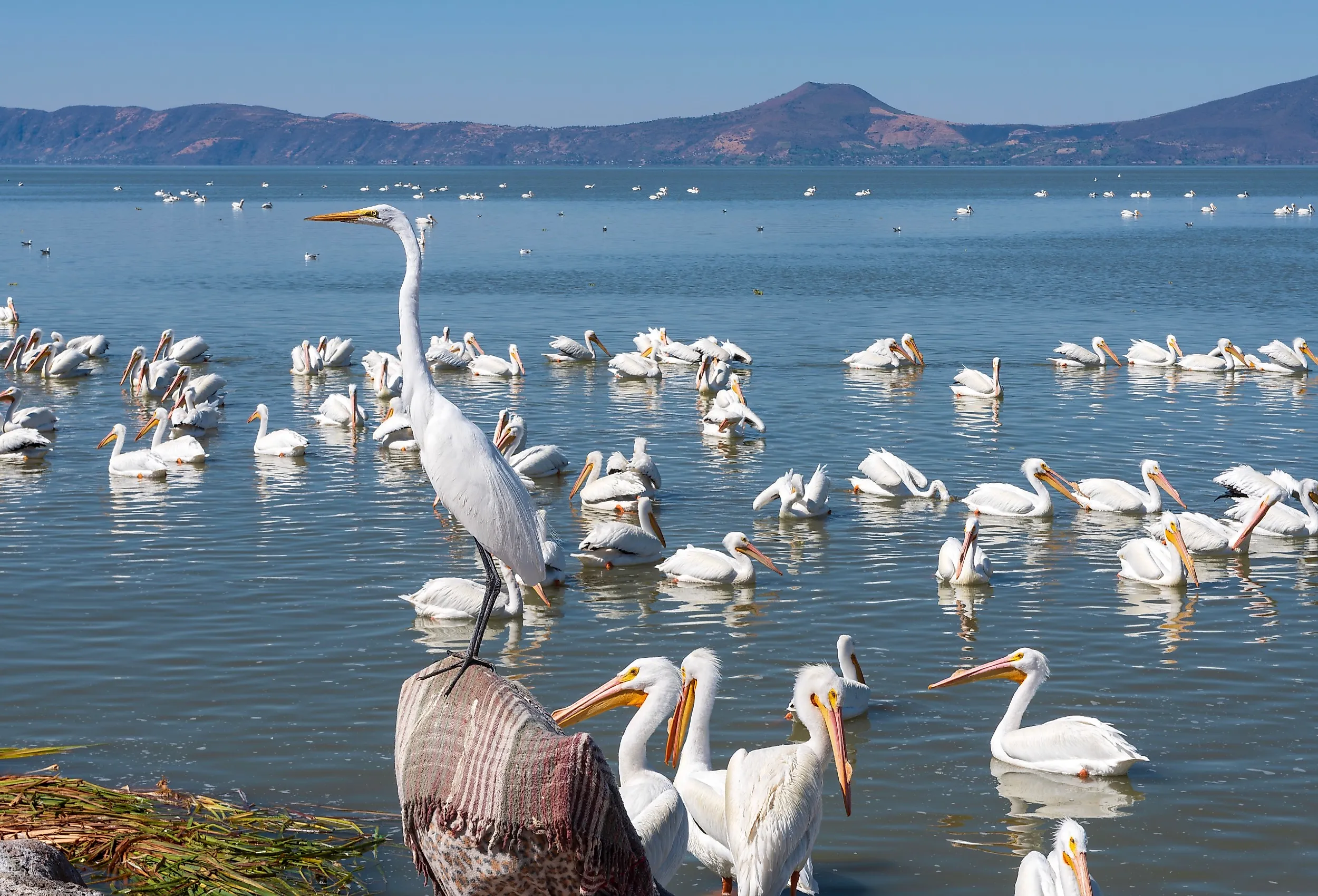
Mexico’s largest lake, Lake Chapala, stretches across the states of Jalisco and Michoacán and provides an important wintering area for migratory waterbirds. More than 365 bird species have been recorded in the wider lakeshore region, although that total includes songbirds, raptors, and other birds that use surrounding terrestrial habitats. Mexican government sources have documented more than 80 species belonging to major waterbird families in the Lake Chapala basin. These include ducks, geese, herons, plovers, cranes, jacanas, gulls, terns, pelicans, cormorants, grebes, rails, avocets, stilts, sandpipers, and ibises.
Lake Chapala is an internationally recognized Ramsar wetland and receives waterbirds migrating from farther north in Canada and the United States. Common winter visitors include northern pintails, American wigeons, northern shovelers, green-winged teal, blue-winged teal, lesser scaup, and American coots. Its shallow waters, marshes, and shoreline vegetation provide feeding and resting habitat throughout the migration season. However, waterbirds and their habitats remain threatened by declining water levels, pollution, invasive water hyacinth, and the loss or degradation of shoreline wetlands.
Waterbird Populations in North America
Because surveys differ in geographic scope, sampling effort, and the bird groups they include, there is no standardized average for the number of waterbird species found at a North American lake. The totals presented here are therefore best understood as evidence of each lake’s ecological importance rather than a precise continental ranking. High species richness alone also does not establish that bird populations are healthy; population health must be assessed through abundance, breeding success, habitat condition, and long-term trends.
Both the Salton Sea and the Great Salt Lake face extreme depletion of water volume. At its 2022 record low, Great Salt Lake had lost an estimated 73% of its water volume and 60% of its surface area relative to historical averages. Subsequent wet years produced a partial recovery, but the lake remains below healthy levels. As these lakes shrink, rising salinity can disrupt or collapse the food chains on which waterbirds depend, directly threatening migratory species along the Pacific and Central flyways.
The Great Lakes face different pressures. Lake Erie has the region’s most acute harmful-algal-bloom problem, while Lake Ontario’s harmful blooms are generally localized, and its nuisance-algae and nearshore problems vary by area. Both lakes also contend with invasive species and other water-quality stresses that affect waterbird habitat and food supplies. All of these sites remain vital to birds, but population status varies substantially by species and location, and several groups, including shorebirds and Salton Sea fish-eating birds, have experienced serious declines. That variation reinforces why no single species average can accurately describe North America’s lakes or the health of the waterbirds that rely on them.