The Lakes Where Bowfin Grow Largest
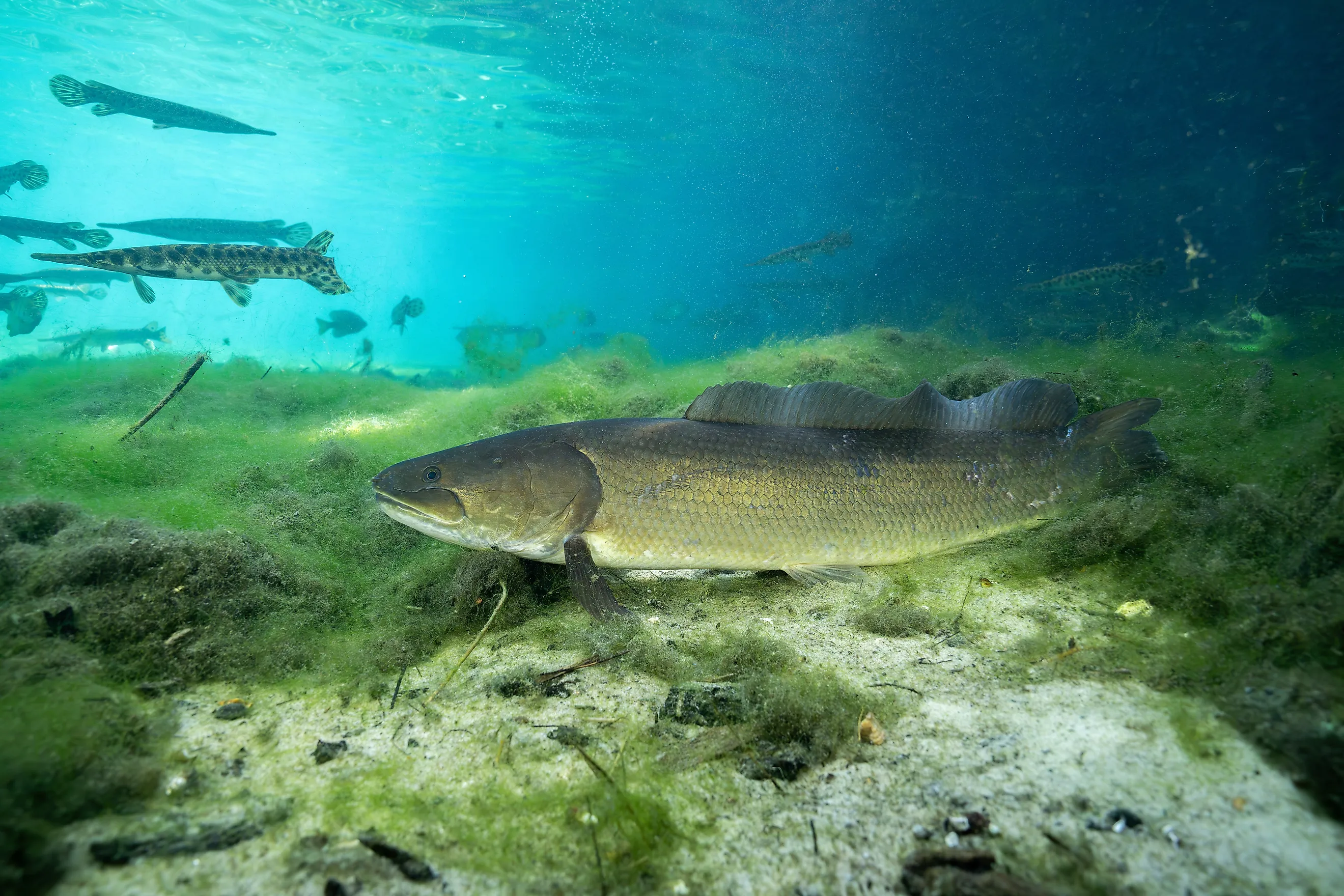
Almost nobody fishes for bowfin on purpose, which is the first thing worth fixing. It is the sole surviving member of a family whose fossil record stretches past 150 million years. It breathes air. It has been recorded surviving three weeks buried in the mud of a drained pond, and it fights harder than almost anything else in a weedy American lake. Anglers call it mudfish, dogfish, grindle, blackfish, cypress trout, and in Louisiana, choupique. A typical one weighs two to six pounds. The ones that matter here weigh three to four times that, and they are not distributed evenly across the map.
Here is the honest state of the question, plus where the giants actually come from and why.
The Record Came From A Lake You Cannot Name
The all-tackle world record bowfin weighed 21 pounds 8 ounces. Robert L. Harmon caught it on January 29, 1980, at Forest Lake in Florence, South Carolina. It is recognized by both the International Game Fish Association and the Fresh Water Fishing Hall of Fame, and it has stood for more than forty-five years.
Forest Lake is a community lake in a mid-sized South Carolina city. It is not Santee Cooper, it is not a famous fishery, and it is not somewhere anyone travels to chase records. Two quick corrections while we are here, because both errors are in circulation: West Virginia's own wildlife agency places the catch near Greenville rather than Florence, and several sites credit the wrong angler entirely.
The takeaway is the same one that applies to crappie. Individual monsters come out of small, lightly fished water. Consistent big fish come from somewhere else.
The Real Answer Is A Gradient, Not A Lake

Line up the state records and a pattern appears immediately. The Southeast produces twenty-pounders. The North produces twelve- and thirteen-pounders and treats them as monsters.
New York's record, set in June 2021 in a Lake Ontario tributary, weighed 13 pounds 8 ounces. New Jersey's, set in December 2024, weighed 12 pounds 10 ounces at 33 inches. Wisconsin's stands at 13 pounds 1 ounce from the Willow Flowage in Oneida County, caught in 1980. West Virginia's is 9.25 pounds. Massachusetts has a tie at 8 pounds 1 ounce, caught by a father and son two days apart on the same river in 2017. Michigan's Fish of the Year threshold is 27 inches or 7 pounds.
None of those would place in the top half of a South Carolina conversation. The gradient runs on growing season, and it runs steeply.
The Taxonomy Just Complicated This Enormously

This is the part that has not filtered into fishing coverage yet, and it changes the question.
In October 2022, a phylogenomic study in Scientific Reports found that what everyone had been calling Amia calva is actually two species. The northern fish was resurrected as Amia ocellicauda, the eyespot or emerald bowfin, a name John Richardson originally assigned in 1836 to specimens from Lake Huron before it got lumped in with the southern fish. It has fewer teeth on the dentary, fifteen against sixteen or seventeen, and a smaller interopercle.
So the world record from Forest Lake is a southeastern Amia calva. The 13-pounders coming out of New York and Wisconsin may well be Amia ocellicauda. Comparing them is arguably comparing two different animals, and because the split is recent, the exact boundary between the two ranges is still being worked out.
Nobody has rewritten the record books to account for this. If someone eventually does, the northern fish gets its own list and every state record above the Ohio River suddenly looks a lot more impressive.
Lake Champlain

If one named lake deserves a reputation for northern bowfin, it is this one.
Lake Champlain held the New York state record until 2021 with a fish measuring 34 inches. The catch that finally beat it was three and a half inches shorter, because New York certifies records by weight rather than length. The all-tackle length record on fly also came off the Champlain shore, at North Hero, Vermont in July 2018, at 32.28 inches. The lake has the combination bowfin want: enormous shallow weedy bays on the Vermont side, warm summer water, and very little fishing pressure aimed at them.
It also has a self-selecting angler population. Fly anglers in the Northeast have adopted bowfin as a target species, and Champlain is where most of them go.
Lake Okeechobee And The Florida Shallows

On paper Florida should be the best bowfin water in the country, and in terms of habitat it is. Okeechobee averages about nine feet deep across 730 square miles, holds vegetation nearly everywhere, and never gets cold enough to shut a fish down.
Bowfin tolerate water up to about 95 degrees Fahrenheit, well past the point where bass go sluggish, and they breathe air when oxygen drops. In a Florida marsh in August that is not a survival trick, it is a competitive advantage.
What Florida lacks is record-keeping enthusiasm. Bowfin here are usually an accident on a bass trip, which means the big ones get unhooked and forgotten rather than weighed.
The Louisiana Bayous, Where They Are Worth Money

Louisiana is the one place in the country where bowfin have commercial value, and it is not for the meat.
Bowfin roe has been marketed as a low-cost caviar substitute under names including Choupiquet Royal. That gives the fish a market, a fishery, and a local name with real cultural weight. Choupique is not an insult in Louisiana the way mudfish is elsewhere.
The Atchafalaya Basin in Louisiana, along with the state's oxbows and backwaters, hold enormous numbers of them in exactly the low-oxygen, heavily vegetated water they evolved for. Whether the biggest individuals are here is genuinely unknown, because commercial roe harvest and record certification are two entirely separate worlds.
Why Some Waters Grow Bigger Ones

Four things drive it, and only one is in the angler's control.
Sex is the biggest factor and it is not close. Females grow substantially larger than males and live longer. Males top out near 24 inches. Females reach 30 and beyond, and every record fish worth discussing is a female.
Then the growing season, which is the gradient explanation. Then habitat, meaning shallow warm water with heavy vegetation and soft bottom, and enough forage to support a fish that eats crayfish, frogs, sunfish, and other bowfin without discrimination.
Finally, age. Otolith work has shown free-living bowfin exceeding 30 years, so a genuine twenty-pounder is not just well fed. It is old, and it got old by living somewhere nobody bothered to fish for it.
Where To Actually Go

For the biggest possible fish, go southeast and go shallow. South Carolina holds the record, the Santee Cooper region and the state's coastal plain oxbows and mill ponds are full of them, and the water stays warm for most of the year.
For the best odds of a big one you can plan around, Lake Champlain in summer is the answer, because it is the only northern water where enough people target bowfin to know where they are.
And if the goal is simply to catch one and understand why people get obsessed, find any weedy backwater in the Mississippi drainage, throw something that looks alive, and hold on. The fish has been doing this since the Jurassic. It will not be impressed by your tackle.