The Great Lakes Ranked By Number Of Beaches
The Great Lakes have thousands of miles of shoreline, but the number of beaches does not simply correspond to lake size. Lake Huron has the longest shoreline, while Lake Superior has the largest surface area, yet neither has the most documented bathing beaches. Lake Michigan takes the top spot with 535 monitored beaches, more than twice the total recorded for second-place Lake Superior.
The totals come from the 2022 State of the Great Lakes technical report and use data from the 2018 and 2019 swimming seasons. For each lake, the ranking adds the monitored beaches listed across the report’s three performance categories. The comparison covers US recreational beaches on the lakes and their connecting channels, but excludes the St. Lawrence River. Unmonitored and Canadian beaches are not included in this ranking, so the figures represent monitoring totals rather than a complete count of every beach.
5. Lake Ontario: 55 Monitored Beaches

Lake Ontario ranks fifth with 55 monitored US beaches during the 2018 and 2019 swimming seasons. It is also the smallest Great Lake by surface area, covering about 7,340 square miles (19,000 km²). Its US shoreline lies entirely within New York, where beaches occur in parks, waterfront communities, and recreational areas.
Lake Ontario forms the final link in the Great Lakes system. Water enters from Lake Erie through the Niagara River before continuing into the St. Lawrence River and toward the Atlantic Ocean.
4. Lake Huron: 107 Monitored Beaches

Lake Huron ranked fourth with 107 monitored beaches, despite having the longest shoreline of the five Great Lakes when its islands are included. The lake's shoreline measures about 3,827 miles (6,157 km), and approximately 30,000 islands contribute to that total.
The shoreline includes extensive wetlands, forests, rocky areas, islands, and relatively undeveloped stretches, so a long coastline does not necessarily translate into large numbers of monitored swimming areas. Lake Huron also contains about 183,000 acres (74,000 hectares) of coastal wetlands, more than any other Great Lake, providing important wildlife habitat.
Its Canadian shore adds even more coastline and recreational beaches, but those sites are outside this US-only assessment.
3. Lake Erie: 164 Monitored Beaches

Lake Erie ranked third in the number of monitored US beaches, with 164 recorded during the 2018 and 2019 swimming seasons. It is the fourth-largest Great Lake by surface area, covering about 9,910 square miles (25,700 km²). However, it is the shallowest, with an average depth of about 62 feet (19 m).
That shallow water allows Lake Erie to warm more quickly during spring and summer, while its populated shoreline supports numerous communities and recreational areas. Public beaches occur along several states' Lake Erie shorelines, including at Presque Isle State Park in Pennsylvania.
Lake Erie had the weakest beach safety assessment during the study period. Only 71 monitored beaches, or 43%, were safe for swimming for more than 90% of the season. Another 39 beaches were safe for more than 80%, while 54 were safe for less than 80%. The lake has experienced harmful algal blooms and other water-quality problems associated with its heavily developed and agricultural watershed.
2. Lake Superior: 226 Monitored Beaches

Lake Superior ranked second with 226 monitored beaches. This figure is not surprising considering the lake covers about 31,700 square miles (82,100 km²) and has approximately 2,726 miles (4,385 km) of shoreline when islands are included.
However, a long shoreline does not automatically produce many designated swimming beaches. Lake Superior's coast includes cliffs, rocky shores, islands, forests, wetlands, and remote stretches that are far less developed than many shorelines around the southern Great Lakes.
Temperature also distinguishes Superior from the other lakes. It is the coldest Great Lake and has an average depth of about 483 feet (147 m), allowing cold water to persist through summer. Of its 226 monitored beaches, 194 were safe for swimming for more than 90% of the season, while 23 were safe for more than 80%, and nine were safe for less than 80%.
1. Lake Michigan: 535 Monitored Beaches

Lake Michigan has 535 monitored beaches. Its 1,638 miles (2,633 km) of shoreline and surface area of 22,300 square miles (57,756 km²) spans four states: Illinois, Indiana, Michigan, and Wisconsin. It is also the only Great Lake located entirely within the US.
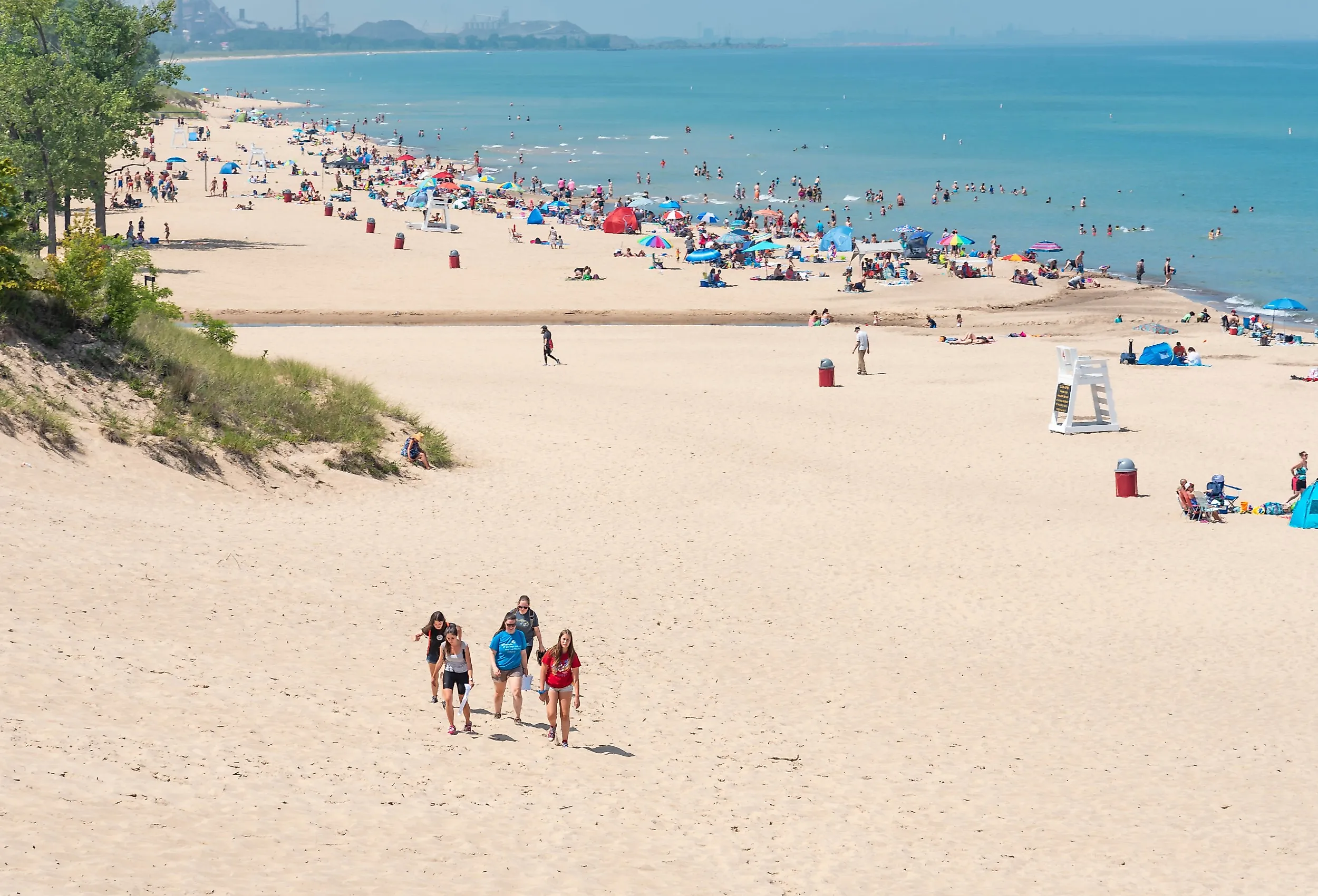
The lake's shoreline combines major metropolitan areas with state parks, forests, and smaller coastal communities. The lake also contains extensive dune landscapes. Indiana Dunes National Park protects 15 miles (24 km) of Lake Michigan shoreline, including several beaches.
Chicago's lakefront includes numerous public beaches, while Michigan's Lake Michigan coast contains extensive sandy areas and recreational parks. Of Lake Michigan's 535 monitored beaches, 475, or 89%, were open and safe for swimming for more than 90% of the season based on E. coli standards. Another 40 were safe for more than 80%, while 20 were safe for less than 80%.
Why Beach Counts Vary Across the Great Lakes

The ranking shows why lake size and shoreline length cannot predict the number of monitored beaches. Lake Superior covers about 42% more surface area than Lake Michigan, yet Michigan had more than twice as many monitored beaches during this study period.
The reported totals partly reflect which beaches monitoring programs selected, with coverage influenced by funding, staffing, recreational use, and perceived health risk. Lakes Huron and Superior, on the other hand, have extensive undeveloped shorelines.
The definition of a monitored beach also matters. The State of the Great Lakes assessment does not attempt to count every place where sand meets water. Instead, it evaluates recreational beaches participating in monitoring programs and tracks the percentage of swimming-season days when those beaches remain open and meet bacterial standards.
The 2018 and 2019 data provide a two-season snapshot, but monitoring frequency and program coverage varied among states. Beach monitoring programs can shift, new recreational areas can open, and existing beaches can change their status. Canadian beaches also fall outside of this US-only comparison.
What the Beach Rankings Show

Lake Michigan had the most monitored beaches in the State of the Great Lakes assessment, followed by Lake Superior, Lake Erie, Lake Huron, and finally Lake Ontario. The order demonstrates that shoreline length and surface area are only part of the equation.
The report does not determine why the lakes have different monitored-beach totals, so the ranking should not attribute those differences to population, geology, infrastructure, or water temperature. A large lake can have enormous amounts of shoreline without having many monitored beaches, while a smaller lake with densely developed recreational areas can support many more.
The Great Lakes, therefore, offer a useful reminder that geography is not determined by size alone. The number of places where people can safely swim and enjoy the beach landscape depends on how the shoreline has developed and how communities use their coastal areas.