How Much Water Is In All The Great Lakes Combined
The Great Lakes combined have a water volume of 5,439 cubic miles. To put that number in perspective, that accounts for 6 quadrillion gallons of water. If spread out over the entire continental U.S., it would flood the entire continent in around 10 feet of water. This is why the Great Lakes are commonly viewed as inland seas rather than just lakes.
On a global level, the Great Lakes account for close to 20% of surface freshwater on Earth, not counting groundwater or water trapped inside of glaciers. In this article, we will break down the amount of freshwater in each lake, along with offering some little-known facts about each Great Lake, starting from the smallest of the lakes by volume to the largest.
Lake Erie

Lake Erie has a water volume of 116 cubic miles, which is less than a third of the volume of the next smallest of the Great Lakes. Due to this feature, Lake Erie is the shallowest of the Great Lakes, with an average depth of 62 feet and a maximum depth of 210 feet.
Due to its shallowness, Lake Erie has the highest average water temperature, only dropping down to 31 degrees in January and reaching highs of 75 degrees in August. Because of this feature, it is the most biologically diverse of the Great Lakes, home to 130 fish species such as walleye, lake trout, and lake sturgeon. Despite its productivity, it was among the last of the Great Lakes to be mapped by Europeans, though the French interpreter Étienne Brûlé had likely seen it by around 1615, decades before Louis Jolliet's documented passage across it in 1669.
Lake Ontario

With a water volume of 393 cubic miles, Lake Ontario is the second smallest by water volume, but the smallest by surface area at only 7,340 square miles. It is the most easternmost of the Great Lakes, and has a direct outlet to the Atlantic Ocean via the St. Lawrence River. Since water flows to the east from here, it does not have any saline content.
It is known as the lower lake, as it has an average elevation of 243 feet above sea level. It is home to around 9 million people, and supports more Canadians in its watershed than any other watershed in Canada. There is another lake named after Lake Ontario, located on Saturn's moon Titan. It is called Ontario Lacus, and is made of a mixture of liquefied substances such as ethane, methane, and propane.
Lake Huron

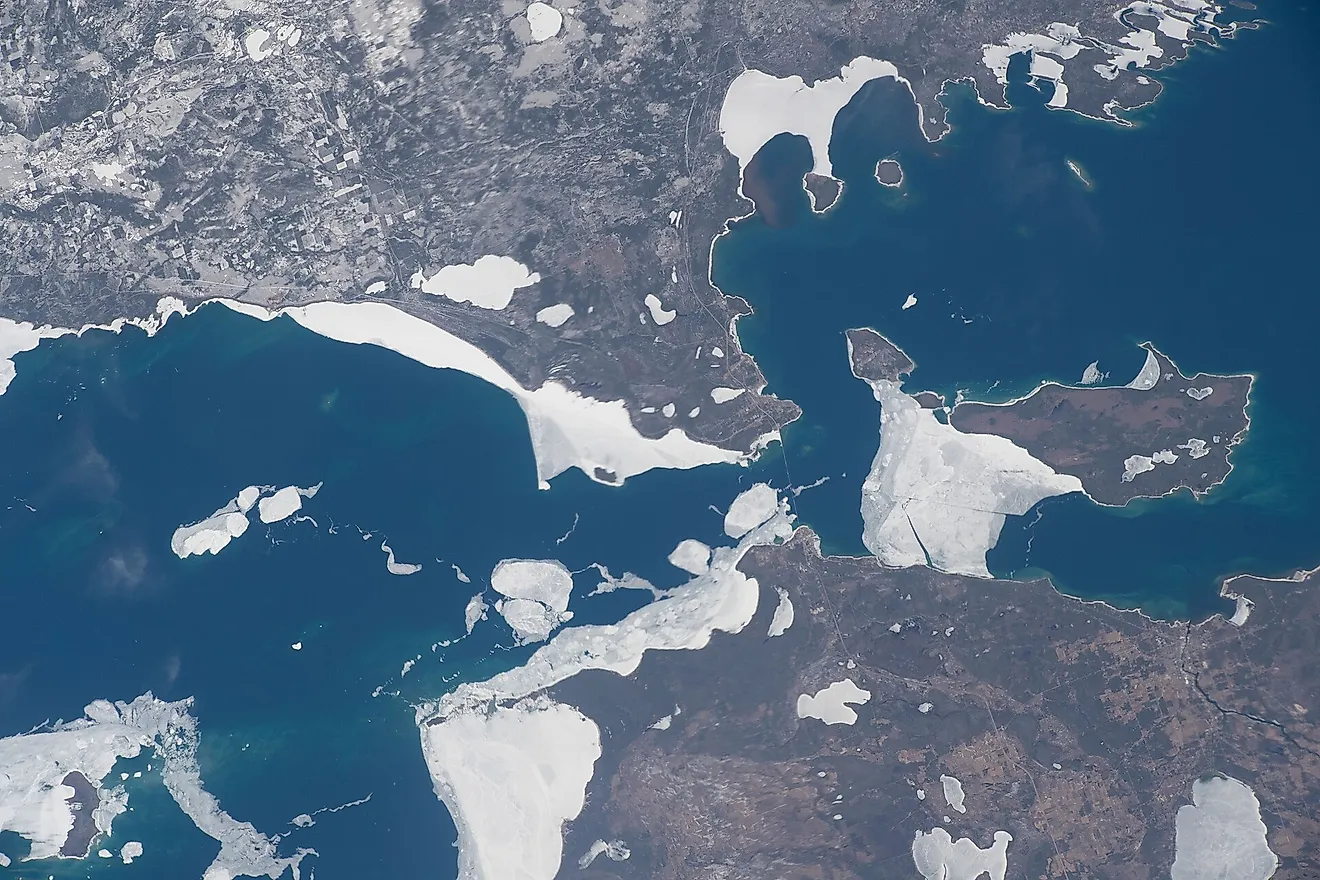
Lake Huron is more than double the size of Lake Ontario when it comes to water volume at 850 cubic miles. Although considered an individual lake, it is hydrologically combined with Lake Michigan via the Strait of Mackinac. It is bordered only by Michigan and Ontario, Canada, and it has the longest shoreline of the lakes at 3,827 miles.
Lake Huron was among the first of the Great Lakes reached by Europeans. The interpreter Étienne Brûlé, who traveled ahead of Samuel de Champlain, is generally credited as the first European to see it, and Champlain reached its shores in 1615. Champlain referred to it as a freshwater sea, a name that is still applied to the Great Lakes to this day. Many ships were wrecked while traversing these waters and are visible via the Fathom Five National Marine Park by diving or going on a glass-bottomed boat.
Lake Michigan

Lake Michigan is the second largest of the Great Lakes by water volume at 1,180 cubic miles. This is still less than half the water volume of the largest of the Great Lakes, but it does provide water for 12 million people. This is because it is in very close proximity to major metro areas such as Chicago, Illinois.
Lake Michigan is considered one of the most difficult of the Great Lakes to navigate via ship. That's because it's oriented north to south, which means ships have little room to maneuver when storms come in from the west. Of the around 8,000 shipwrecks in the Great Lakes, Lake Michigan accounts for around 35% of them. Another rare feature of Lake Michigan is its freshwater dunes, which are preserved at the Sleeping Bear Dunes National Lakeshore and the Indiana Dunes National Park.
Lake Superior

Lake Superior has more water in it than all of the other Great Lakes combined. Its water volume is 2,900 cubic miles. For comparison, Lake Huron, Erie, Michigan, and Ontario have a combined water volume of 2,539 cubic miles.
Lake Superior is also the largest freshwater lake by surface area on Earth at 31,700 square miles. Due to its large water concentration, it has a water retention time of 191 years and has a maximum depth of 1,330 feet, making it the deepest of the Great Lakes.
Despite this depth, it has the highest visibility of any of the Great Lakes, making it so one can see 27 feet underwater on average from the surface. The lake has far less urbanization than the other Great Lakes, meaning it has far less pollution both on its shoreline and waters.
The Great Lakes are invaluable
The water in the Great Lakes is an invaluable resource for those who live in its watershed. Putting it into perspective, more than 30 million people get their drinking water from the Great Lakes, which accounts for 10% of the U.S. population and 30% of the Canadian population. According to the Office for Coastal Management, the Great Lakes also support 311,000 jobs, which account for $8.8 billion in wages. Beyond the economic benefits, the Great Lakes provide countless recreational activities, whether that's going out to Isle Royale National Park on an island in Lake Superior or exploring the freshwater sand dunes of the Indiana Dunes National Park.