How Much Of The World's Freshwater Is In The Great Lakes?
Calculating the amount of freshwater in the Great Lakes depends on what figures one uses. If looking at only water found in lakes, rivers and swamps, the Great Lakes contain just over 24% of surface freshwater. If soil moisture is considered, that figure drops to 19.6%.
To calculate these figures, we have to look specifically at the total amount of surface freshwater available on the planet in lakes and rivers. This does not include groundwater, ice caps, and glaciers. We then add up the water volume of each of the Great Lakes.
How much freshwater is in the world?

The vast majority of water on Earth is too salty for human consumption, such as the world's oceans and brackish waters off of gulfs. According to the U.S. Geological Survey, the world contains 332.5 million cubic miles of water, but close to 97% is salt water. Only 2.5% of the water on Earth is fresh.
However, the vast majority of that is not available on the surface. The majority, at 68.7% is frozen inside glaciers and ice caps on the far north and southern poles of the planet. Groundwater accounts for 30.1% of freshwater, which is where most humans get their drinking water from. Of the remaining 1.2%, most of that water is either permafrost or in some other form. Only 0.3% of all freshwater on Earth is accessible from the surface, in lakes, swamps, and rivers, according to a course from Pennsylvania State University.
The U.S. Geological Survey states that this surface water is 22,300 cubic miles by volume, compared to 332.5 million cubic miles of total water in the world. However, if that figure factors soil moisture alongside bodies of water, it rises to roughly 27,740.65 cubic miles.
Lake Superior

Lake Superior is by far the largest of the Great Lakes both by surface area and water volume. It has 2,900 cubic miles of water by volume and 31,700 square miles of surface area, making it the largest lake by surface area.
Lake Superior is the third largest lake in the world by water volume, surpassed by the central African Lake Tanganyika at 4,500 cubic miles and Lake Baikal in Russia at 5,521 cubic miles. Out of the Great Lakes, Lake Superior has more water than all of the other Great Lakes combined.
Lake Superior is also the deepest and coldest of the Great Lakes, with a maximum depth of 1,333 feet and an average temperature of 55 degrees Fahrenheit. Due to this cold temperature, it has fewer fish species than the other Great Lakes, with 52 known to exist.
Lake Michigan

Lake Michigan has 1,180 cubic miles of water by volume, less than half of Lake Superior. It is the most developed of all the Great Lakes, providing drinking water for around 12 million people, many of whom live in metro areas such as Chicago.
Unlike the other Great Lakes, it is entirely contained within the boundaries of the United States, sharing a shoreline with Michigan, Wisconsin, Illinois, and Indiana. In addition, Lake Michigan is directly connected to Lake Huron through the Straits of Mackinac, leading some to consider the two lakes one lake.
Lake Michigan has a large number of freshwater dunes on its shoreline, which are formed through wind and receding shorelines. The Indiana Dunes National Park and the Sleeping Bear Dunes National Lakeshore protect these rare environments, of which the Sleeping Bear Dunes are the largest freshwater dunes in the world.
Lake Huron

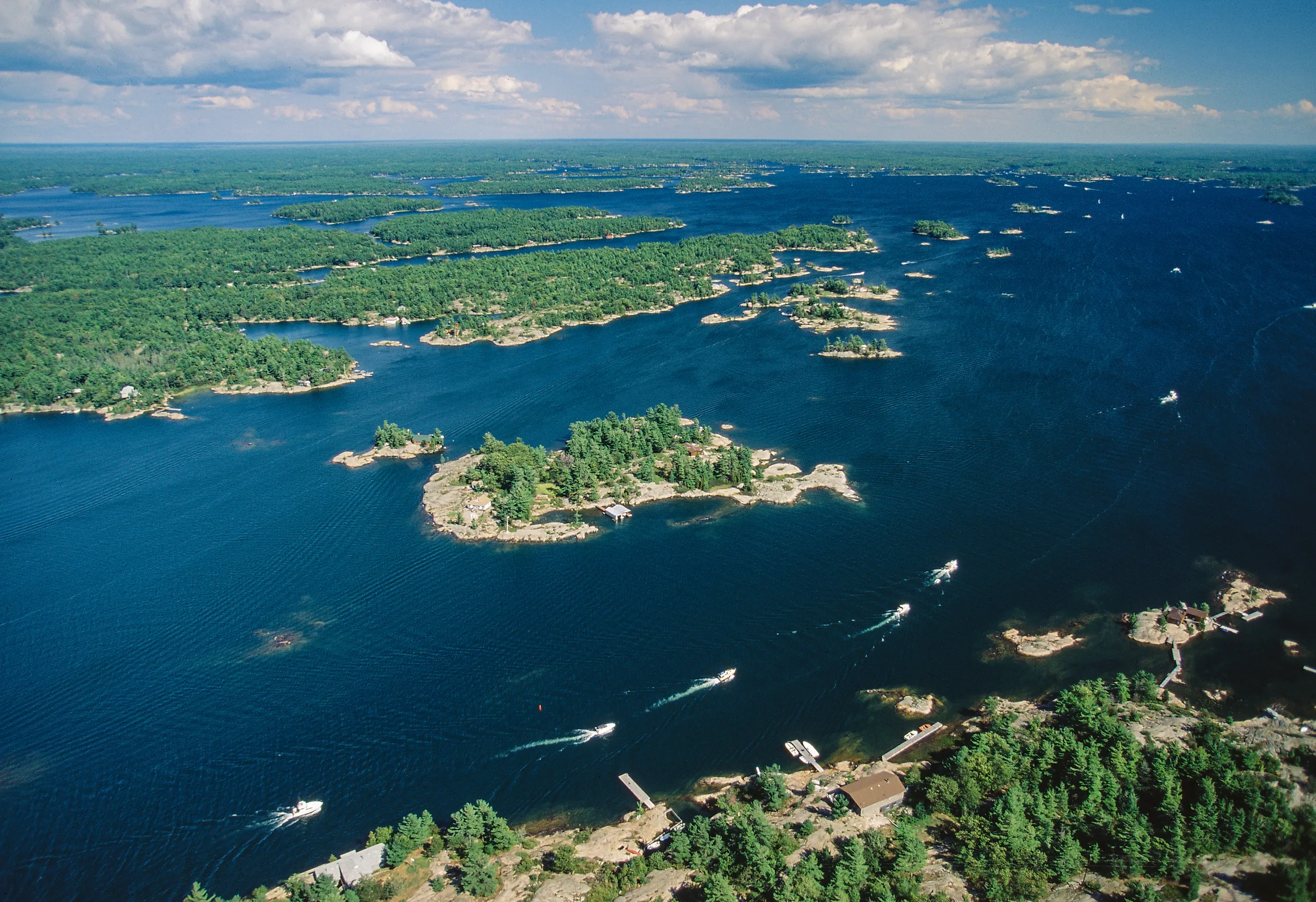
Lake Huron has 850 cubic miles of water, but is the second largest by surface area at 23,000 square miles. It is also the fourth deepest of the Great Lakes, reaching a maximum depth of 750 feet. It provides drinking water for around 3 million people, split 50/50 between Americans and Canadians.
Lake Huron holds one world record through its island, Manitoulin Island. This island is 1,068 square miles, with a shoreline of 100 miles, making it the largest freshwater island in the world. Another intriguing fact is that Manitoulin Island itself has 100 lakes, making it one of the few places on earth to have lakes within an island in a lake. Another rare environment found in Lake Huron is alvar habitats, plains made of limestone.
Lake Ontario

Lake Ontario has a water volume of 393 cubic miles and is the smallest of the Great Lakes by surface area at 7,340 square miles. It is the easternmost of the Great Lakes, connecting to the Atlantic Ocean through the St. Lawrence River.
Lake Ontario is sometimes referred to as the Lower Lake, as it is only 243 feet above sea level. It makes up for its size with depth, with a maximum depth of 802 feet. Lake Ontario has served a very important maritime purpose. Due to its close proximity to the ocean and human activity such as damming, it has been the entry point for invasive species such as sea lampreys, which devastated the fishing industry in the early to mid 1900s throughout the entire Great Lakes.
Lake Erie

Lake Erie has 116 cubic miles of water volume, making it the smallest by water volume. This also contributes to it being the shallowest of the Great Lakes, with a maximum depth of 210 feet and an average depth of 62 feet. It flows through the Niagara River into Lake Ontario.
Due to this depth, it is the warmest of the five lakes, reaching average temperatures of 74 degrees Fahrenheit during July. Due to these warm waters, it's one of the most popular lakes for swimming and recreational fishing, especially for walleye. In 2025, an estimated 77.4 million walleye in Lake Erie were at least two years old. This is why Lake Erie is called the Walleye Capital of the World.
Adding up the totals
In total, the Great Lakes have 5,439 cubic miles of water. Added together, the only place on Earth that has more freshwater is Lake Baikal. The Great Lakes provide drinking water for 42 million people living in Canada and the United States. With so much water, the Great Lakes have often been considered an inland sea.
Despite this impressive size, when put into perspective, the Great Lakes make up 19.6% of all freshwater in lakes, rivers, swamps, marshes, and water in the soil, but all of that water is only a tiny percentage of the freshwater on Earth and an even more minuscule portion of the total water on Earth.