How Many States Touch the Great Lakes?
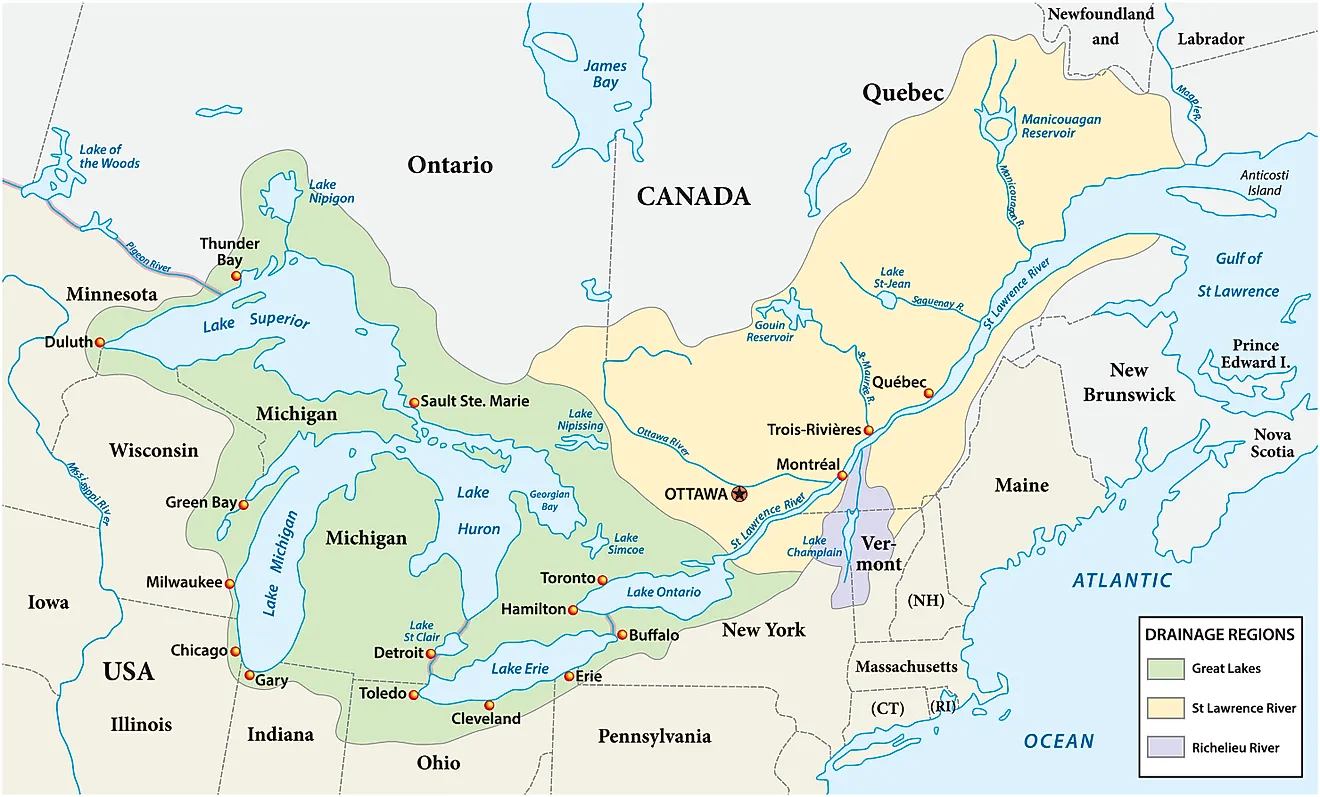
Michigan reaches into four of the five Great Lakes, more than any other state in the country. Seven more states line this freshwater coast along the northern United States. Minnesota meets Lake Superior where the North Shore climbs into cliffs and cold water. Wisconsin holds shoreline on two lakes at once while Illinois fits Chicago onto one short run of Lake Michigan. Indiana keeps its dunes at the lake's southern edge and Ohio and Pennsylvania sit along shallow Lake Erie. New York is the only state that touches Lake Ontario, since the far shore is Canada.
Minnesota

Minnesota touches one Great Lake, Lake Superior. The state's North Shore runs along the western end of the lake and gives Minnesota some of the most dramatic Great Lakes scenery in the country. Cliffs, cobble beaches, lighthouses, and forests line a cold-water coast that feels more oceanic than inland.
Duluth anchors the Minnesota shore as one of the busiest freshwater ports in the region. Farther up the coast, Two Harbors, Grand Marais, Split Rock Lighthouse State Park, and the Superior Hiking Trail draw a steady stream of visitors, making this stretch central to the state's tourism and outdoor recreation.
Wisconsin

Wisconsin touches two Great Lakes, Lake Superior and Lake Michigan. Its Lake Superior shoreline sits in the far north around Superior, Ashland, Bayfield, and the Apostle Islands. The Lake Michigan shoreline runs down the eastern side of the state through Green Bay, Manitowoc, Sheboygan, Milwaukee, Racine, and Kenosha.
The result is two very different Great Lakes identities within one state. Lake Superior offers islands, sea caves, cold-water kayaking, and Northwoods forest. Lake Michigan brings beaches, harbors, lakefront cities, and a long line of historic ports along the state's eastern edge.
Illinois

Illinois touches one Great Lake, Lake Michigan. Its shoreline is short next to Michigan's or Wisconsin's, yet Chicago gives that stretch an outsized presence.
Lake Michigan defines much of Chicago through its beaches, harbors, lakefront parks, and skyline views. That single stretch of coast is one of the most urban and heavily visited in the entire Great Lakes region. Navy Pier, the Chicago Lakefront Trail, Millennium Park, and the Museum Campus all sit close to the water, and for most visitors the lake is how they experience the city.
Indiana

Indiana touches one Great Lake, Lake Michigan. Its shoreline is short like Illinois', but it carries real ecological, industrial, and recreational weight.
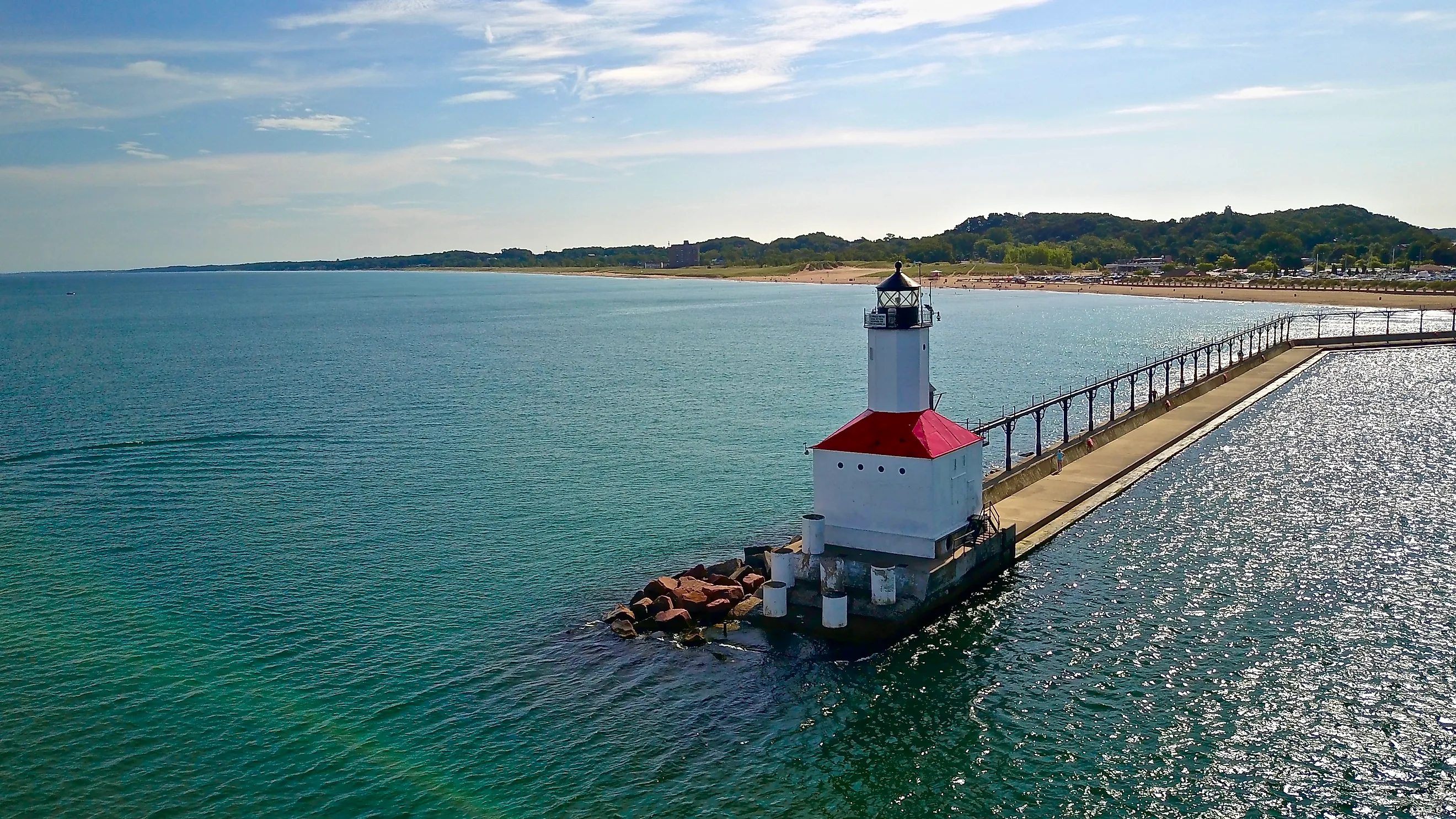
The best-known landmark here is Indiana Dunes National Park, where sand dunes, beaches, wetlands, oak savannas, and prairie habitats meet Lake Michigan's southern shore. The same coast holds industrial ports and the cities of Gary, Hammond, East Chicago, and Michigan City, where beaches, dunes, shipping, and steel history sit within a few miles of one another.
Michigan

Michigan touches four Great Lakes, Lake Superior, Lake Michigan, Lake Huron, and Lake Erie. No other state touches more than two, which is why Michigan is the state most closely tied to the Great Lakes. Its coast runs more than 3,000 miles (4,828 km) along those four lakes, the longest freshwater shoreline of any state.
That reach gives Michigan an unusually varied landscape. Lake Superior shapes the Upper Peninsula with rocky shores, waterfalls, and remote beaches. Lake Michigan forms the western edge with sand dunes, resort towns, and sunset beaches. Lake Huron defines much of the eastern Lower Peninsula and includes the Straits of Mackinac, while Lake Erie gives the southeast corner a smaller connection near Monroe and the Detroit River.
Ohio

Ohio touches one Great Lake, Lake Erie. The lake forms the entire northern boundary of the state and supports its cities, ports, beaches, islands, fisheries, and recreation areas.
Cleveland, Toledo, and Sandusky all lean on Lake Erie for tourism, shipping, and local identity. The lake also holds some of Ohio's most visited spots, including Cedar Point, the Cuyahoga County lakefront parks, and the Lake Erie Islands such as South Bass Island and Kelleys Island. As the shallowest of the Great Lakes, Erie is also the most sensitive to water-quality problems, and the EPA tracks its recurring harmful algal blooms closely.
Pennsylvania

Pennsylvania touches one Great Lake, Lake Erie. It has the shortest shoreline of any Great Lakes state, but that small corner of Lake Erie still gives Pennsylvania its own freshwater coast of beaches, harbors, and fishing grounds.
Erie is the major city on that shoreline, and Presque Isle State Park is its standout natural feature. The park's sandy peninsula curves into Lake Erie and creates beaches, lagoons, trails, birding areas, and calm protected water. Small as it is, Pennsylvania's Great Lakes coast remains important for recreation, shipping, fishing, and the identity of the Erie region.
New York

New York touches two Great Lakes, Lake Erie and Lake Ontario. Lake Erie meets the state in the west near Buffalo, and Lake Ontario runs along the northern edge of western and central New York.
The two lakes give New York two distinct coastlines. Lake Erie ties closely to Buffalo, the Niagara River, and the waterfront that both have been rebuilding. Lake Ontario brings harbors, bluffs, lighthouses, state parks, and communities such as Rochester, Oswego, and Sackets Harbor. New York is also the only state that touches Lake Ontario, since the lake's opposite shore belongs to Canada.
Which State Touches The Most Great Lakes?
Michigan touches the most Great Lakes, with shoreline on four of the five: Superior, Michigan, Huron, and Erie. Wisconsin and New York each touch two, while Minnesota, Illinois, Indiana, Ohio, and Pennsylvania each touch one.
The only Great Lake Michigan does not reach is Lake Ontario, and the only state on Lake Ontario is New York.
Which Great Lake Touches The Most U.S. States?
Lake Michigan and Lake Erie tie for the most, at four states each. Lake Michigan borders Wisconsin, Illinois, Indiana, and Michigan, and it is the only Great Lake that lies entirely within the United States. Lake Erie borders Michigan, Ohio, Pennsylvania, and New York.
Lake Superior reaches Minnesota, Wisconsin, and Michigan. Lake Huron touches only Michigan on the U.S. side, and Lake Ontario touches only New York.
The Bottom Line
Eight states touch the Great Lakes: Minnesota, Wisconsin, Illinois, Indiana, Michigan, Ohio, Pennsylvania, and New York. Michigan holds the broadest connection with four lakes, and Pennsylvania holds the smallest shoreline yet still keeps a real foothold on Lake Erie.
Together these eight states form the U.S. side of one of North America's largest freshwater systems, holding roughly a fifth of the world's surface fresh water. That water shapes the cities, beaches, shipping routes, drinking-water systems, and ecosystems of the northern United States far beyond what a map alone suggests.