The Oldest Man-Made Lakes in the United States
In 1699, the New York merchant Jacobus Van Cortlandt dammed a Bronx stream to power his sawmill, and the mill pond he made still survives today. Long before the federal dam-building era, colonists were already turning rivers into lakes for their gristmills and forges, and canal companies later did the same on a far larger scale. A man-made lake is any reservoir created by damming a river or stream, not carved by glaciers or geology, and the United States has thousands of them. The seven here are among the oldest still in use, a span that includes colonial mill ponds and the great hand-dug canal reservoirs. In order of age, they trace how American water needs changed across two centuries.
| Lake | State | Year completed | Surface area |
|---|---|---|---|
| Van Cortlandt Lake | New York | 1699 | ~16 acres |
| Lake Matoaka | Virginia | around 1700 | ~40 acres |
| Lake Hopatcong | New Jersey | 1750s (raised 1831) | 2,500 acres |
| Batsto Lake | New Jersey | 1766 | not recorded |
| Buckeye Lake | Ohio | 1830 | ~3,100 acres |
| New Croton Reservoir | New York | 1842 (rebuilt 1906) | 2,182 acres |
| Grand Lake St. Marys | Ohio | 1845 | 13,500 acres |
Van Cortlandt Lake, New York

Van Cortlandt Lake is among the oldest man-made bodies of water in the country, older than the United States itself. In 1699, Jacobus Van Cortlandt dammed Tibbetts Brook on his Bronx plantation to power a sawmill and gristmill, flooding the low ground into a mill pond. The mills ground grain and cut timber that moved by water toward Manhattan, and the pond later supplied ice to local families well into the 1800s. At about 16 acres it is small, yet it is still the largest freshwater lake in the Bronx. Today it lies inside Van Cortlandt Park, ringed by old-growth forest and walking trails, with the oldest house in the Bronx standing nearby.
Lake Matoaka, Virginia

Lake Matoaka is the oldest man-made lake in Virginia and one of the oldest in the country. English colonists dammed College Creek around 1700 to power a gristmill known as Ludwell's Mill, named for the plantation owner Philip Ludwell. The mill pond turned grain into flour for more than a century. The College of William and Mary reacquired the 40-acre lake in the 1920s and renamed it Matoaka, after the Powhatan woman known as Pocahontas. Its surrounding College Woods is the largest unbroken forest left in Williamsburg, and the lake now frames an amphitheater, a boathouse, and miles of wooded trails.
Lake Hopatcong, New Jersey

New Jersey's largest lake traces its man-made history to the 1750s, when a forge dammed the outlet of the Great Pond and the Little Pond, raising the water and joining the two. In 1831, the Morris Canal Company replaced that dam with a larger one and flooded the basin to near its present shape, using the high lake to feed the Morris Canal over the state's northern ridges. When rail traffic ended the canal era late in the 1800s, the lake found a second life as a resort. Steamboats, lakeside hotels, and summer estates made it a retreat for well-off New York City families by the early 1900s. Today it spreads across about 2,500 acres in Morris and Sussex counties and remains a center for boating and fishing, with traces of the old canal still visible at its southern end.
Batsto Lake, New Jersey

Batsto Lake formed in 1766, when Charles Read dammed the Batsto River to drive the bellows and hammers of his new Batsto Iron Works deep in the New Jersey Pine Barrens. The furnace smelted local bog iron into pots and kettles, and during the Revolutionary War it cast cannonballs and camp kettles for the Continental Army. George Washington thought enough of the place to order custom iron firebacks from it, two of which remain at Mount Vernon. Iron later gave way to glassmaking and then to farming, and the village around the pond fell quiet by the late 1800s. The state rebuilt the dam for recreation in the 1950s, and Batsto Lake now lies at the center of Batsto Village, a restored Pine Barrens town inside Wharton State Forest.
Buckeye Lake, Ohio

Buckeye Lake began as the Licking Summit Reservoir, dug between 1826 and 1830 to feed the Ohio and Erie Canal, and it counts as one of the first large man-made reservoirs in the country. Workers flooded a glacial swamp south of Newark, and because each canal lock spent about 80,000 gallons of water per lift, this high-elevation reservoir fed the canal through the dry months. Ohio renamed it Buckeye Lake in 1894 and made it the state's first state park in 1949. By the 1940s the lakeshore amusement park pulled crowds reported as high as 50,000 a day, with big-band and jazz acts like Glenn Miller and Louis Armstrong on the bill. The park closed by 1970, and a major dam rebuild between 2015 and 2019 secured the 3,100-acre lake for boating and fishing.
New Croton Reservoir, New York

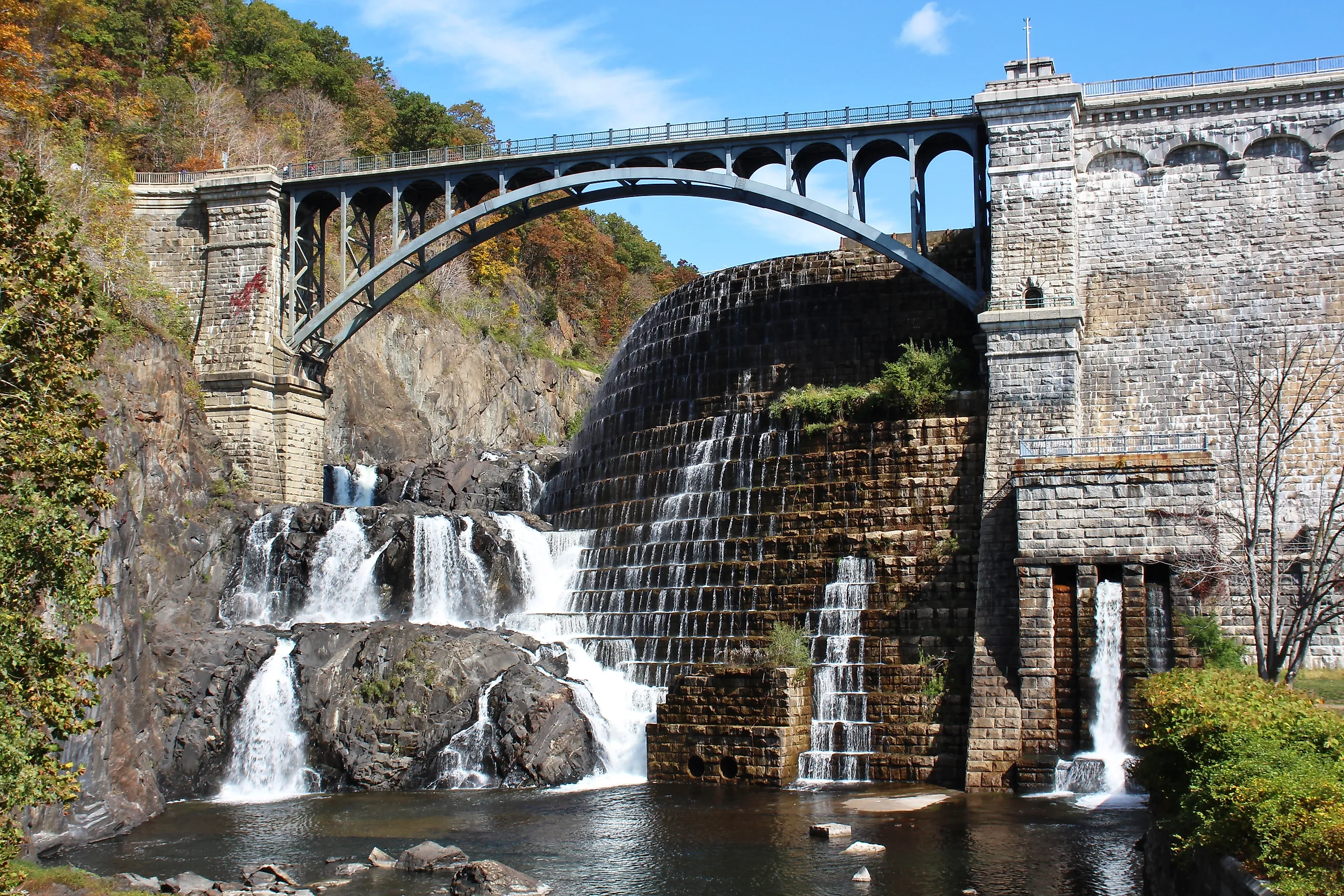
A cholera epidemic in 1832 killed thousands in New York City and pushed leaders to find clean water beyond Manhattan's fouled wells. The answer was the Croton River. Crews dammed it and built the 41-mile Old Croton Aqueduct, which carried fresh water south by gravity starting in 1842 and became a model for American city water systems. As the population climbed, the city replaced the original works with the New Croton Dam, finished in 1906. The enlarged reservoir spans 2,182 acres and stores 19 billion gallons along a basin about nine miles long. It is deep enough that the New Croton Dam submerged the original 1842 dam upstream.
Grand Lake St. Marys, Ohio

Grand Lake St. Marys from the western shore, south of Celina, Ohio. Editorial credit: Wikimedia Commons
Grand Lake St. Marys was once the largest hand-dug reservoir in the world. Between 1837 and 1845, around 1,700 German and Irish laborers excavated the basin by hand for about 30 cents a day, plus a daily jigger of whiskey meant to fend off malaria. The finished lake fed the nearly 250-mile Miami and Erie Canal across western Ohio. Decades later it made history again when drillers planted derricks on cribs out in the open water, creating what is often called the world's first offshore oil field in the 1890s. The oil is long gone, but the shallow 13,500-acre lake remains a destination for boating, fishing, camping, and bald eagle watching.
The Lakes That Came First
What stands out across these lakes is how thoroughly their first jobs have ended. The mill that made Lake Matoaka burned down generations ago, and the iron furnace that gave Batsto Lake its name went cold in the 1800s. Grand Lake St. Marys was dug by hand to float canal boats and now carries pleasure craft and bald eagles. Only the New Croton Reservoir still does close to its original work, sending water toward the city that built it. The rest have outlived their purposes and become parks, the oldest of them older than the country itself.