7 Must-See Historic Forts In Maine
Maine’s military history dates back to the 1600s, and several forts built along its shores and inland waterways are still standing today. Walk through Fort Knox, the first granite fort in the state, and see a stunningly preserved example of Civil War-era engineering. In Augusta, take a tour of Fort Western, the oldest surviving wooden garrison in the country. Kittery Point near the New Hampshire border was the site of defensive structures as early as the 17th century, and Fort McClary’s hexagonal blockhouse still sits at the mouth of the Piscataqua River. Exploring these historic forts provides a window into Maine’s past and illuminates the unique challenges of defending the state’s 3,500 miles of coastline.
Fort Knox

Fort Knox sits on the banks of the Penobscot River in Prospect, Maine. The first fort in the state to be built entirely of granite, it is one of the best-preserved examples of mid-19th-century coastal fortification in New England and has remained largely intact since work stopped in 1869.
After enduring the British occupation of the strategically vital timber region between Bangor and Castine during both the American Revolution and the War of 1812, Fort Knox was established in 1844 to protect the resource-rich Penobscot River Valley from any future British incursion. Upon its completion, Fort Knox garrisoned volunteer troops undergoing training, including members of the 20th Maine Regiment who would go on to fight at the Battle of Gettysburg. Visitors to Fort Knox can explore the passageways and ramparts, learn about 19th- century military life through a series of interpretive exhibits, or visit the 420-foot-tall Penobscot Narrows Observatory for great views of the river valley the fort was built to defend.
Fort Halifax

Located at the confluence of the Sebasticook and Kennebec Rivers in Winslow, Fort Halifax is the oldest surviving blockhouse in the US. The fort was built by English settlers in the mid-18th century to protect the Upper Kennebec River Valley from French forces in Quebec and their Native American allies. The original fort consisted of four blockhouses, a barracks, and a main building, but only one of the original blockhouses remains standing.
During the French and Indian Wars in the mid-18th century, land companies in Boston sought to protect their holdings in the Kennebec Valley. In 1754, a force of 600 British soldiers, under the command of Major General John Winslow, traveled from Fort Western in present-day Augusta to establish a defensive position on the Kennebec River. The fort’s military importance was short-lived, as the British gained control of the Kennebec River Valley in the 1760s, and the Fort was abandoned in 1766. The lone remaining blockhouse is maintained today as the Fort Halifax State Historic Site and has been listed on the National Register of Historic Places since 1968. The structure and the surrounding land are open to the public and provide great views of the Kennebec River and the Waterville riverfront.
Fort Western

Just a few miles downriver from Fort Halifax, you can see the oldest surviving hand-hewn wooden garrison in New England. Fort Western was built in 1754 at the head of navigation on the Kennebec River in present-day Augusta, and its history is closely linked to its neighbor further north.
Supply ships were only able to sail up the Kennebec River as far as the Cushnoc trading post. To get provisions to Fort Halifax, they had to be rowed about 18 miles upriver, a task made difficult by Maine’s harsh winters and the difficult terrain. To solve this problem, the Governor of the Province of Massachusetts approved the construction of Fort Western to keep provisions until they could be safely delivered to Fort Halifax. The fort was decommissioned in 1767 and sold to Captain James Howard, who enjoyed a second life as a store and family home. In 1775, the fort regained brief military significance when it was used by the Continental Army, under the command of Colonel Benedict Arnold, as they prepared for an assault on Quebec. Today, visitors to Fort Western can tour the original garrison building, as well as reconstructions of the blockhouses, watch boxes, and palisade, and learn about the site’s history and strategic importance to colonial trade in the 18th century.
Fort McClary

Fort McClary is located on Kittery Point at the mouth of the Piscataqua River, which separates Maine and New Hampshire. The surviving hexagonal blockhouse at the Fort McClary State Historic Site was built in 1844, but the location was used for various defensive fortifications as early as 1689.
The first permanent structure was likely built in the early 1700s to collect customs duty on ships entering Portsmouth Harbor. During the American Revolution, the New Hampshire militia manned the fort until 1779, when it was abandoned and later ceded to the federal government in the early 19th century. The new “second system” fort was named for Major Andrew McClary, a New Hampshire native and the highest-ranking officer killed at the Battle of Bunker Hill. After the construction of the main blockhouse in the 1840s, the fort remained active until it was decommissioned around 1918 after World War I. In 1924, the management and control of the property were transferred to the state of Maine. Since being placed on the National Register of Historic Places in 1969, the fort has been maintained and refurbished, preserving its unique design and storied past.
Fort Popham

Standing on the west bank of the Kennebec River in Phippsburg, Fort Popham was one of several forts built during the Civil War to protect Maine’s vulnerable waterways from potential Confederate invasion. The unique, semi-circular design features 30-foot granite walls and housed 36 cannons capable of firing shots weighing nearly 500 pounds.
Before the fort’s construction in 1862, the site had housed other defensive structures, including a small battery in the early 1800s, to help enforce Thomas Jefferson’s Embargo Act of 1807. Approval for the permanent structure was granted to protect the Bath shipyards and the Maine’s capital from the Confederate Navy’s newer and highly effective naval ships. Despite the initial urgency, construction was never completed. Although the fort was used temporarily during the Spanish-American War and World War I, the construction of Fort Baldwin on the nearby headlands rendered Fort Popham obsolete. The land was eventually sold to the state of Maine and added to the National Register of Historic Places in 1969.
Fort Gorges

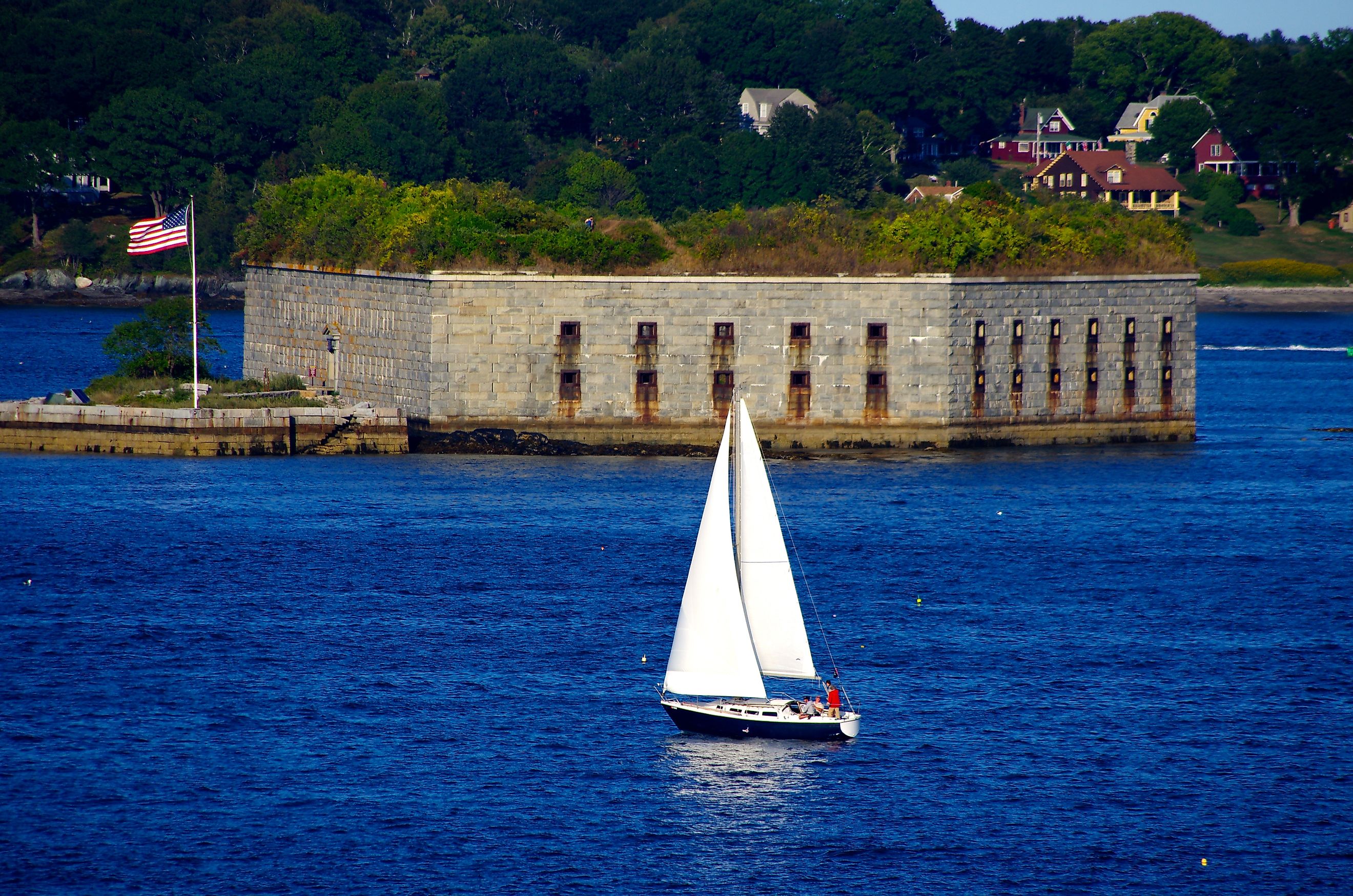
This Civil War-era fort on Hog Island Ledge in Casco Bay can only be reached by kayaking or taking a water taxi from Portland. The original proposal for the island fortification came in response to the threat of the British Navy during the War of 1812, and is one of three forts built to protect Portland Harbor. The two-story, enclosed structure had emplacements for 56 guns, one of which can still be seen today.
Fort Gorges was designed to support nearby Fort Preble and Fort Scammel. The Army Corps of Engineers began construction in 1858. Despite the outbreak of the Civil War hastening completion, by the time the original plans were completed in 1865, emerging technologies such as ironclad warships and improved artillery had rendered them obsolete. The fort never saw battle or garrisoned troops, but the island was used to store naval munitions during both World Wars. Today, the property is owned by the city of Portland and remains an excellent example of mid-19th-century military engineering.
Battery Steele

The most recently built of Maine’s historic forts, Battery Steele, can be reached by taking the Peaks Island Ferry from downtown Portland. Unlike most other forts in the state, this reinforced concrete fortress was built by the Army Corps of Engineers in the 1940s as part of a program to upgrade Portland’s harbor defenses during World War II.
Battery Steele’s construction started and terminated in the early to mid-1940s, and it remained operational through the end of the war. The battery housed two sixteen-inch guns, capable of firing projectiles weighing over a ton, almost thirty miles out to sea. These massive weapons were the largest land-based guns in the history of American coastal defense. The fort was the most important fortification in Casco Bay until the end of the war, when the military hardware was removed, and the battery was abandoned before being officially decommissioned in 1948. The property went largely unused until the battery and the surrounding 14 acres of land were acquired by the Peaks Island Land Preserve in 1995. The original concrete fortification remains open to the public and was added to the National Register of Historic Places in 2005.
Maine's historic forts bring military history to life!
These seven structures tell the story of Maine’s involvement in both World Wars, the Civil War, and the American Revolution. From the oldest blockhouse in the country at Fort Halifax to one of the largest coastal fortifications built in World War II on Peaks Island, these historic sites now enjoy a second life as public parks that will delight history and nature lovers alike.