10 Best Towns In Switzerland To Retire Comfortably
Switzerland routinely tops global quality-of-life rankings, and retirees drawn to its lakes, alpine air, and dependable public services have plenty of reasons to agree. Brig offers comparatively affordable housing near Alpine landmarks, while Yverdon-les-Bains pairs lakeside living with thermal baths and a regional hospital. Thun provides castle views and quick trains to Bern, Schaffhausen places the Rhine Falls beside a preserved old town, and walkable Aarau offers major medical facilities and connections across the country. Together, these towns show how retirees can balance beauty, convenience, and practical services in Switzerland.
Brig

Brig sits in the Upper Valais at the foot of the Simplon Pass, where it has anchored alpine trade routes for centuries. Its skyline is dominated by the Stockalper Palace, a three-towered Baroque landmark raised between the 1650s and the 1670s by Kaspar Stockalper, the merchant and financier known as the King of the Simplon. It was the largest private building put up in 17th-century Switzerland, and its arcaded Renaissance courtyard and gardens are open to visitors. A walk through the cobbled old town past the patrician houses leads over the Rhône to Naters and the World Nature Forum, an interactive museum dedicated to the UNESCO-listed Aletsch Glacier. The Brigerbad thermal baths sit just outside town, drawing on natural hot springs year-round, and rank as the largest open-air thermal complex in the country. Brig is also the most affordable town on this list. Its median house price sits at CHF 928,545, well under the national figure, according to RealAdvisor. Healthcare runs through Spitalzentrum Oberwallis, which operates sites in both Brig and Visp. The Brig hospital covers rehabilitation, rheumatology, geriatrics, and outpatient clinics, while acute and emergency care is concentrated at the Visp site, under ten minutes away by train. Rail links along the Simplon and Lötschberg lines keep Brig connected to Milan and the rest of Switzerland, a practical plus for retirees who want mountain quiet without total isolation.
Schaffhausen

Perched on the Rhine near the German border, Schaffhausen pairs a well-preserved medieval old town with one of Europe's most dramatic natural features. The Rhine Falls, Europe's largest plain waterfall at 150 meters (490 feet) across, sit just minutes away and remain a draw for residents who never seem to tire of the view. In town, the 171 ornately painted bay windows have earned the old town a reputation as a "bay window capital," and the frescoed Haus zum Ritter is a standout example. The Munot, a circular 16th-century fortress on a hill above the rooftops, still has a resident watchman who rings its bell by hand for five minutes every evening at nine, using a bell cast in 1589. Housing here runs below the national median: RealAdvisor lists the median house price at CHF 1,105,955. Medical care is centred at Spitäler Schaffhausen, the cantonal hospital group, with the private Privatklinik Belair adding orthopedic and eye surgery. Direct trains connect Schaffhausen to Zurich in about 40 minutes, making it a workable base for retirees who still want occasional access to a bigger city without actually living in one.
Yverdon-les-Bains

At the southern tip of Lake Neuchâtel, Yverdon-les-Bains has drawn visitors to its warm sulphur springs since Roman times, when the settlement was known as Eburodunum. Today, the Grand Hôtel & Centre Thermal d'Yverdon-les-Bains offers year-round bathing in naturally warm mineral water, a practical draw for retirees managing joint or circulation issues. The 13th-century Château d'Yverdon anchors the old town and now houses the Museum of Yverdon and Region, tracing 8,000 years of local history. Nature lovers can walk the marshland trails of the Grande Cariçaie, the largest lakeshore wetland in Switzerland, a short trip from the town center. Housing costs land below the Swiss median, with RealAdvisor listing the median house price at CHF 1,198,264. Healthcare runs through the Hôpital d'Yverdon-les-Bains, the main site of the Établissements Hospitaliers du Nord Vaudois network, which offers round-the-clock emergency care and a full range of specialties. Yverdon-les-Bains is roughly 25 minutes by train from Lausanne, keeping the city's services within reach for larger errands or specialist appointments.
Thun

Thun sits at the northwestern tip of Lake Thun, where the Aare River flows out toward Bern, and it functions as the main gateway to the Bernese Oberland. Thun Castle, with four corner towers dating to the end of the 12th century, rises directly above the old town and houses a museum tracing 800 years of regional history. Down in the pedestrian center, the Rathausplatz has served as the civic heart of the town since about 1500 and still hosts a Saturday market. Just off it runs Obere Hauptgasse, built on two levels, with an upper walkway laid over the roofs of the shops below. In summer, locals float the Aare on the current running past the Obere Schleuse, a covered wooden bridge and lock. Median house prices sit close to the national figure, at CHF 1,201,357, according to RealAdvisor. Retirees have access to Spital Thun, part of the Spital STS network, for general and emergency care, with Bern's larger Inselspital an easy rail trip away for specialized treatment. Thun's direct trains to Bern take under 25 minutes, useful for retirees who want city access without city prices.
Aarau

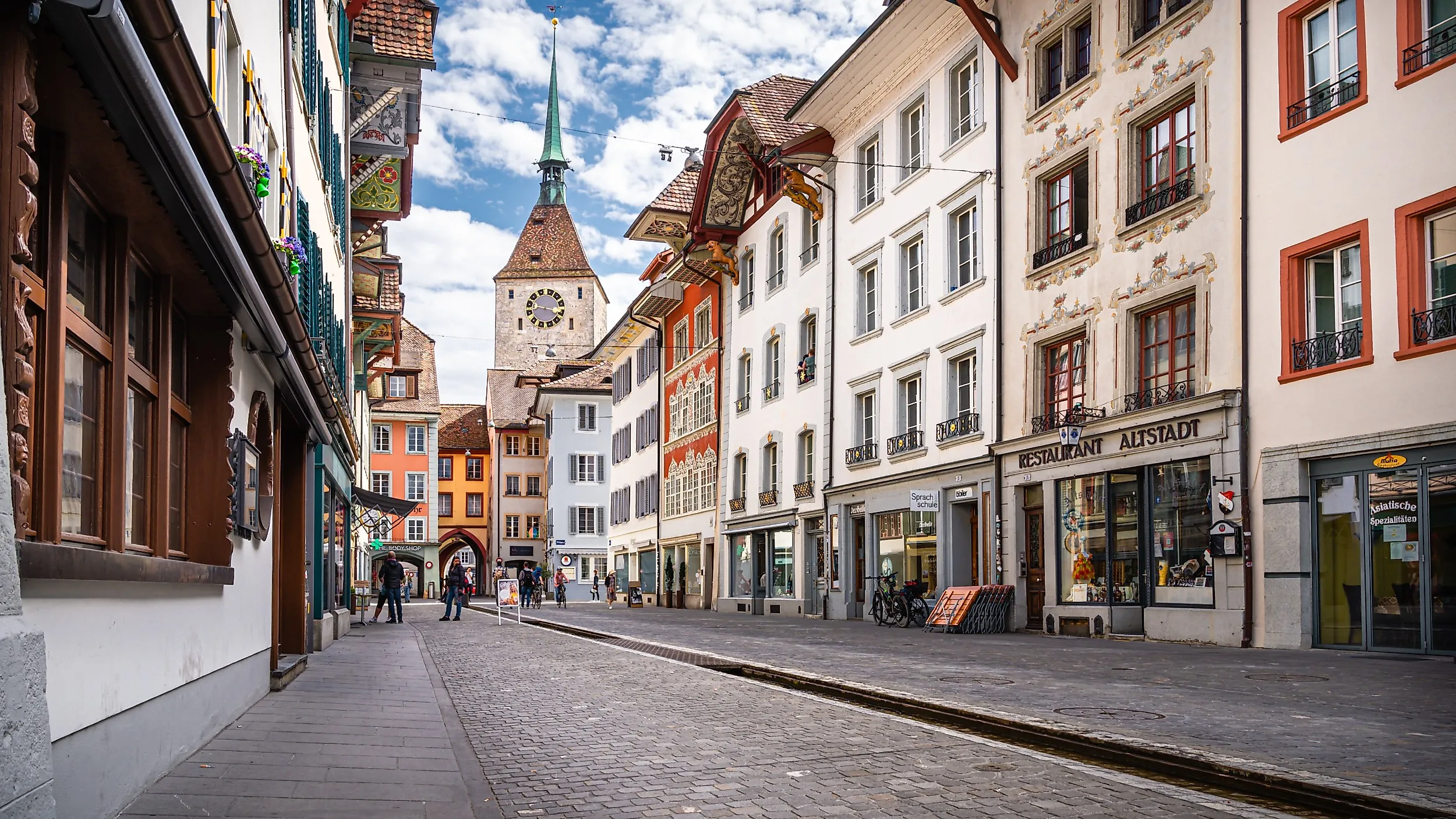
The cantonal capital of Aargau, Aarau sits on the Aare River and is known locally for its Dachhimmel, the painted undersides of the projecting roof eaves that overhang the old town lanes. Roughly 90 of them survive, each one a display of its owner's wealth. The Obertorturm, a medieval gate tower with a historic clock, marks the entrance to the old town, and a walk from there passes the town church and the Kettenbrücke over the river. Aarau also served briefly as the first capital of Switzerland in 1798, when the national parliament sat here for the first time. The compact center keeps shops, cafés, and arcaded streets within easy walking distance, a practical advantage for retirees prioritizing mobility. Housing costs run close to the Swiss median, with RealAdvisor placing the median house price at roughly CHF 1,365,000 to CHF 1,389,649 depending on current listings. Medical care is anchored by Kantonsspital Aarau, a major regional hospital with a full range of specialties, along with the private Hirslanden Klinik Aarau for additional options. Aarau's central location gives retirees direct rail access to Zurich, Basel, and Bern, each under an hour away, without the cost of living inside any of those cities.
Murten

Few Swiss towns preserve their medieval defences as completely as Murten. Its 13th-century Ringmauer is among the best-preserved town walls in Switzerland. The covered rampart walk is open daily between sunrise and sunset at no charge, with views over the red-tiled old town and Lake Murten below. Twelve fortress towers punctuate the wall, several with information panels on the 1476 Battle of Murten, when the town held out for twelve days until a Bernese relief army routed Charles the Bold. Inside the walls, arcaded streets host the Musée de Morat, which covers the town's history, and a scattering of Baroque and Gothic buildings from the 17th and 18th centuries. The lakefront Strandbad Murten offers swimming and a beach in warmer months. Median house prices run slightly above the national figure, at CHF 1,382,267, according to RealAdvisor. Healthcare is handled by HFR Meyriez-Murten, a site of the Fribourg cantonal hospital network. It sits just outside town in Meyriez, about a 10-minute walk from the train station, and offers acute medicine, rehabilitation, palliative care, and a seven-day walk-in emergency service. Murten sits roughly 30 minutes from Bern by train, keeping the capital's larger hospitals within easy reach for specialized needs.
Rapperswil-Jona

Known locally as the "town of roses," Rapperswil-Jona sits on the eastern shore of Lake Zurich in the canton of St. Gallen. The 13th-century Rapperswil Castle overlooks the old town from Lindenhof hill, its courtyard and grounds open to visitors, and the Polish Museum inside documents Polish exile history in Switzerland. True to its nickname, the town maintains more than 15,000 rose bushes across several gardens. The Capuchin Monastery's public rose garden is in bloom between May and October. Families and grandchildren alike gravitate to Knie's Children's Zoo, a longtime local attraction near the lakefront promenade. Housing here runs well above the national median, with RealAdvisor listing the median house price at CHF 1,870,070. Healthcare access runs through Spital Linth in nearby Uznach, part of the HOCH Health Ostschweiz network, though the canton has given that site only a time-limited mandate through the end of 2027 while its finances are under review. Kantonsspital St. Gallen handles more specialized care. Boats and direct trains connect Rapperswil-Jona to Zurich in under 40 minutes, a workable link for retirees who want lake living without leaving the Zurich region entirely.
Vevey

Set on the shores of Lake Geneva and often called the "pearl of the Swiss Riviera," Vevey pairs a mild lakeside climate with an outsized cultural pedigree. Charlie Chaplin spent the last 25 years of his life at the Manoir de Ban in neighbouring Corsier-sur-Vevey, a house that reopened in 2016 as Chaplin's World museum. A bronze statue of him stands on the lakefront promenade, near The Fork, a 26-foot steel sculpture rising from the lake. The Alimentarium, the world's first museum dedicated entirely to food and nutrition, sits a short walk away and remains a popular stop for residents with visiting family. Vevey is also the gateway to the Lavaux vineyards, a UNESCO World Heritage terraced wine region climbing the hills above the lake. Housing costs run well above the national median here, with RealAdvisor listing the median house price at CHF 2,022,685. Healthcare access runs through Hôpital Riviera-Chablais in nearby Rennaz, which serves the broader Vevey-Montreux region with a full range of specialists. Rail connections along the lake reach Lausanne and Geneva in well under an hour, keeping international airport access within easy range.
Ascona

On the northern shore of Lake Maggiore, Ascona is the lowest-lying town in Switzerland, sitting at 196 meters (643 feet) above sea level. The feel is distinctly Mediterranean, with palm-lined promenades and a mild, sunny climate rare elsewhere in the country. The old town, known as the Borgo, is a maze of narrow lanes leading to boutiques and the 16th-century Church of San Pietro e Paolo, whose tall bell tower is the town's landmark. Above town, Monte Verità draws retirees interested in history and wellness alike: founded in 1900 as a commune devoted to vegetarianism and alternative living, it now houses a museum complex and hosts university seminars. Boat trips from the lakefront reach the Brissago Islands, home to the only botanical garden on a Swiss island. Only Weggis costs more than Ascona on this list. RealAdvisor puts the median house price at CHF 2,245,803, well above the Swiss median. Medical care runs through Ospedale La Carità in nearby Locarno, the region's primary hospital for specialist and emergency care. Ascona's Italian-influenced dining scene and year-round mild weather make it a distinctive pick for retirees prioritizing climate over cost.
Weggis

Nicknamed the "Lucerne Riviera" for its unusually mild microclimate, Weggis sits on the northern shore of Lake Lucerne at the base of Mount Rigi. Palm, chestnut, and fig trees line its lakefront promenade, a rarity this far from the Mediterranean. A memorial stone along the water marks the spot where Mark Twain sat during his stay in the summer of 1897. He spent about ten weeks in the village and wrote to a friend that he had found nowhere in the world better. A cable car from town climbs directly to Rigi-Kaltbad, where retirees can soak at the Mineralbad & Spa Rigi Kaltbad or continue on to the summit's hiking network. The village square and boat landing double as a low-key social hub for residents most mornings. Weggis carries the highest housing costs on this list, with RealAdvisor listing a median house price of CHF 2,658,488. For hospital-level care, residents rely on the Luzerner Kantonsspital in nearby Lucerne, a major regional hospital reachable by boat or road in well under an hour. Weggis suits retirees drawn to lake scenery and mountain access who are prepared to pay a premium for the climate.
Finding The Right Fit
These ten towns span a real range, each offering a different balance of climate, culture, and cost. Thermal water defines daily life in Brig and Yverdon-les-Bains, medieval fortifications set the tone in Murten and Schaffhausen, and lake culture runs through Vevey, Ascona, Weggis, and Rapperswil-Jona in different registers, from Mediterranean warmth to rose gardens to Mark Twain nostalgia. Every town on this list is connected to Switzerland's mandatory health insurance system and a designated regional hospital, so healthcare access is consistent even where costs vary widely. For American retirees, the practical first step remains the same regardless of which town appeals most: confirming residency eligibility before house-hunting, since Switzerland's rules apply well before any of these towns come into play.