The Emptiest Counties In The Great Plains
These days, many parts of the country can seem uncomfortably crowded, even compared to a few years ago. However, this is by no means true everywhere. Just look at the Great Plains, the vast expanse of rolling landscapes that runs north out of Texas and across the Canadian border. But even within this low-density region, certain areas stand out as particularly empty. Here's a closer look at the emptiest counties in the Great Plains and why so few people call them home.
King County, Texas (0.211 residents per square mile)

In north Texas, near the southern end of the Great Plains, lies the region's emptiest county, King County, Texas. It is home to just 192 residents settled across an area of nearly 911 square miles, resulting in a hard-to-imagine population density of barely a fifth of a person per square mile. For context, New York City is home to over 29,300 people per square mile, while the closest major city, Fort Worth, has a population density of 2,646 people per square mile.
Part of the Rolling Prairie region of North Texas, the county was organized in 1891 and has an economy primarily focused on ranching, with several famed historic ranches in the area, alongside farming and energy production. Most residents live in the county's primary community, Guthrie. However, shopping, dining, and entertainment amenities are very limited, with the best alternatives nearly 100 miles away in Lubbock.
Garfield County, Montana (0.245 residents per square mile)

At the opposite end of America's portion of the Great Plains is Garfield County, located in eastern Montana north of Billings. Census estimates put 1,148 residents in the county, which spans a whopping 4,676 square miles. This is equivalent to just over a thousand people living in an area nearly four times the size of Rhode Island, creating a remarkably low population density of under a quarter of a person per square mile.
The area was settled just before the turn of the 20th century and established as a county in 1919, following a boom in homesteading in the surrounding area. Jordan is the county's largest community and county seat, combining an Old West atmosphere with significant paleontological sites that have produced numerous notable dinosaur fossils. Garfield County is also home to Hell Creek Recreation Area, a top spot for boating, fishing, and camping near Fort Peck Reservoir.
Harding County, New Mexico (0.290 residents per square mile)

New Mexico may not always be associated with the Great Plains, but the wide open spaces of the state's eastern half fit the definition to a T, including the vast emptiness of Harding County, population 617. They are spread across a county of 2,125 square miles near the Oklahoma and Texas borders. Notably, the county's population peaked at around 5,000 around the time it was officially formed in 1921, and has lost residents steadily ever since, with barely one resident for every four square miles.
Harding County's vast emptiness is the primary draw, with the western unit of the Kiowa National Grassland and its Mills Canyon area reaching into the county. Both preserve the unique scenery of the plains and surrounding environments, a relative rarity in modern America. Communities include the towns of Mosquero, the county seat, and Roy, both of which are relatively tiny with few amenities. Mills Canyon sits a few miles west of the near-deserted community of Mills, north of Roy, where the Canadian River has cut a canyon some 700 feet deep.
Petroleum County, Montana (0.331 residents per square mile)

Central Montana's Petroleum County is home to a remarkably low population density of fewer than a third of a resident per square mile. It achieves this impressive emptiness by spreading just 548 residents over a county of 1,655 square miles. Unlike many low-density counties on this list, this is actually an improvement from previous decades, since Petroleum County had just under 500 residents in 2010.
It was established in 1925, the last county created in the state, for reasons made clear by the name, which is oil drilling and energy production. Ranching has also been a significant part of the local lifestyle and economy in this wide open expanse of plains. Even the largest communities, such as the county seat, Winnett, are just a few blocks of homes with a local business or two, spread far apart from one another. That leaves plenty of room for preserved land such as the Charles M. Russell National Wildlife Refuge, a popular spot for hiking, fishing, hunting, camping, and other outdoor recreation.
Carter County, Montana (0.414 residents per square mile)

Another of Montana's vast, lightly populated counties is Carter County, set into the state's southeastern corner near the borders with Wyoming and South Dakota. Its 1,383 residents are spread across more than 3,340 square miles of land, resulting in a minuscule population density of about two people per five square miles.
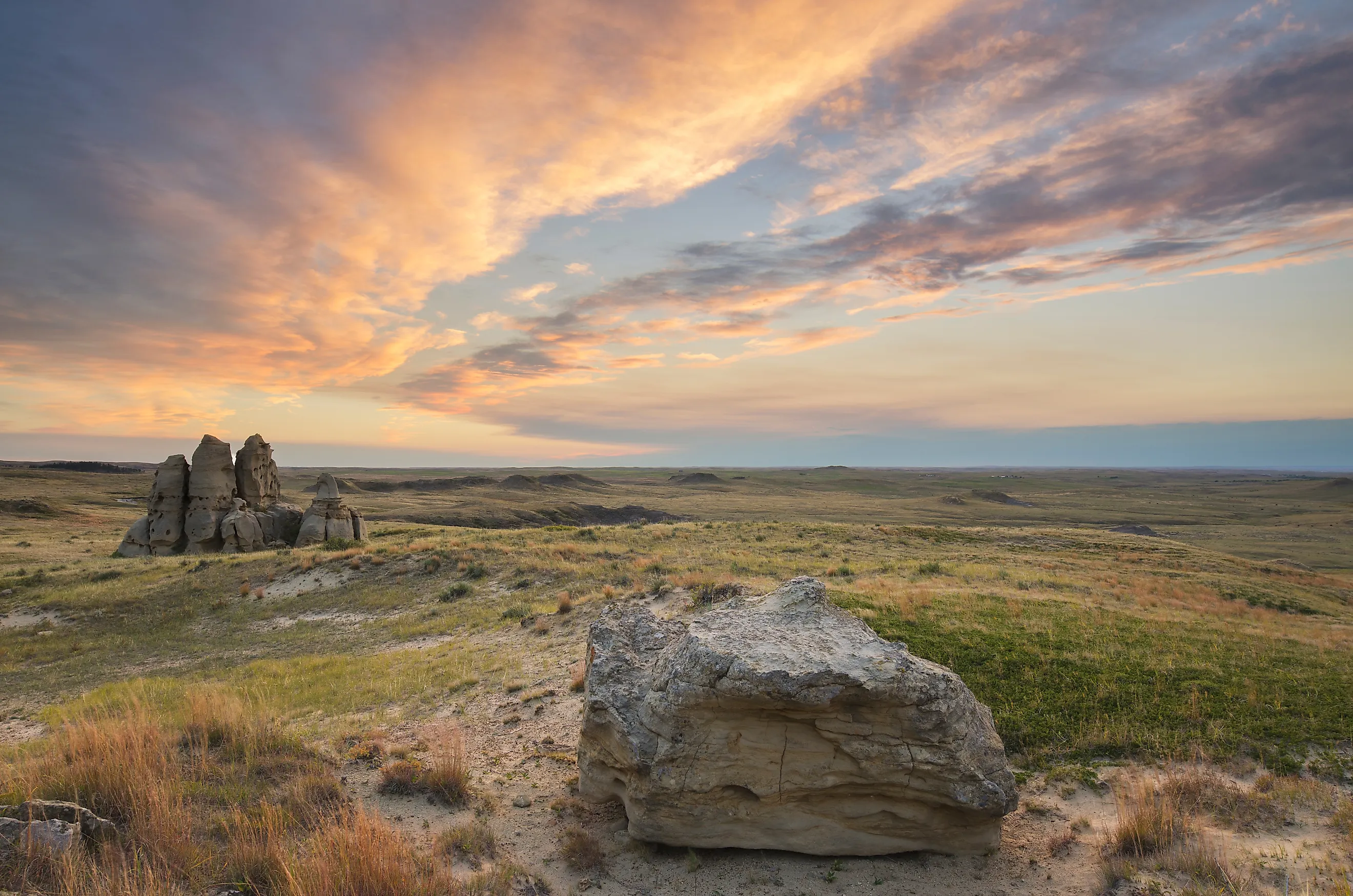
Carter County was established in 1917, and farming and ranching remain its principal industries, with beef production particularly important. Ekalaka is the county seat and only incorporated community, serving as the main hub for this otherwise rural landscape. The town is home to the Carter County Museum, notable for its fossil collections. Just north of Ekalaka, Medicine Rocks State Park protects a landscape of unusual eroded sandstone formations and offers hiking, camping, wildlife viewing, and stargazing.
McPherson County, Nebraska (0.429 residents per square mile)

This particularly empty corner of Nebraska sits in the state's west-central Sandhills region, far from even the modestly sized towns and cities peppered through this primarily rural state. At about 859 square miles, it is almost three times the size of New York City, but is home to just 369 people in 2025. That is a stark decline from even the paltry 539 who lived in McPherson County in 2010.
It was formed in 1890, named after Civil War General James B. McPherson. McPherson has no incorporated communities in the entire county, including the county seat of Tryon, one of only two such county seats in Nebraska. The county is almost entirely agricultural and ranch land, making it a true expanse of emptiness in one of the most spacious regions of the country.
Plenty of Wide Open Spaces Remain on America's Great Plains
If you need a little breathing room, head to the Great Plains and leave the crowds behind. These six counties may differ in their location, economies, local culture, and attractions, but they share one critical factor, which is room. The people who live in them are among the relatively few Americans who choose to call these vast expanses of land home.