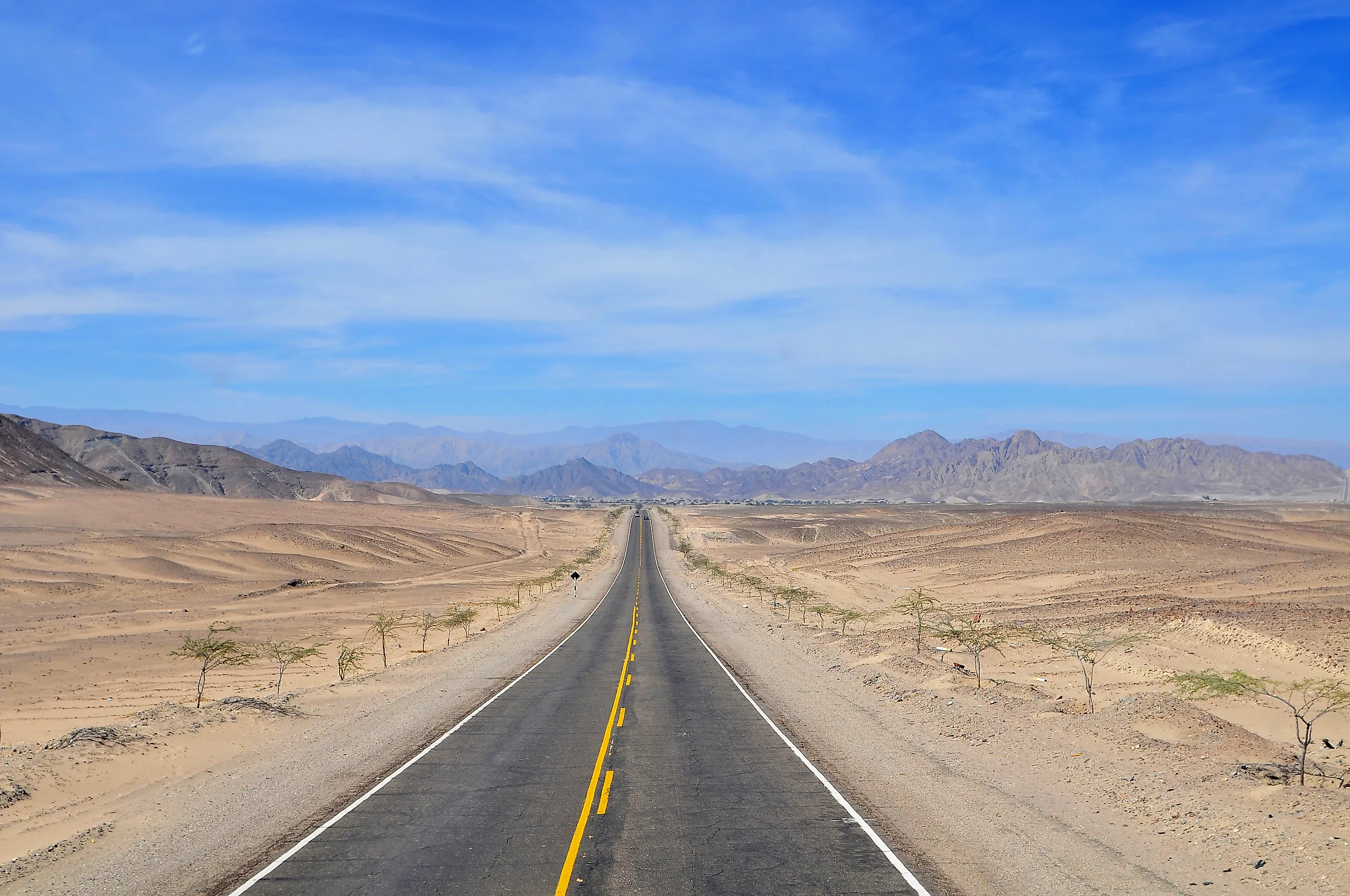
The Longest Highways In The World
Some of the world's highways seem never to end. The Pan-American Highway, for instance, stretches across two continents and is the longest motorway in the world, according to Guinness World Records. Highway 1 in Australia is a circumferential road that surrounds the continent. The famous Trans-Siberian Highway, meanwhile, connects St. Petersburg to Vladivostok. This article lists the longest highways in the world by total system route length.
Pan-American Highway

The Pan-American Highway is nearly 19,000 miles (around 30,000 kilometers) long, and links Prudhoe Bay in Alaska to Ushuaia in Argentina. It is unique in that, while it passes through 14 countries and two continents, there is a section known as the Darién Gap in Panama and Colombia that must be crossed by boat. The idea of the Pan-American Highway was suggested at the Fifth International Conference of American States in 1923, and construction started in the 1930s. Different countries joined the effort initially kicked off by the U.S. and Mexico. There have been efforts to fill in the Darién Gap, but environmental concerns still make this impossible. Those who take the Pan-American Highway today can explore different cultures and traditions on one very long road trip. The highway also has a major positive impact on the economies of the countries it links, as it makes tourism that much easier. Travelers who want to experience the longest highway in the world will drive routes that intersect with sections of the historic U.S. Route 66. They will pass through Mexico, then the landscapes of Central America, Costa Rica, and Nicaragua before traversing the Andes Mountains in South America. Taking this route also allows access to Machu Picchu in Peru and other ancient sites before finally passing through Patagonia and ending in Ushuaia.
Highway 1

The 'Big Lap' or Highway 1 in Australia boasts the distinction of being the second-longest highway in the world and also the longest national highway in the world. Highway 1 is 9,000 miles (14,500 kilometers) long and loops around the country's mainland. Like the Pan-American Highway, Highway 1 consists of an interconnected road system. This system links every state capital in the country as well as all major coastal cities. These include Sydney, Brisbane, Cairns, and Darwin. The highway was created in 1955 to form part of the National Route Numbering System. Its sheer length and the way it loops around the mainland ensure that most travelers making their way along the coast will end up driving on it at some point. Highway 1 also features the 90 Mile Straight, which is a section of the Eyre Highway between Balladonia and Caiguna that has no sharp turns or curves. Today, the highway remains fully paved and is maintained under federal and state transport authority jurisdiction. It carries around a million people traveling across Australia every day. Those who want to drive all of its miles should plan for a minimum of six weeks' travel. Along the way, there is the Sunshine Coast to see, as well as the Blue Mountains, Kakadu National Park, and the Great Ocean Road.
Trans-Siberian Highway

The Trans-Siberian Highway is around 6,800 miles (11,000 kilometers) long, stretching between St. Petersburg and Vladivostok and crossing eight time zones. It only became fully paved in 2012. The complete route can be driven starting in Moscow at the Red Square, finishing in Vladivostok, or the other way around. This can only be done during the summertime as travelers make their way through 23 different regions. However, unlike some of the other highways on this list, the Trans-Siberian Highway can be extremely challenging in places. There is harsh weather to contend with as well as a lack of service stations along the way. The physical condition of the road also shifts in sections, with drivers having to navigate gravel while not having guardrails or proper lighting to rely on. Because of this, many consider the highway to be the most dangerous in the world.
Trans-Canada Highway

At a length of around 4,860 miles (7,820 kilometers), the Trans-Canada Highway is Canada's longest national road. The highway travels in an east-west direction across the country, passing through all ten provinces while linking all the major cities. When it opened in 1962, the Trans-Canada Highway was the longest uninterrupted national highway in the world. Before it opened, the only way for people to get from one place to another across the country was by train. Now, travelers can travel from coast to coast (Pacific and Atlantic), crossing six time zones, and stop by Chippewa Falls at the Highway's halfway point. There have been some comparisons made between the Trans-Canada Highway and America's Route 66 since the Canadian highway runs directly through several towns and cities. It also features businesses and homes built right next to it. Some of the things to see while driving the highway include the Terry Fox Memorial and Lookout, as well as the World's Biggest Nickel. The highway also traverses Banff National Park, with 83 kilometers of it upgraded since 1981 to protect wildlife and improve driver safety.
U.S. Route 20

U.S. Route 20 is America's longest highway, passing through twelve states and crossing 4 time zones. At around 3,250 miles (5,230 kilometers), U.S. 20 links Newport, Oregon to Boston, Massachusetts. Along the way, drivers will see the Pacific Ocean, several Great Lakes beaches, and lots of wine country. When it was first built, the highway ran from Boston to Yellowstone National Park. It was extended to the Oregon coast in 1940, mostly running parallel to I-90, after becoming an official U.S. highway in 1926. When it reaches Yellowstone, the road becomes unnumbered, technically stopping at the eastern entrance and restarting at the western entrance. On November 11, 2026, U.S. 20 will reach the 100-year mark since the route designation. The same day will also celebrate the establishment of the famous Route 66.
U.S. Route 6

U.S. Route 6 runs inland to the coast between Provincetown, Massachusetts, and Bishop, California, which sits in the Owens Valley near the Sierra Nevada mountains. The highway is around 3,200 miles long (5,150 kilometers), runs along Lake Erie, crosses several rivers, and stretches through five state capitals. It also goes up and across the Continental Divide. U.S. 6 was designated in 1926 and expanded in 1937. It was also named the Grand Army of the Republic Highway to honor Union veterans of the American Civil War. The highway once extended 3,652 miles to Long Beach, California, before state highway renumbering shortened its west terminus in 1964. It takes travelers across highly diverse terrain, crosses the Great Basin Desert and also carries them over the Loveland Pass in the Colorado Rocky Mountains. The highway is fully paved and is maintained by the individual state departments of transportation across twelve states.
Interstate 90

I-90 was created in 1956 and officially opened in 1959, but not all sections were ready. Over the next decade, more sections opened, with the final one opening in 1969. Today, it is still the longest interstate in America at 3,020 miles (4,860 kilometers). I-90 starts in Seattle and ends in Boston, traveling through thirteen different states. Its construction integrates many toll turnpikes, including the Massachusetts Turnpike, New York State Thruway, Indiana Toll Road, and Jane Addams Memorial Tollway. In western Montana, the freeway runs parallel to the Clark Fork River and the Bitterroot Range for nearly 150 miles. Travelers have plenty to look forward to on this extra-long road trip, such as seeing the floating bridges in Washington, the Jolly Green Giant in Minnesota, and the Corn Palace in South Dakota.
Maintaining the World's Longest Roads
These roads mean long-standing records, but this does not come without constant year-round work. Local and national road crews deal with challenging road conditions every day. They have to clear snow off the mountain passes like Loveland, and patch potholes on some of the busiest routes like Interstate 90. Highways that cross international borders, like the Pan-American Highway, require countries to work together on border rules and maintenance. The combined effort keeps both people and animals safe as maintenance continues to include fixing roads and bridges and adding overpasses for wildlife where possible.
Keeping Up With Long-Distance Highway Travel
The world's longest highways are not continuous and are updated to keep up with traffic. Narrow lanes are widened, electronic toll options are added, and mountains get tunnels built right through them. These upgrades can often change the total mileage of a route (typically not by much), but more importantly, they allow these highways to keep people and goods moving.