6 Must-See Historic Forts In New York
Three flags have flown over Old Fort Niagara (French, British, and American) across more than 300 years of continuous occupation, the longest tenure of any military post in New York. The five other forts on this list trace the same colonial geography: chokepoints on the rivers, lakes, and carrying places that controlled who could move through the interior. Fort Ticonderoga, originally the French Fort Carillon, sat at the narrow water gate between Lake Champlain and Lake George, where 4,000 French defenders repelled 16,000 British troops in the 1758 Battle of Carillon and where Ethan Allen's Green Mountain Boys took the post on May 10, 1775. Fort Stanwix on the Oneida Carry blocked the British advance from Canada in August 1777, an action that helped force the British surrender at Saratoga two months later. Fort Ontario at Oswego saw service from 1755 through World War II, when it housed the only Holocaust refugee shelter the United States operated for the duration of the war. The six forts below are open to visitors today as state historic sites, national monuments, and private foundations, with original structures going back as far as 1726.
Old Fort Niagara

Old Fort Niagara sits at the mouth of the Niagara River on Lake Ontario, the chokepoint between the lower Great Lakes and the Saint Lawrence corridor that the French, British, and finally American garrisons all wanted to control. The French Castle, the oldest standing structure on the property, was built in 1726 as a fortified house disguised in the form of a French country residence; the cover was meant to slip a stone garrison past the suspicions of the local Haudenosaunee (Iroquois Confederacy) without triggering open resistance. The thick limestone walls, narrow stair passages, and sealed powder magazines inside tell what the building actually was. The British took the fort by siege in July 1759 during the French and Indian War, holding it until 1796 and again briefly during the War of 1812 before American troops returned for permanent occupation in 1815. Fort Niagara stayed an active US Army post through World War II and was only formally retired in 1963.
The fort is run today by a private nonprofit, the Old Fort Niagara Association. The French Castle, the Powder Magazine (1757), the gate buildings, and the South Redoubt are preserved or carefully reconstructed and open for self-guided exploration. Through the warmer months, costumed interpreters run musket and artillery firings, military drills, and fife-and-drum demonstrations. Indoor exhibits cover the fort's place in the Haudenosaunee diplomatic system, the French and Indian War, the Revolution, and the War of 1812.
Fort Ticonderoga

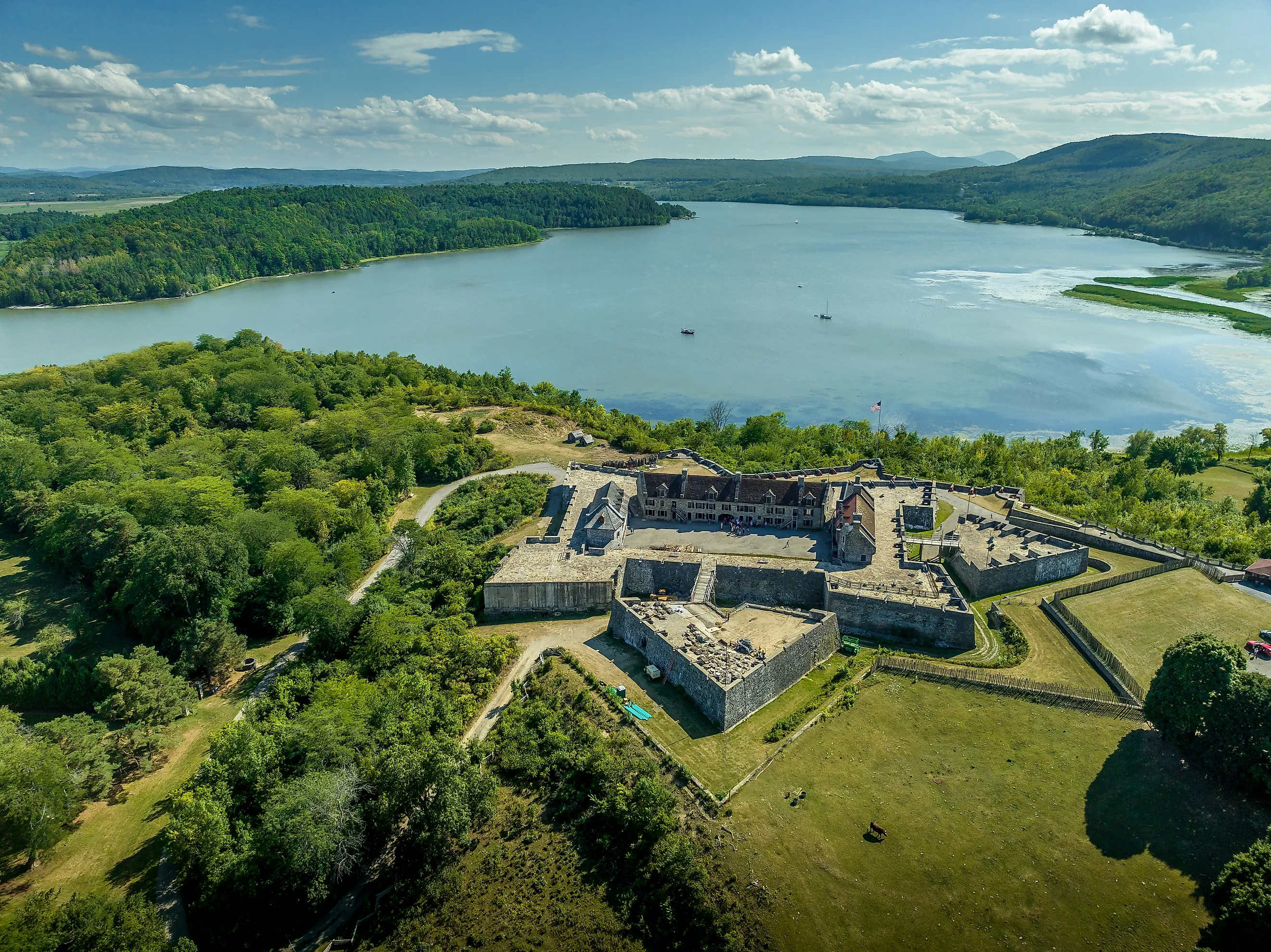
Fort Ticonderoga, originally the French Fort Carillon, sits on a peninsula between Lake George and Lake Champlain, the strategic corridor that ran from New York Harbor to the Saint Lawrence River. The French built the four-bastion star fort between October 1755 and 1757 under Canadian engineer Michel Chartier de Lotbinière. In the 1758 Battle of Carillon, 4,000 French defenders under the Marquis de Montcalm repelled an attacking force of 16,000 British and provincial troops under General James Abercromby, the bloodiest battle fought in North America before the Civil War. The British took the fort under General Jeffrey Amherst the following year. On the night of May 10, 1775, Ethan Allen and Benedict Arnold's Green Mountain Boys crossed Lake Champlain in the dark and took the British garrison without firing a shot, the Continental Army's first significant offensive of the Revolutionary War. That winter, Henry Knox dragged the fort's artillery roughly 300 miles overland to Boston in his "Noble Train of Artillery," an operation that broke the British siege of the city the following March.
The fort sits today on a 2,000-acre property run by a private nonprofit founded by the Pell family in 1909 after they restored the ruined structures. The museum holds the largest 18th-century artillery collection in North America, plus reconstructed soldiers' barracks, a powder magazine rebuilt in 2008 from the 1755 plans, and the King's Garden first laid out by French soldiers. The 250th-anniversary commemoration of the May 1775 capture began in 2025 and continues through 2027 with expanded exhibits and programs. The Carillon boat tour runs 75-minute narrated cruises on Lake Champlain throughout the May-October season, with sonar imagery of several of the lake's shipwrecks visible from the deck.
Fort Stanwix

Fort Stanwix sat at the Oneida Carry, the mile-long portage between the Mohawk River and Wood Creek where travelers had to drag their boats out of the water and across to reach the Oswego River system and Lake Ontario. The British built the original earthen-and-timber fort in 1758 during the French and Indian War. American Continental troops re-occupied and rebuilt the fort in 1776 under Colonel Peter Gansevoort. In August 1777, a British force under Brigadier General Barry St. Leger laid siege to the post as the northern wing of a coordinated three-pronged campaign meant to split New England from the rest of the colonies. Gansevoort's garrison held for 21 days. The siege broke when Benedict Arnold marched a relief column from the Mohawk Valley and used a deception campaign through Hon Yost Schuyler to convince St. Leger's Indigenous auxiliaries that a much larger American army was approaching; St. Leger withdrew. The diversion of British strength contributed materially to the surrender of General John Burgoyne's main column at Saratoga two months later, the strategic turning point of the war.
The reconstructed fort in downtown Rome, New York, is run by the National Park Service as Fort Stanwix National Monument. The original earthworks and timber stockade were lost long ago; the present structure is a faithful 1976 reconstruction built from the original British survey plans. The visitor center runs orientation films and exhibits, costumed living-history programs through the warm months, and a Junior Ranger program for children. The fort still carries the nickname it earned in 1777: the Fort That Never Surrendered.
Fort William Henry

Fort William Henry stood at the southern end of Lake George, built by the British in 1755 as the southern anchor of the Lake George-Lake Champlain corridor. The Marquis de Montcalm laid siege to the fort in August 1757 with a French and Indigenous-allied force of more than 6,000, against a British garrison under Lieutenant Colonel George Monro of about 2,300. French cannon fire flattened the wooden walls inside a week, and Monro surrendered on August 9 under terms granting his troops safe passage out. As the British withdrew the next morning, Indigenous allies of the French attacked the column in what came to be known as the Fort William Henry massacre, killing or capturing several hundred British and provincial soldiers. James Fenimore Cooper drew the central plot of The Last of the Mohicans (1826) from this episode, fixing it in American memory.
The French burned the fort to the ground after taking it. The site sat as a ruin for nearly two centuries before a private group rebuilt the fort in the early 1950s as a museum, opening to the public in 1953. The reconstruction follows the 1755 plans on roughly the original footprint. Through the season, the site runs musket and cannon firings, ranger and sutler interpretation, and an evening haunted-history tour that draws on the post-massacre legends.
Fort Montgomery

Fort Montgomery sat on the bluffs of the Hudson Highlands, on the west bank of the Hudson River, built by the Continental Army in 1776 to anchor a great iron chain that the Americans stretched across the river to block Royal Navy warships from sailing north. The British attacked on October 6, 1777, but not from the water. Sir Henry Clinton landed troops at Stony Point downriver, marched them inland through the woods, and approached Fort Montgomery and the smaller Fort Clinton from the rear. The American garrisons of about 600 troops were outnumbered roughly five to one. The fight came down to bayonets, knives, and hand-to-hand close quarters as the British took the walls. American commander General George Clinton (the future first governor of New York and fourth Vice President of the United States) escaped into the woods. The British destroyed the fortifications before withdrawing, and the iron chain was lifted from the river. A new chain was reset further north at West Point the following spring.
The fort site sits today in the Town of Highlands as a 14-acre New York State historic site with stone foundations, a museum overlooking the river, and original artifacts from the 1777 battle. Trails connect the foundation remains and interpretive panels along the route the British took up from the river. The visitor center runs living-history demonstrations and seasonal programs.
Fort Ontario

Fort Ontario stands on a bluff above the mouth of the Oswego River on the south shore of Lake Ontario, built by the British in 1755 as the northern anchor of a chain of forts running south to the Hudson River. The post changed hands three times in its first century. The original wood structure was burned by the French in 1756. A second fort was destroyed by the British themselves during the Revolution. The present star-shaped masonry fort was built between 1839 and 1844. The post stayed active in some form into 1944, when the US Army turned it over to the War Refugee Board. The Board converted it into the Fort Ontario Emergency Refugee Shelter, the only emergency refugee shelter the United States operated for Holocaust victims during World War II. From August 1944 through February 1946, 982 refugees lived inside the fort (912 of them Jewish, the others Catholic, Protestant, and Greek and Russian Orthodox); they had been brought from a transit camp in Bari, Italy, on the SS Henry Gibbins. The fort was decommissioned for the last time after the war and turned over to New York State for a state park in 1949.
Fort Ontario today operates as both a state historic site and home to the Safe Haven Holocaust Refugee Shelter Museum, which preserves the refugees' story through original photographs, oral histories, and the original camp records. The fort buildings are open for self-guided walking tours through the powder magazine, officers' quarters, and barracks, with seasonal living-history demonstrations. The post burial ground from the early 19th century includes the grave of Corporal John Fykes; local legend holds that anyone who steps on Fykes's grave will be haunted by him until they jump back over it and pass the haunting on to someone else.
Experience Living History In New York
The six surviving forts above hold the geography of the colonial Northeast in working condition: original 18th-century buildings, faithful reconstructions on the original ground, and the same lake narrows, river bends, and carrying places that decided which empire ran the interior. They are operated today by the National Park Service, New York State, and private nonprofits, all open to the public seasonally. A long weekend with a good map can cover three or four of them, and the historical interpretation at each is current enough that the soldiers' lives, the Indigenous diplomacy, and the strategic logic come through clearly without a textbook.