8 Must-See Historic Forts In The United States
From centuries of occupation by European forces to armed struggle between colonial powers to the long history of the Indigenous peoples of America, the United States is rich in military history. Western expansion and coastal defences have necessitated building forts throughout the United States, both by American forces and by the French, British, and Spanish. The forts themselves fulfilled many functions, for trading, refuge for settlers, and military checkpoints. Whether from small squirmishes or large-scale conflicts such as the Revolutionary War, the War of 1812, or the Civil War, forts mark the history of the United States. Luckily, many have been preserved and are open to the public, sometimes with museums or reenactments, but always as a way to educate and commemorate those who came before.
Castillo de San Marcos National Monument (St. Augustine, Florida)

Built by the Spanish in the 17th century, this is the oldest masonry fort in the United States. It was built from coquina, a sedimentary rock made almost entirely from fossil shell fragments. Built between 1672 and 1695 when Florida was a Spanish colony, it was constructed to protect Spanish Florida and the Atlantic trade routes. In its over-450 years of existence, Castillo de San Marcos was never taken by force.
An important example of a 17th-century Spanish Vauban fortress, it is star-shaped with four bastions to eliminate blind spots. The coquina walls were able to absorb or deflect cannon fire. The fort was exceptionally durable. Over the centuries, the fort passed through Spanish, British, and finally American control. It is now a tourist attraction, bringing history alive through demonstrations and exhibits, preserving Florida’s colonial history and its artifacts. The Castillo de San Marcos National Monument has been recognized as a National Park Service site since 1933.
Fort McHenry National Monument And Historic Shrine (Baltimore, Maryland)

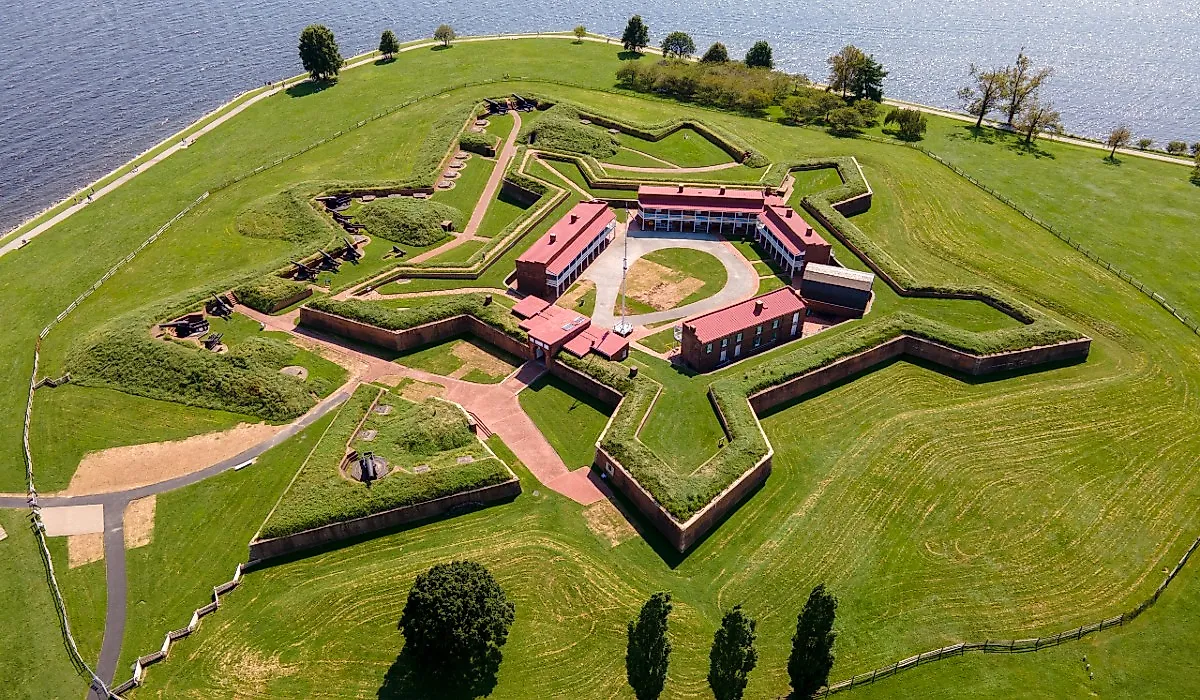
This star-shaped fort on the Baltimore Harbor is most famous for inspiring “The Star-Spangled Banner”. In 1814, during the War of 1812, the Battle of Baltimore took place. The successful defense against the British navy helped to preserve this crucial harbor. The British were forced to abandon their attack on Baltimore, something that historians say was a turning point in the war.
The fort was completed in 1800 and was an active military post for over 100 years. With its five-pointed star design, 360-degrees of defense was possible. During the Civil War, Fort McHenry served as a prison for Confederate sympathizers. The Fort McHenry National Monument and Historic Shrine is managed by the National Park Service, and visitors can see the fort and watch reenactments like cannon firings.
Fort Ticonderoga (Ticonderoga, New York)

This 18th-century star-shaped fort was of strategic importance for control of a narrow point between Lake Champlain and Lake George. It was a crucial part of both the French and Indian War and the American Revolution. The British controlled the Hudson River Valley, while both the French and the British controlled the St. Lawrence River Valley. Built by the French in 1755, it was originally called Fort Carillon and was the site of the 1758 Battle of Carillon during the French and Indian War.
The British took the fort, and during the Revolutionary War, it controlled movement between Canada and the American colonies. In 1775, it was captured by American forces led by Ethan Allen and Benedict Arnold and provided the Americans with some much-needed heavy artillery. The fort’s cannons were transported across frozen rivers in the winter of 1775-1776, enabling the Continental Army to force the British out of Boston in March 1776. Today, the fort is an education center and museum and is the center of over 2,000 acres of preserved historic landscape.
Fort Sumter And Fort Moultrie National Historical Park (Charleston, South Carolina)

Fort Sumter is noted in history as the site where the Civil War began. South Carolina militia forces fired the first shots at Fort Sumter on April 12, 1861, and the fort became a symbol of that brutal and costly conflict. Fort Moultrie, which shares the national historical park with Fort Sumter, was a key fortification for the Revolutionary War. The original palmetto log fort defended Charleston against the British navy. On June 28, 1776, it was the site of a crucial American victory over the British.
With the beginning of the armed conflict in 1861, Fort Sumter came under Confederate control, where it remained for most of the war. Today, the Fort Sumter and Fort Moultrie National Historical Park showcases the evolution of coastal defenses from the Revolutionary War through World War II. Fort Sumter was rearmed when the US entered WWII, with guns ready to defend Charleston Harbor. That attack never came, and it was decommissioned in 1948. The museum houses over 60,000 artifacts, with a focus on the Civil War, the Confederacy, slavery, and the Reconstruction Era.
Fort Pulaski National Monument (Savannah, Georgia)
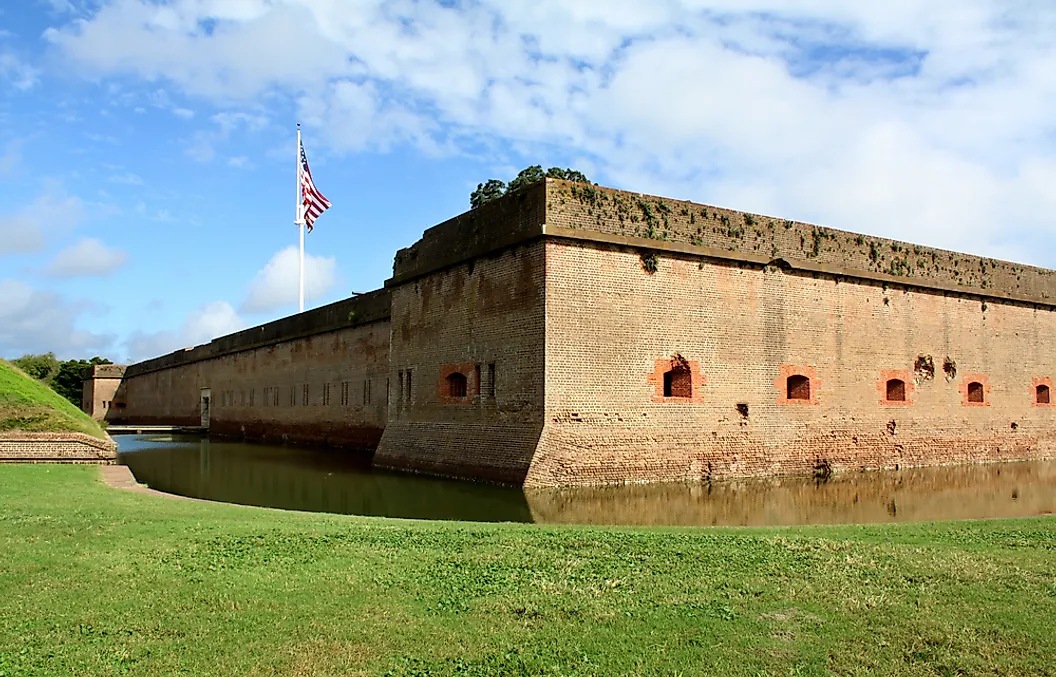
As a part of Civil War history, Fort Pulaski is important, but it is also a landmark of 19th-century military engineering. This marks the shift from masonry forts to earthworks and eventually concrete. A new type of cannon was introduced, the rifled cannon, which had a longer range and was more accurate. It also volleyed a heavier shot. Starting on April 11, 1863, Union troops bombarded Fort Pulaski for 30 hours, forcing Confederate troops in the fort to surrender. Massive brick fortifications were now obsolete.
With the gain of Fort Pulaski, Union troops were able to close the port of Savannah, tightening the blockade. The fort served as a refuge for formerly enslaved people. Despite the damage from the Union barrage, the fort and its over 25 million bricks were preserved. The Fort Pulaski National Monument preserves the fort and the surrounding salt marsh and maritime forests and is managed by the National Park Service.
Fort Monroe National Monument (Hampton, Virginia)

Dubbed "Freedom’s Fortress," Fort Monroe was a crucial refuge for escaping enslaved people during the Civil War. It was the largest stone fort in the United States, and it was an important stronghold for the Union. Union General Benjamin Butler declared all escaping enslaved people who sought refuge at Fort Monroe as "contraband of war" and refused to return them to slaveholders. Over 10,000 former slaves were able to seek shelter, and therefore freedom, at the fort. The site of the fort is also significant: the fort stood at the very location where enslaved Africans were brought to the Virginia Colony.
The fort was built between 1819 and 1834, built in stone to defend Chesapeake Bay. The Fort Monroe National Monument was designated in 2011 as a National Monument by President Barack Obama. The site protects acres, including the fort, the Casemate Museum, and surrounding historic areas. The Algernourne Oak, which is approximately 500 years old, is located at the monument site.
Fort Apache Historic Park (Fort Apache, Arizona)

This 288-acre National Historic Landmark preserves over 30 buildings from between 1870 and 1930, dubbed the Apache Wars era. The intersection of histories here is crucial to understanding the complex story of Western Expansion, and the site provides an understanding of US military history, Apache culture, and federal policies of forced assimilation. Adjacent to the Fort Apache Historic Park is the Theodore Roosevelt Indian Boarding School, a part of the assimilationist drive.
Completed in 1871, the fort was an important base of operations during the Apache Wars. The historic buildings on the site include General Crook's Cabin, from 1871. The Fort Apache Historic Park is home to the White Mountain Apache Cultural Center (Nohwike' Bágowa), a hub for education on Apache history and heritage. Within the center are museums and archives, while nearby are the prehistoric Kinishba Ruins, also managed by the park. The entire site is managed by the White Mountain Apache Tribe.
Fort Necessity National Battlefield (Farmington, Pennsylvania)

Fort Necessity is a historically important site as the location of an early battle of the French and Indian War (1754-1763). It is also the place where George Washington surrendered for the first and last time. This was the escalation of a regional conflict into the Seven Years' War, a global conflict, and a major power shift in North America from France to Britain. In 1754 at Great Meadows, the war between Britain and France began over the control of the Ohio Valley.
On July 4, 1754, a 22-year-old Washington surrendered to French forces, a pivotal moment in his early military career. The opening battle is what ultimately triggers the Seven Years’ War, with power shifting to the British, setting the stage for the American Revolution. A 1953 excavation of the site allowed for a reconstruction of the original palisade. The battlefield site also features the historic Mount Washington Tavern and Jumonville Glen, the site of the initial fight that led to the construction of Fort Necessity. The battlefield site is managed by the National Park Service, with educational resources for understanding the colonial period leading up to the American Revolution.
History Comes Alive In These Memorials
Hundreds of forts were built across what is now the United States over the centuries. Many have long gone, abandoned, and disappeared as nature reclaimed the land. Others stand in ruins, but many have been restored and are open to the public to teach history and commemorate those figures of the past who helped shape the country. Forts can be found in any part of the nation, including islands off the Atlantic and Pacific Coasts, and from any period of European colonization and the founding of the United States.