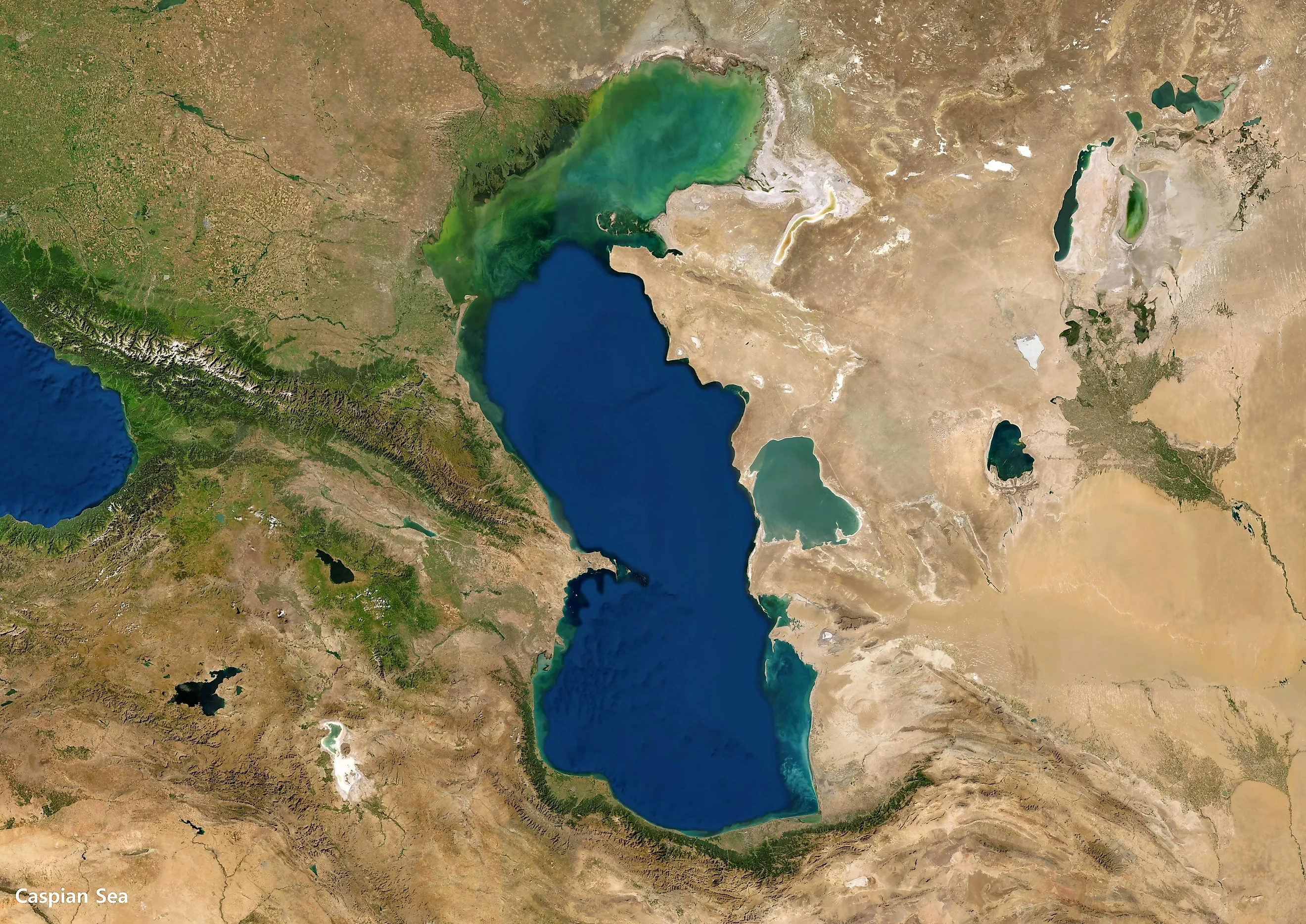
Every Country That Borders The Caspian Sea
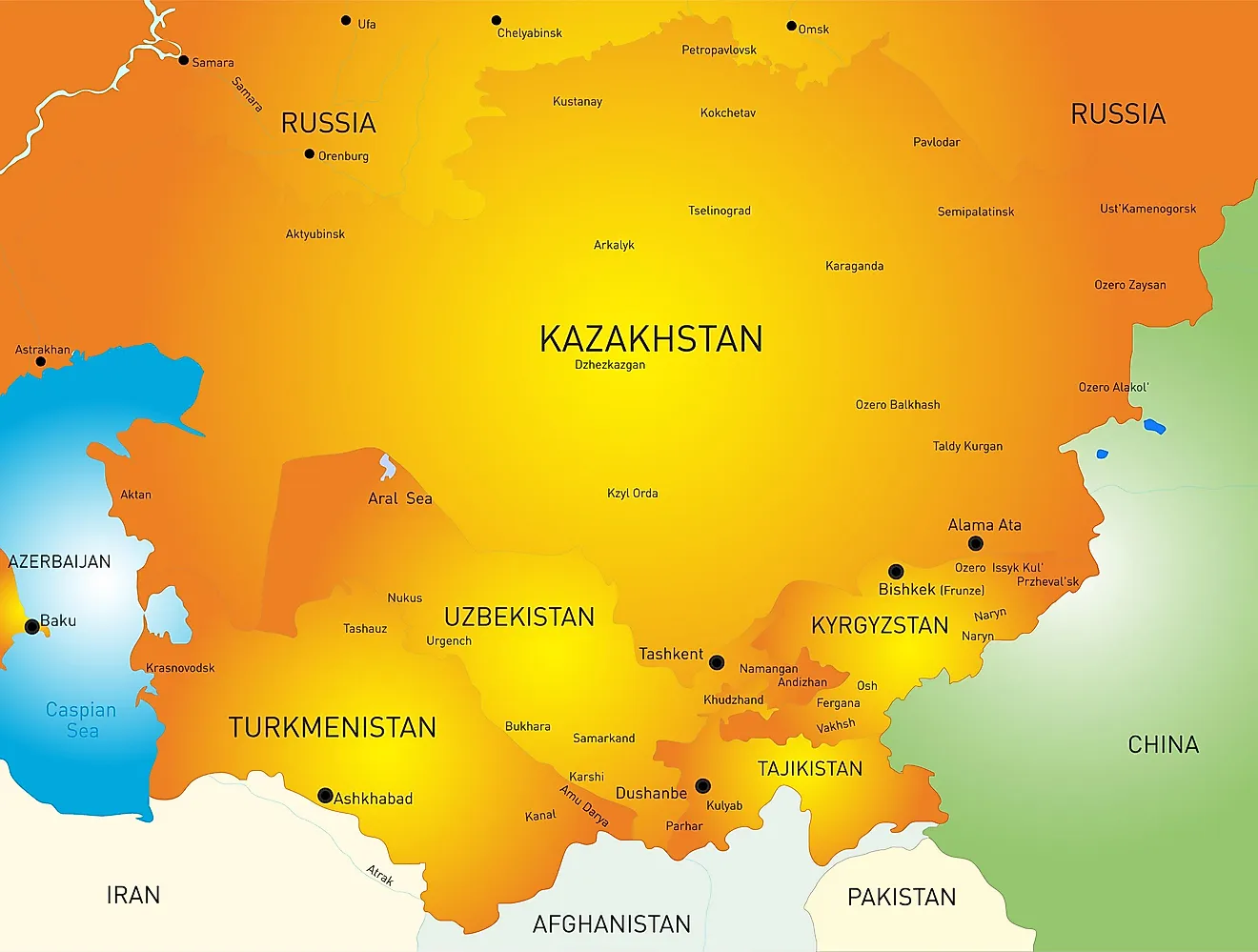
Every country that borders the Caspian Sea shares a shoreline that sits roughly 28 meters below global sea level. The sea stretches roughly 1,200 kilometers along its north-south axis across the boundary between Europe and Asia, spanning about 371,000 square kilometers. The basin divides into three distinct regions: the extremely shallow Northern Caspian, which averages only five to six meters deep; the Middle Caspian, which drops to an average depth of 190 meters; and the Southern Caspian, which reaches 1,025 meters at its deepest point. The Volga River, Europe's longest river, drains into the northern end of the sea and provides roughly 80% of the sea's freshwater inflow.
Kazakhstan holds the longest stretch of the coastline, followed by Turkmenistan, Azerbaijan, Iran, and Russia. The total shoreline, including islands, runs approximately 7,000 kilometers. In August 2018, these five states signed the Convention on the Legal Status of the Caspian Sea, a treaty that created a unique legal framework for the basin. The sea also sits atop one of the world's largest concentrations of untapped oil and gas reserves, making the pipelines and ports along its shores critical pieces of global energy infrastructure.
Kazakhstan

Kazakhstan claims the longest Caspian coastline of any littoral state, with approximately 2,320 kilometers of shore along the northeastern and eastern basin. The terrain here is flat, desolate steppe that often sits at or below sea level. Aktau serves as the country's primary Caspian gateway. Founded in 1961 as a settlement for uranium geologists and expanded with its first seaport phase in 1967, the city hosted the Fifth Caspian Summit in August 2018, where the five presidents signed the Convention on the Legal Status of the Caspian Sea.
Kazakhstan's economy depends heavily on Caspian hydrocarbons. The Tengiz, Karachaganak, and Kashagan fields account for the bulk of national oil production. Kazakhstan has signed seabed delimitation agreements with Russia, Azerbaijan, and Turkmenistan. Its Caspian boundaries are comparatively settled, while the most persistent unresolved delimitation issues lie farther south, especially where Iranian, Azerbaijani, and Turkmen claims have overlapped. Through the Caspian Pipeline Consortium, Kazakhstan transports the majority of its oil exports across the sea's northern reach to the Black Sea port of Novorossiysk. The pipeline spans 1,511 kilometers and carried around 63 million tons of Kazakh crude in 2025.
Russia

The northwestern Caspian shore belongs to Russia, where the Volga River delta, Europe's largest inland delta, dominates the landscape and empties into the shallow Northern Caspian. The historic city of Astrakhan sits at the mouth of the delta and serves as Russia's primary southern port for Caspian shipping. Further south, the coastline extends through Dagestan and Kalmykia, where the terrain shifts to arid steppe.
Moscow maintains the most powerful Caspian naval flotilla, based in Kaspiysk, Dagestan. The Russian State Duma adopted the Convention on the Legal Status of the Caspian Sea on September 19, 2019, and President Vladimir Putin signed the federal ratification into law on October 1, 2019. Russia has used the treaty's military restrictions to block outside powers, particularly NATO, from establishing a Caspian naval presence. The country has also signed bilateral seabed agreements with Kazakhstan and Azerbaijan, leaving only the southern waters as the primary zone of unresolved contention.
Azerbaijan

Azerbaijan has approximately 813 to 955 kilometers of western coastline, including the Absheron Peninsula, where the capital is located. Baku is the largest city on the Caspian Sea, with a metropolitan population exceeding 2 million. The city has anchored the region's petroleum industry since the 19th century, and the State Oil Company of the Azerbaijan Republic continues to operate the bulk of offshore production. The country's lowest point is the Caspian shoreline itself, at 28 meters below sea level.
In 1994, Azerbaijan signed the Contract of the Century to develop the Azeri-Chirag-Gunashli fields. The country now serves as the western anchor for the Southern Gas Corridor, a network of pipelines that delivers Caspian gas to Turkey and Europe. Azerbaijan ratified the 2018 Convention on February 22, 2019, and has signed seabed delimitation agreements with Kazakhstan and Russia. In 2021, a dispute with Turkmenistan over the Serdar/Kapaz field in the southern Caspian found some resolution in a joint development agreement, which renamed the field Dostluk.
Turkmenistan

Southeastern Caspian shores mark Turkmenistan's approximately 1,035 to 1,200-kilometer coastline, characterized by indented limestone shores and the Garabogaz Bay inlet. The terrain here is predominantly desert, with the Garagum Desert occupying the interior. Turkmenbashi, formerly Krasnovodsk, serves as the country's principal port. Established in 1896, the city now handles freight, oil products, containers, and passenger ferries to Baku and Astrakhan.
Turkmenistan holds massive gas reserves, particularly at the Galkynush field, and has sought export routes that bypass Russia. The country ratified the Convention on the Legal Status of the Caspian Sea on December 12, 2018, making it the first of the five littoral states to do so. The early ratification signaled Ashgabat's openness to trans-Caspian pipeline projects, though the country has since prioritized Chinese markets through the Central Asia-China pipeline.
Iran

The southern Caspian coast stretches across 728 to 900 kilometers of Iranian territory, backed by the Alborz Mountains, which rise steeply from the shore. The coastline is comparatively smooth, cut by the Anzali Lagoon in the west and Gorgan Bay in the east. Bandar Anzali serves as the country's principal Caspian harbor. Located in Gilan province, about 40 minutes from Rasht, the port dates to the Qajar period, when it was known as Enzeli and functioned as a semi-official Russian commercial enclave with regular steamship connections to Baku and Astrakhan.
As of May 2026, Iran remains the only littoral state that has not ratified the 2018 Convention. Conservative parliamentarians have criticized the treaty for reducing Iran's effective share from the 50-50 division it held with the Soviet Union under the 1921 and 1940 treaties to roughly 11 to 13% of the Caspian. Iranian officials, including former Foreign Minister Mohammad Javad Zarif, have tied ratification to the resolution of seabed delimitation in the southern Caspian, where Iran, Azerbaijan, and Turkmenistan converge.
The 2018 Convention on the Legal Status of the Caspian Sea

The Convention on the Legal Status of the Caspian Sea created a sui generis framework that is neither fully sea nor lake. The five presidents signed the treaty on August 12, 2018, in Aktau, Kazakhstan, after more than two decades of post-Soviet negotiation. The agreement establishes 15-nautical-mile territorial waters and an adjacent 10-nautical-mile exclusive fishing zone for each state. Beyond these belts, the surface waters remain open to all littoral states for navigation. The seabed and subsoil, however, are subject to bilateral and multilateral agreements between the states rather than automatic division.
Article 14 of the Convention removed a critical legal obstacle to energy infrastructure by requiring agreement only between the countries whose sectors a pipeline crosses, eliminating the need for unanimous consent from all five states. The treaty also bars non-littoral states from deploying armed forces in the Caspian and forbids any party from allowing its territory to be used for aggression against another littoral state.
As of May 2026, four of the five states have ratified the Convention. Turkmenistan ratified on December 12, 2018; Kazakhstan on February 8, 2019; Azerbaijan on February 22, 2019; and Russia on October 1, 2019. Iran has not ratified, and Russian Foreign Minister Sergey Lavrov stated in December 2025 that Moscow expects Tehran to do so before the next Caspian summit, scheduled for August 2026.
Energy Infrastructure

Two major pipeline systems dominate Caspian energy flows. The Caspian Pipeline Consortium operates a line from the Tengiz field in western Kazakhstan to the Novorossiysk marine terminal on the Black Sea. The pipeline spans 1,511 kilometers and carries more than two-thirds of Kazakhstan's oil exports. In 2025, it transported approximately 70.52 million tons total, of which 63 million tons were Kazakh crude. Ownership is divided among Russian state entities, Kazakhstan's KazMunayGas, Chevron, and other Western shareholders. The US Treasury has issued general licenses authorizing transactions involving the pipeline despite sanctions on Russian oil companies, recognizing the line as critical international infrastructure.
The consortium has faced severe disruptions. Ukrainian drone attacks damaged the Novorossiysk terminal on November 29, 2025, and again in January 2026. Severe winter storms on December 29 and 30, 2025, forced a complete operational suspension.
The proposed Trans-Caspian Pipeline would carry Turkmen gas across the Caspian seabed to Azerbaijan, where it would connect to the Southern Gas Corridor for delivery to Turkey and Europe. Initial capacity estimates run to 30 billion cubic meters per year, with a projected cost of approximately $12 billion. The EU designated it a Project of Common Interest in 2013. And yet, construction has not begun. An Iran swap arrangement that moved Turkmen gas to Azerbaijan and Turkey collapsed in 2025 after US and EU sanctions on Iran disrupted the mechanism. On April 24, 2026, Turkish Energy Minister Alparslan Bayraktar called for urgent international discussions on the project after Iranian gas supplies to Turkey ceased.
What the Convention Left Open

The 2018 agreement clarified surface navigation and fishing rights but deliberately deferred the hardest question: seabed delimitation for hydrocarbon extraction. The southern Caspian, where Azerbaijan, Iran, and Turkmenistan converge, remains partly undelimited. The former Serdar/Kapaz dispute blocked Azerbaijan-Turkmenistan cooperation for decades before a 2021 joint development agreement renamed the field Dostluk, though broader southern Caspian delimitation questions remain sensitive.
Environmental governance also remains underdeveloped. The five states signed the separate Tehran Convention in 2003 for marine environmental protection, but its protocols on biodiversity and environmental impact assessment have not been fully ratified. The Caspian faces falling water levels, pollution from upstream dams on the Volga, and declining sturgeon populations. These issues require coordinated management that the 2018 Convention's framework does not directly address.
Five Nations, One Sea
Five countries share the Caspian Sea, but the basin operates as a single system. Ice sheets, desert, and mountain slopes ignore the borders drawn across the shoreline, and the oil and gas beneath the seabed connect the economies of all five states. The August 2018 Convention established rules for navigation, fishing, and military access, yet the questions of who drills where, who builds pipelines where, and who protects the sturgeon remain open. Until Iran ratifies, the treaty cannot formally enter into force, though the four ratifying states already apply its provisions in practice. The August 2026 summit in Tehran will test whether the fifth signature finally becomes a fifth ratification.