What Are The Origins Of The Names Arctic And Antarctica?
The names Arctic and Antarctica describe two of the least populated regions on Earth, and both come from a single Greek word. Arktos (ἄρκτος) means "bear," and through ancient Greek geography it became the name for the far north. Antarctica's name simply inverts it: the Greek prefix ant- (a variant of anti-, "opposite") combines with arktikos to yield "opposite the bear," or the region farthest from the northern sky's bear constellation.
Though scientists have spent more than a century studying both regions, the etymology of their names still ties them back to the stargazers of ancient Greece.
Where The Names Came From
The Bear In The Sky

The Greek word arktos referred both to the animal and to the constellation Ursa Major, the Great Bear, which dominates the northern sky and was the most familiar circumpolar constellation in the ancient Mediterranean. From arktos came the adjective arktikos, meaning "of the bear" or "of the north," which entered Latin as arcticus and eventually English as Arctic. The connection is also preserved in the name of the star Arcturus, from the Greek Arktouros, meaning "guardian of the bear." Arcturus is the brightest star in the constellation Boötes and the fourth-brightest in the night sky, and it appears to follow Ursa Major across the heavens, which is how it earned the name. Arcturus is sometimes confused with Polaris, but the two are different stars: Polaris is the present-day North Star, located in Ursa Minor (the Little Bear), while Arcturus sits in Boötes and is not a pole star.
In Greek mythology, the constellation itself comes from the story of the nymph Callisto, who was transformed into a bear and placed in the sky by Zeus. Her son Arcas, also turned into a bear, became Ursa Minor. Whatever the precise mythological origin, the bear association explains why a region defined by ice and snow ended up named for an animal: the Arctic was simply the part of the world that lay beneath the Bear.
Antarctica - The Land With No Bears

The Greek geographer Marinus of Tyre used the term antarktikos in the second century AD, and the Roman writer Pomponius Mela referred to a southern landmass in similar language. The word literally means "opposite to the Arctic," and by the time European mapmakers were charting the unknown southern continent in the 16th and 17th centuries, the name was already attached to the idea of a southern polar region. The literal reading "opposite the bear" turns out to be accurate in a different way as well: there are no bears native to Antarctica, and there never have been. Polar bears live only in the north.
Discovery Of The Arctic And Antarctic

The earliest recorded voyage into Arctic waters belongs to Pytheas of Massalia, a Greek geographer and astronomer from the colony of Massalia (modern Marseille) who sailed north around 325 BC. He circumnavigated parts of the British Isles, reached a place he called Thule (likely Iceland, Norway, or the Shetlands depending on which scholar one trusts), and was the first known writer to describe polar ice, the midnight sun, and the long winter darkness. His original account, On the Ocean, has not survived; what we know of his voyage comes from later writers who often doubted him.
The race to the North Pole came much later. In September 1909, American explorer Frederick A. Cook announced from the Shetland Islands that he and two Inuit companions, Ahwelah and Etukishook, had reached the geographic North Pole on April 21, 1908. Cook said drifting ice and a hard winter had forced his party to shelter on Devon Island for months, delaying his return. Five days after Cook's cable went out, Robert E. Peary announced that he had reached the Pole on April 6, 1909, with his associate Matthew Henson and four Inuit men. The two claims set off a public quarrel that has never been fully settled. Modern analysis of both expeditions' navigation records has cast serious doubt on each claim, and many polar historians now credit the first undisputed surface visit to Roald Amundsen, Oscar Wisting, and the crew of the airship Norge, which flew over the Pole on May 12, 1926.
Antarctica's discovery followed a different path. After Captain James Cook's three voyages from 1772 to 1775 came close to the continent without sighting it, the first confirmed sightings of mainland Antarctica all came in 1820. The Russian expedition under Fabian Gottlieb von Bellingshausen and Mikhail Lazarev saw the coast on January 28, the British naval officer Edward Bransfield sighted Trinity Peninsula on January 30, and the American sealer Nathaniel Palmer reported land in November of the same year. The first claimed landing on the continent was made by American sealing captain John Davis on February 7, 1821, when crew from his ship Cecilia went ashore briefly at Hughes Bay on the west coast of the Antarctic Peninsula. The first landing universally accepted by historians came 74 years later, on January 24, 1895, when a party from the Norwegian whaling ship Antarctic, including Henryk Bull, Carsten Borchgrevink, and Leonard Kristensen, rowed ashore at Cape Adare.
Roald Amundsen and his Norwegian team reached the geographic South Pole on December 14, 1911, beating Robert Falcon Scott's British party by about five weeks. Scott and his four companions died on the return journey. Antarctica has been governed since 1961 by the Antarctic Treaty, which was signed by twelve countries on December 1, 1959, and entered into force on June 23, 1961. The treaty sets the continent aside for peaceful scientific use and prohibits military activity and mineral mining south of 60° south latitude. There are now more than 50 signatory states, and roughly 70 research stations are active across Antarctica, operated by around 30 nations. A 2021 study from the Journal of the Royal Society of New Zealand proposed that Polynesian navigator Hui Te Rangiora may have reached Antarctic waters as early as the 7th century AD, though that interpretation has been challenged by subsequent scholarship and remains contested.
Geography And Climate Of The Two Polar Regions
Oceans And Ice

The two polar regions are mirror images in one respect and opposites in another. The Arctic is an ocean surrounded by land, while Antarctica is a continent surrounded by ocean. The Arctic Ocean covers roughly 5.4 million square miles and is the smallest and shallowest of the world's five oceans, with an average depth of about 3,400 feet and a maximum depth of around 18,200 feet at the Molloy Hole in the Fram Strait. It receives freshwater from a number of major rivers, including Russia's Lena and Ob, and Canada's Mackenzie. A large portion of its surface is covered year-round by sea ice that can exceed six feet in thickness over multi-year floes, though that sea ice extent has been shrinking measurably since satellite records began in 1979.
The Southern Ocean encircles Antarctica and extends from the continental coastline north to the Antarctic Convergence, the marine boundary where cold Antarctic water meets warmer subantarctic waters. Britannica gives its area as 8,479,000 square miles, making it the fourth-largest ocean and around 6 percent of the world ocean surface. Water at the Convergence is significantly colder than the surrounding ocean basins, generally between 28 and 38 degrees Fahrenheit. Antarctica itself is buried under an ice sheet that averages around 1.2 miles thick and contains roughly 60 percent of all the fresh water on Earth. If the entire sheet were to melt, global sea level would rise by about 190 feet.
Temperatures

The Arctic is cold but warmer than its southern counterpart, with winter temperatures averaging around minus 30 to minus 40 degrees Fahrenheit over the central Arctic Ocean. Summer values at the North Pole hover just above freezing. The continental Antarctic interior is far colder. The lowest air temperature ever recorded by a weather station was minus 128.6 degrees Fahrenheit (minus 89.2 degrees Celsius) at Russia's Vostok Station on July 21, 1983. Satellite data published in 2018 by researchers at the National Snow and Ice Data Center identified snow-surface temperatures of minus 144 degrees Fahrenheit (minus 98 degrees Celsius) at several spots on the East Antarctic Plateau, the highest part of the continent, though the air a few feet above the surface is somewhat warmer. The continent's elevation, its proximity to the South Pole, and its highly reflective ice surface all contribute to the extreme cold.
Wildlife

The Arctic supports a substantial range of land mammals as well as marine species. Polar bears are the most carnivorous of all bear species and are typically described as the largest land carnivores on Earth, though large coastal brown bears such as Kodiaks can match their mass. Polar bears hunt seals, primarily ringed seals, from the sea ice through most of the year. When summer ice retreats, they generally fast on land, drawing down fat reserves built up over winter; they may scavenge whale or walrus carcasses or take birds, eggs, or vegetation opportunistically, but those terrestrial foods contribute relatively little to their overall nutrition. Arctic foxes, snowy owls, Arctic hares, lemmings, and several ground squirrel species share the tundra. Migratory caribou, musk oxen, and wolves complete the large-mammal community. The Arctic is also one of the world's most important seabird regions, hosting tens of millions of breeding pairs in summer.

Antarctica is biologically the opposite kind of place. Practically a desert by precipitation (parts of the interior receive less than 50 millimeters of water-equivalent per year), the continent supports only two native vascular plants: Antarctic hair grass (Deschampsia antarctica) and Antarctic pearlwort (Colobanthus quitensis). Annual bluegrass (Poa annua) has been introduced and is non-native. Most other plant-like life consists of mosses, liverworts, lichens, and fungi, with several species of lichen surviving on exposed rock at high elevations.
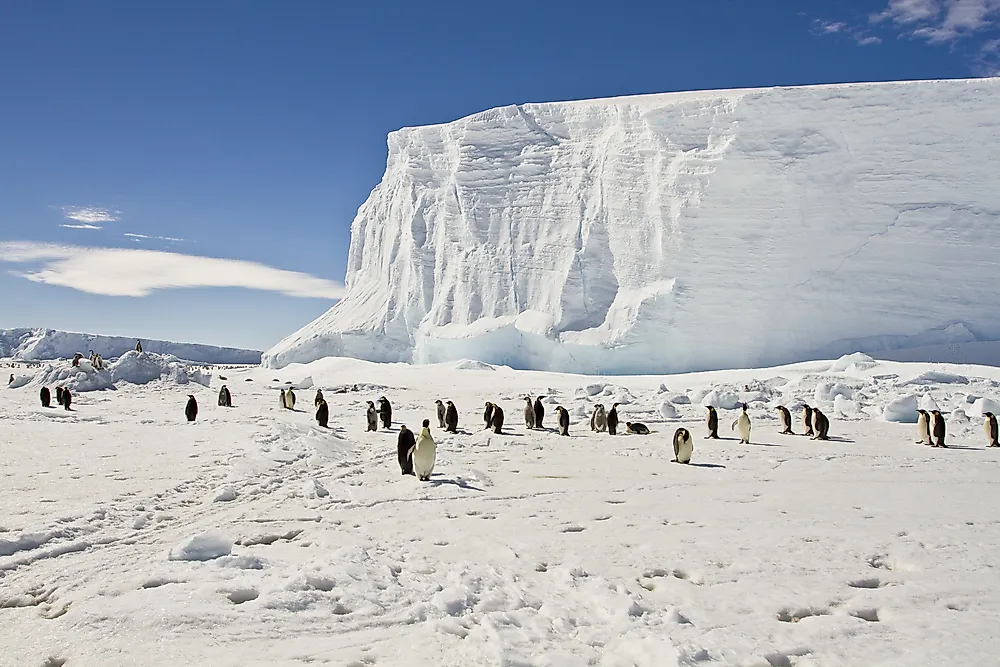
While polar bears do not occur in Antarctica, the Southern Ocean and its sea ice support six species of seal: the Weddell, crabeater, leopard, Ross, southern elephant, and Antarctic fur seal. The crabeater is by far the most numerous, with a population estimated at around 15 million animals, more than any other large mammal in the world apart from humans. Southern elephant seals are the largest of any pinniped: bulls can reach 20 feet in length and weigh up to 8,800 pounds. Weddell seals, which can weigh up to 1,400 pounds, feed on fish, squid, and krill at depths exceeding 1,800 feet. Antarctic waters are also home to several penguin species, including the emperor and Adélie, and to large baleen whales, including humpbacks, minkes, and the blue whale, which feed heavily on Antarctic krill in the summer months.
A Pair Of Polar Opposites
The Arctic and Antarctic are linked by a name that traces back to Greek astronomers, but they are not simply north and south versions of the same place. One is a frozen ocean bordered by inhabited continents; the other is a frozen continent bordered by the deepest oceans on Earth. One has supported human communities for thousands of years; the other has no permanent residents and has only ever hosted scientific stations. Yet the same word for "bear" anchors both names, a reminder that the ancient Greeks were mapping the sky long before anyone could map the regions on the ground.