Which European Countries Are Islands?
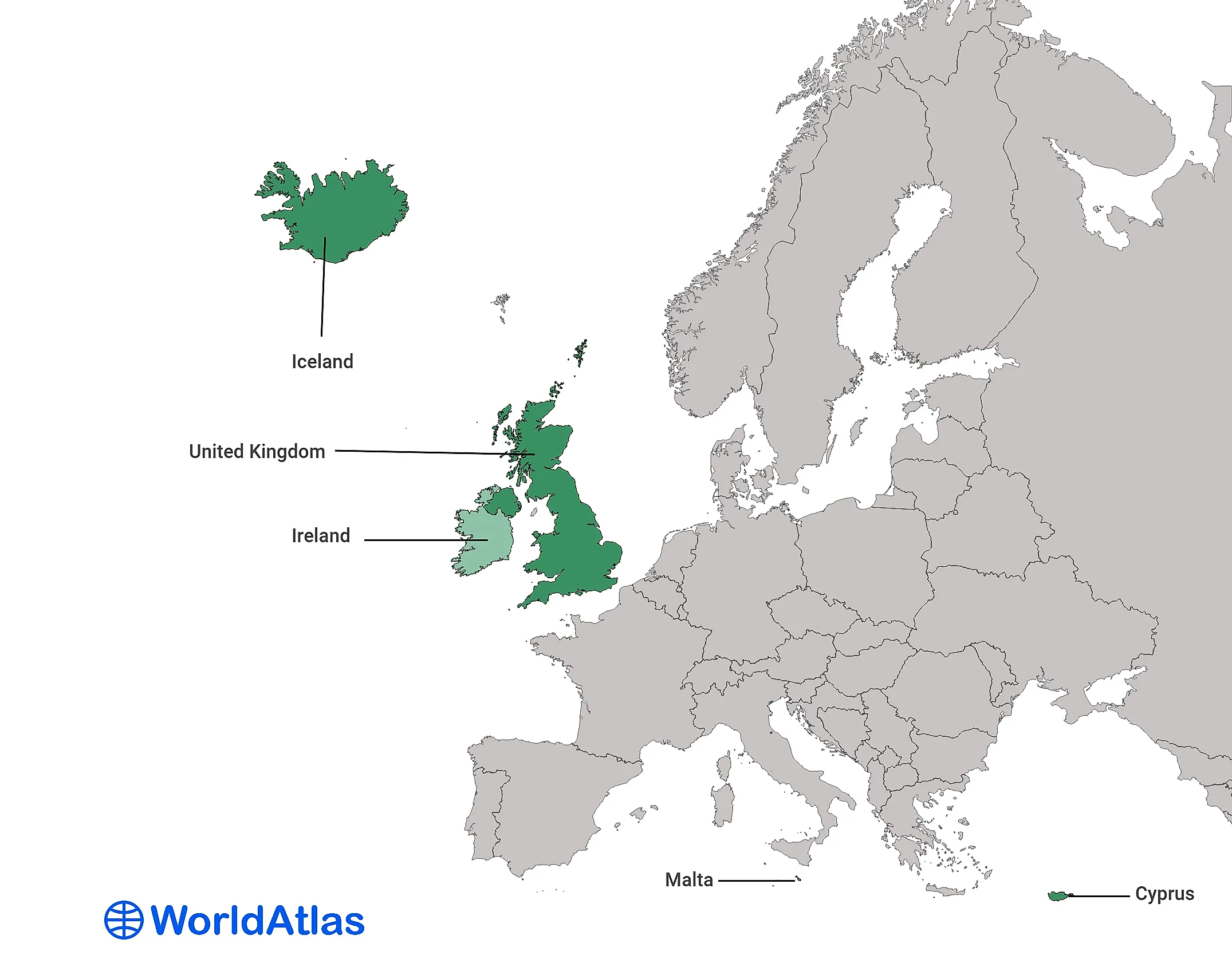
Five of Europe's sovereign states are islands or island groups. Malta at 316 square kilometers is small enough to drive across in 45 minutes, while the United Kingdom at 243,610 square kilometers is roughly 770 times larger. The other three (Cyprus at 9,251 km², Iceland at 103,000 km², and the Republic of Ireland at 70,273 km²) sit between those extremes. Three of the five (Iceland, the United Kingdom, and Ireland) sit in the North Atlantic and are usually classified as Northern European countries, and two (Cyprus and Malta) sit in the Mediterranean and are classified as Southern European. Cyprus sits close enough to the Levantine coast that it is commonly considered a transcontinental country shared between Europe and Asia.
The 5 Island Countries Of Europe
Cyprus

Cyprus is the most populous island in the Mediterranean and the third-largest by area after Sicily and Sardinia. The country covers 9,251 square kilometers, and the whole island has an estimated population of about 1.27 million. Nicosia is the capital and the only national capital in the world that has remained divided by an international demarcation line since 1974, when Turkish forces invaded the northern third of the island. The Republic of Cyprus joined the European Union in 2004 and uses the euro; the self-declared Turkish Republic of Northern Cyprus, which occupies about 36% of the island, is recognized only by Turkey. The Cypriot economy is built on services, tourism, financial services, and shipping, with a GDP per capita of approximately $33,000 nominal (2024).
Iceland

Iceland is the most sparsely populated country in Europe, with about 400,000 people across 103,000 square kilometers (roughly 3.9 people per square kilometer). Reykjavík, the capital, sits on the southwest coast at 64 degrees north latitude and is the world's northernmost capital of a sovereign state. The island sits directly on the Mid-Atlantic Ridge where the North American and Eurasian tectonic plates pull apart, making Iceland one of the most geologically active places on Earth (about 30 active volcanic systems and roughly 200 individual volcanoes have shaped the landscape, with major eruptions every few years). The economy runs on fisheries, geothermal and hydroelectric energy, aluminum smelting (using cheap renewable power), and tourism, with a GDP per capita of approximately $98,000 nominal (2025), among the highest in the world. Iceland is a member of NATO and the European Economic Area but not the European Union, and retains its own currency, the Icelandic króna.
Republic Of Ireland

The Republic of Ireland covers 70,273 square kilometers across 26 of the 32 counties on the island of Ireland; the other six counties form Northern Ireland, which is part of the United Kingdom. The country has a population of approximately 5.4 million, and Dublin is the capital and largest city. Ireland's GDP per capita is approximately $110,000 nominal, one of the highest in the world, although the figure is significantly inflated by US multinational corporations that book European revenue through Irish subsidiaries for tax purposes. The modified gross national income measure (GNI*), which strips out the multinational distortions, puts Irish per-capita income closer to $70,000. The economy is heavily weighted toward technology, pharmaceuticals, and financial services, and Ireland joined what is now the European Union in 1973 and has used the euro since 1999.
Malta

Malta is a Mediterranean archipelago of three inhabited islands (Malta, Gozo, and Comino) plus several uninhabited islets, covering a total of 316 square kilometers. The country has a population of approximately 580,000 and the highest population density of any European country at roughly 1,830 people per square kilometer. Valletta, the capital, has about 6,000 residents in an area of 0.61 square kilometers, making it the smallest national capital in the European Union. Malta sits about 80 kilometers south of Sicily, and its strategic position has produced a layered history of Phoenician, Roman, Arab, Norman, Knights Hospitaller, French, and British rule before independence in 1964. The economy now runs on financial services, tourism, online gaming, and shipping, with a GDP per capita of approximately $42,000 nominal (2024). Malta joined the European Union in 2004 and adopted the euro in 2008.
United Kingdom

The United Kingdom is an island country comprising the island of Great Britain (which contains England, Scotland, and Wales), the northeastern part of the island of Ireland (Northern Ireland), and over 1,000 smaller islands off the European mainland. The UK is the only country on this list with a land border, which it shares with the Republic of Ireland across Northern Ireland. The rest of its boundary is coastline (roughly 12,400 kilometers), one of the longest of any country in Europe. The country has a population of approximately 68 million and a GDP per capita of approximately $52,000 nominal (2024), with London as the capital and largest city. The UK joined what is now the European Union in 1973 and left in January 2020 (the only country to have done so), and now operates under a Trade and Cooperation Agreement with the EU.
Island Countries Of Europe
| Island Country | Total Area (km²) | Total Population (approx.) | Population Density (per km²) |
|---|---|---|---|
| Cyprus | 9,251 | 1,270,000 | 137 |
| Iceland | 103,000 | 400,000 | 3.9 |
| Republic of Ireland | 70,273 | 5,400,000 | 77 |
| Malta | 316 | 580,000 | 1,835 |
| United Kingdom | 243,610 | 68,000,000 | 279 |
What These Five Have In Common
The five island countries of Europe are politically and culturally diverse, but they share a few common patterns. All five are members of the European Union or were (the United Kingdom left in January 2020), and all five use sea-based industries (fishing, shipping, port services, and tourism) as significant parts of their economies. Three of them (Iceland, Ireland, and the UK) sit in the North Atlantic and historically face the open ocean toward the Americas; the other two (Cyprus and Malta) sit in the Mediterranean and have served as strategic stepping stones between Europe, Africa, and Asia for at least three millennia. The population range across the five is unusually wide: about 400,000 in Iceland to roughly 68 million in the UK, a 170-to-1 ratio. The economic profile is also distinctive, with four of the five (Iceland, Ireland, the UK, and Malta) showing GDP per capita above the European average; Ireland's headline figure is the highest by some distance, though it is significantly inflated by the multinational operations headquartered in Dublin for tax purposes.