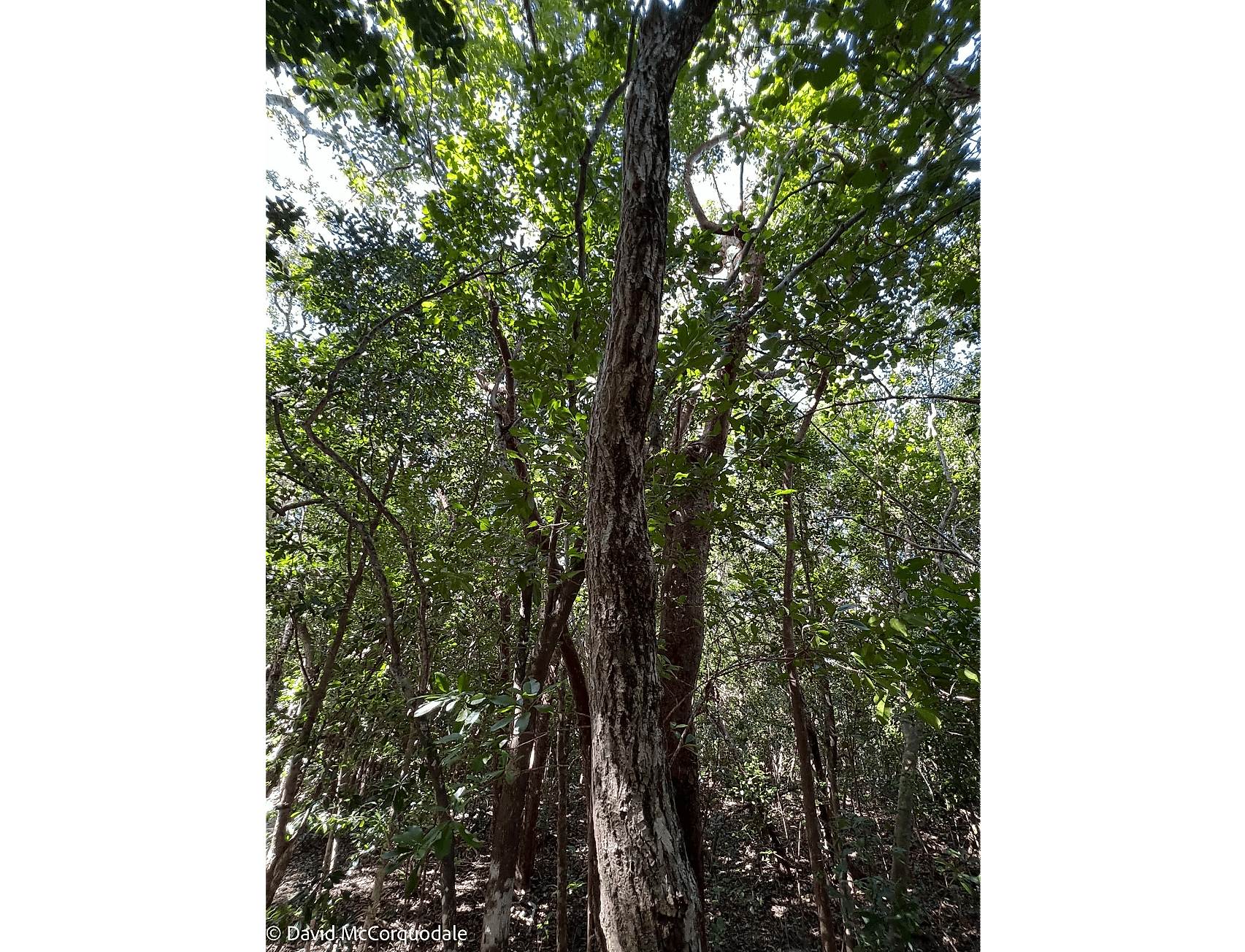
The Heaviest Wood Grown In American Forests
Most wood is light enough to float, but the aptly named black ironwood tree is so dense that it actually sinks in water. Native to the tropical forests of southern Florida, black ironwood (Krugiodendron ferreum) is, in fact, generally considered the heaviest wood produced by any American tree. Its dried timber weighs around 84 pounds per cubic foot (1,355 kg/m³), considerably more than other hardwoods like oak, maple, or hickory. But with its remarkable density, it is also a remarkably slow-growing species that is surprisingly small in stature, rather than the imposing forest giant you might be picturing. Black ironwood has a number of unusual physical properties aside from that, a fairly restricted distribution, and historical uses that further distinguish it from other American hardwoods.
Where Exactly Does Black Ironwood Grow?

In the United States, black ironwood grows naturally in southern Florida, especially Miami-Dade County and the Florida Keys. Its range also extends beyond the country into parts of the Caribbean, Mexico, Central America, and northern South America, where similar climate conditions support its growth.
The tree is mainly associated with tropical hardwood hammocks, dense forests that develop on slightly elevated ground, often over limestone bedrock. These areas have thin, well-drained soils and experience flooding less frequently than surrounding wetlands. As a result, you'll generally see black ironwood grow alongside native species such as gumbo limbo, pigeon plum, satinleaf, and poisonwood, too.
Examples of its typical habitat occur in places like Everglades National Park and the islands of the Florida Keys, including Lignumvitae Key Botanical State Park. It should also be noted that Florida's tropical hardwood hammocks have declined considerably because of human development, making their remaining forests all the more important for preserving a variety of regional trees.
What Makes Black Ironwood So Heavy?
Black ironwood's weight comes from its tightly packed wood fibers and thick cell walls, which leave relatively little empty space within the timber. Its average dried density is around 84 pounds per cubic foot (1,355 kg/m³), compared with roughly 47 pounds per cubic foot (755 kg/m³) for white oak and 33 pounds per cubic foot (530 kg/m³) for Douglas fir, two species that are much more commonly used for construction.
Water has a density of about 62.4 pounds per cubic foot (1,000 kg/m³), meaning black ironwood is substantially denser and will sink rather than float. Even after drying, its timber retains this unusual characteristic.
The same structure that makes black ironwood so heavy, of course, makes it exceptionally hard and resistant to wear. However, this density also makes cutting, shaping, and working the timber difficult. Furthermore, its weight and hardness cause it to be impractical for many ordinary woodworking and construction applications without specialized tools.
The Tree Behind this Tough Timber
Black ironwood is a slow-growing evergreen tree that typically reaches 16-33 feet (5-10 m) tall, although larger specimens do occasionally occur. It has a short trunk, a rounded crown, and smooth, leathery leaves that grow in opposite pairs. When it comes to the bark, it is generally grayish-brown, becoming rougher as the tree matures.
Unlike many familiar hardwoods, black ironwood does not develop large, showy flowers or distinctive seasonal foliage. This tree species instead produces small, greenish-yellow flowers followed by dark, rounded fruits that provide food for birds and other wildlife.
Black ironwood tolerates both drier conditions and occasional flooding, although it grows best in well-drained soil. It also tends to excel at withstanding persistent winds and salt exposure, traits that help it survive in Florida and across other coastal regions.
Historical Uses of Black Ironwood
As you can imagine, black ironwood has historically been valued for its durability, although in its native Florida and the Caribbean, its timber was more so used for small, labor-intensive applications rather than being cut in service of larger construction projects. Traditional uses included tool handles, mallets, wooden posts, and carved ornamental objects. Its strength also shone for certain boat fittings and other components exposed to repeated stress.
Despite these advantages, black ironwood never became a major commercial timber. Its relatively small trunks, sluggish growth, and difficulty of processing limited the amount of usable lumber it could make available. Today, it is more commonly grown as a shade tree, where its evergreen foliage and resistance to coastal conditions have made it a popular choice for landscaping.
Other Exceptionally Heavy American Woods
Black ironwood is not the only American tree that produces metal-like timber. Lignum vitae, one more tropical hardwood native to the Caribbean and South Florida, averages around 79 pounds per cubic foot (1,260 kg/m³) and contains natural oils that make it exceptionally resistant to friction and wear. With that, it was historically used for ship bearings and industrial machinery components.
Another heavyweight is desert ironwood, endemic to the Sonoran Desert of Arizona, California, and northwestern Mexico, which has an average dried weight of 75 pounds per cubic foot (1,210 kg/m³). Its reddish-brown heartwood is similarly valued for decorative woodworking, and its sheer hardness makes it difficult to process as well. Like anything in nature, however, these figures can vary between individual trees and different moisture conditions.
A Unique Species Worth Protecting
Black ironwood demonstrates how unusual some native hardwoods can be. Although its timber is extremely heavy and durable, the tree itself remains relatively unimportant in modern American lumber production. Its greatest significance today lies in Florida's tropical hardwood hammocks, where state and national parklands often protect remaining forests to help preserve this remarkable species and the habitat it depends on.