When Snake Season Actually Ends In Every Southern State
Ask when snake season ends in the South and you will hear a confident answer in every state, usually involving the first frost, a family rule, or a date somebody's grandfather swore by, and nearly all of those answers share one flaw: snakes cannot read a calendar. Snake activity runs on temperature, and the South's temperatures run on a thousand-mile gradient, which means "snake season" closes at wildly different times in Lexington and Lake Charles and, in two famous corners of the region, never closes at all. The honest map of when southern snakes actually stand down runs in climate bands rather than state lines, comes with a counterintuitive October twist, and ends with a rule worth memorizing in every zip code: the season does not end on a date, it ends at a temperature, and it restarts, briefly, on the first warm afternoon that beats it.
The Thermostat Rule

The physiology sets the schedule. Snakes run entirely on borrowed heat, and the practical arithmetic is consistent across species: with daytime highs reliably in the 70s and 80s, snakes are fully in business; in the 60s they work the warm hours; once highs struggle to clear 60 degrees Fahrenheit and nights dip toward frost, surface activity collapses, and the animals withdraw into brumation, the reptile version of winter dormancy, in dens, burrows, stone walls, and whatever deep cover their local housing market provides. What ends snake season anywhere, in other words, is a sustained forecast, not a month.

The thermostat also explains the exceptions in both directions. Cold-tolerant generalists like garter snakes work later into fall and emerge on milder winter days than anything else in the woods, while the aquatic cottonmouth stays in business deep into autumn because the water it hunts cools far more slowly than the air above it. Every "last snake of the year" story in the South is usually one of those two, and neither consulted a calendar either.
October's False Ending
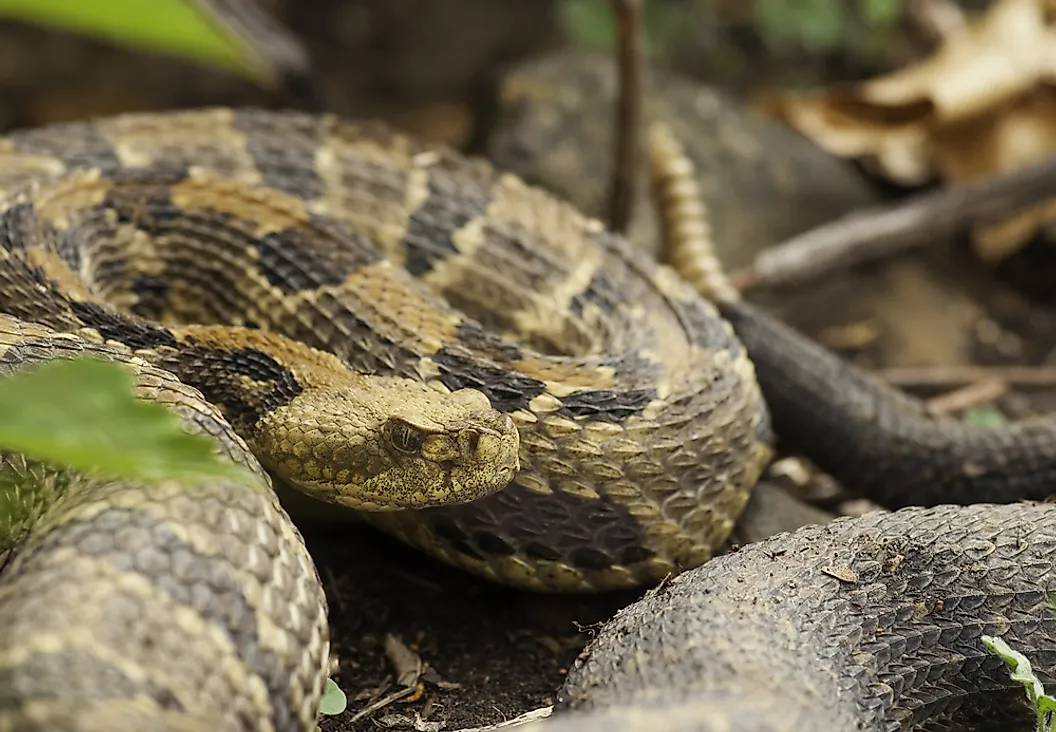
Here is the part the folk calendars get backward: across most of the South, the weeks before snake season ends are its busiest. Fall triggers a surge of movement, with snakes feeding hard to bank fat for the dormant months, late-summer-born juveniles dispersing and hunting their first winter shelter, copperheads and others running a late-season breeding window, and den-faithful species like timber rattlesnakes traveling overland back to ancestral winter dens, journeys that put them across trails, yards, and roads in October numbers that rival May's. Wildlife agencies across the region log a distinct fall bump in snake encounters and calls for exactly this reason.
So the practical translation of "season's ending" is not "guard down" but the opposite: October and early November are prime time for the firewood-pile grab, the leaf-pile surprise, and the snake crossing the driveway at dusk, in venomous-snake country most of all. The season goes out with a rush hour, not a whimper, and the rush is the den commute.
The Upper South: Done By Halloween

The earliest curtain falls along the region's northern tier and its high ground: Kentucky, West Virginia, Virginia, Tennessee, and the Appalachian spines of North Carolina and northern Georgia. First frosts here arrive in October, the mountains sooner than the valleys, and snake activity tapers hard through the month, with the den species, timber rattlesnakes and copperheads above all, largely settled into their rock by late October and the stragglers finished in the first mild days of November. Halloween is the honest folk marker in this zone, and for once the folk marker is roughly right.
The asterisk is altitude's mirror: the same mountains that end the season early also host the South's most tightly packed dens, so the final October weeks concentrate snakes around sunny ledges and south-facing slopes just as the hiking weather peaks. The Upper South's season ends early, but it ends in a crowd.
The Mid-South: The Thanksgiving Taper

The broad middle band, the Carolina and Georgia piedmont, most of Alabama and Mississippi away from the coast, Arkansas, Oklahoma, and northern and central Texas through the Hill Country, runs about a month behind the mountains. Frosts arrive from late October into November, warm afternoons keep interrupting the cold, and snakes here work a stop-start schedule deep into the month, active on the mild days and holed up through the snaps, with the last consistent activity fading around Thanksgiving in a normal year. In Texas especially, a 75-degree November afternoon is routine, and so is the rattlesnake using it.

Brumation in this zone is correspondingly lighter, less a five-month burial than a long series of naps, with many snakes wintering shallow enough to answer any week of false spring. The Thanksgiving taper, in other words, is an average rather than a wall, and mid-South residents doing December yard cleanup in a warm spell should treat the brush pile accordingly.
The Gulf Coast: December At The Earliest

Along the Gulf and lower Atlantic coastal plain, Louisiana, coastal Mississippi and Alabama, south Georgia, Florida's panhandle neighbors, and the South Carolina lowcountry, the season barely pretends to close before December. First frosts hold off until late November or December, the swamps and blackwater rivers stay warm long after the air cools, and cottonmouths, water snakes, and the coastal plain's big rattlesnakes stay on the clock through what the Upper South would call winter, with eastern diamondbacks commuting between basking aprons and the sheltering burrows that serve as their cold-snap insurance.

Even at its deepest, the coastal winter works as a dimmer rather than a switch: a run of hard nights sends everything to shelter, and the next 70-degree week, which every Gulf winter contains, brings the basking snakes back out along sunny edges and canal banks. December through February here is best described as the low season, defined by shorter activity and longer naps, and the only month a Gulf Coast snake has never been seen in is the one that has not happened yet.
Florida And Deep South Texas: It Never Ends

Two corners of the South simply decline the question. Peninsular Florida and the subtropical tip of Texas around the Rio Grande Valley rarely or never freeze, winter days routinely run warm enough for full snake business, and the state agencies in both places say it plainly: snake season is 12 months long, with winter merely shifting activity toward the sunny midday hours instead of the dawn and dusk of summer. In Florida, January hikers meet basking diamondbacks and cruising cottonmouths as a matter of routine, and the peninsula's native snakes share the no-off-season rule with its most famous invader.

Winter does mark these places, just gently: a strong cold front will quiet the landscape for a few days and send the reptiles to cover, and then the subtropics resume. If the question is when snake season actually ends in Florida or deep south Texas, the actual answer, delivered without apology by every herpetologist who works there, is that it does not, and planning around any other answer is how January surprises happen.
The Fine Print Every State Shares

Three clauses apply across every zone on this map, Kentucky down to Key West. First, the warm-day rule: brumating snakes are sleeping lightly, not sealed away, and a winter afternoon in the mid-60s or better can produce a basking snake at a den mouth or sunny wall in any southern state, in any month, which is why "it's winter" has never once been a guarantee. Second, the hands-and-feet rule outlives the season, because dormant snakes winter inside exactly the things people grab in winter, firewood stacks, brush piles, tin, junk, and crawl spaces, so gloves and a look-first habit are December equipment, not just July's. Third, the ending is also a beginning: the same thermostat that shuts the season down reopens it in a rush, with early spring emergence, March in the Gulf states, April in the mountains, ranking with fall as the year's peak for encounters.
And one modern clause is being added in real time: southern winters are measurably warmer and shorter than they were a generation ago, which trims the dormant season at both ends, keeps the Gulf zone's dimmer switch higher, and nudges every boundary in this article slowly north. The folk calendars were approximations when grandfather made them. The thermometer they approximated is now moving.
A Season With Five Endings

So when does snake season actually end in the South? Around Halloween in the Appalachians and the Upper South, around Thanksgiving through the piedmont, the mid-South, and the Texas Hill Country, sometime in December along the Gulf and lowcountry coasts, and never in peninsular Florida or the southern tip of Texas, with every one of those endings written in pencil and subject to the next warm front. The season closes with a rush of den traffic, sleeps with one eye open, and reopens on the first afternoon that clears the thermostat, which is the only rule that has ever really governed it. The snakes do not know it is November, anywhere in snake country. They only know it is 63 degrees and sunny on the rock.