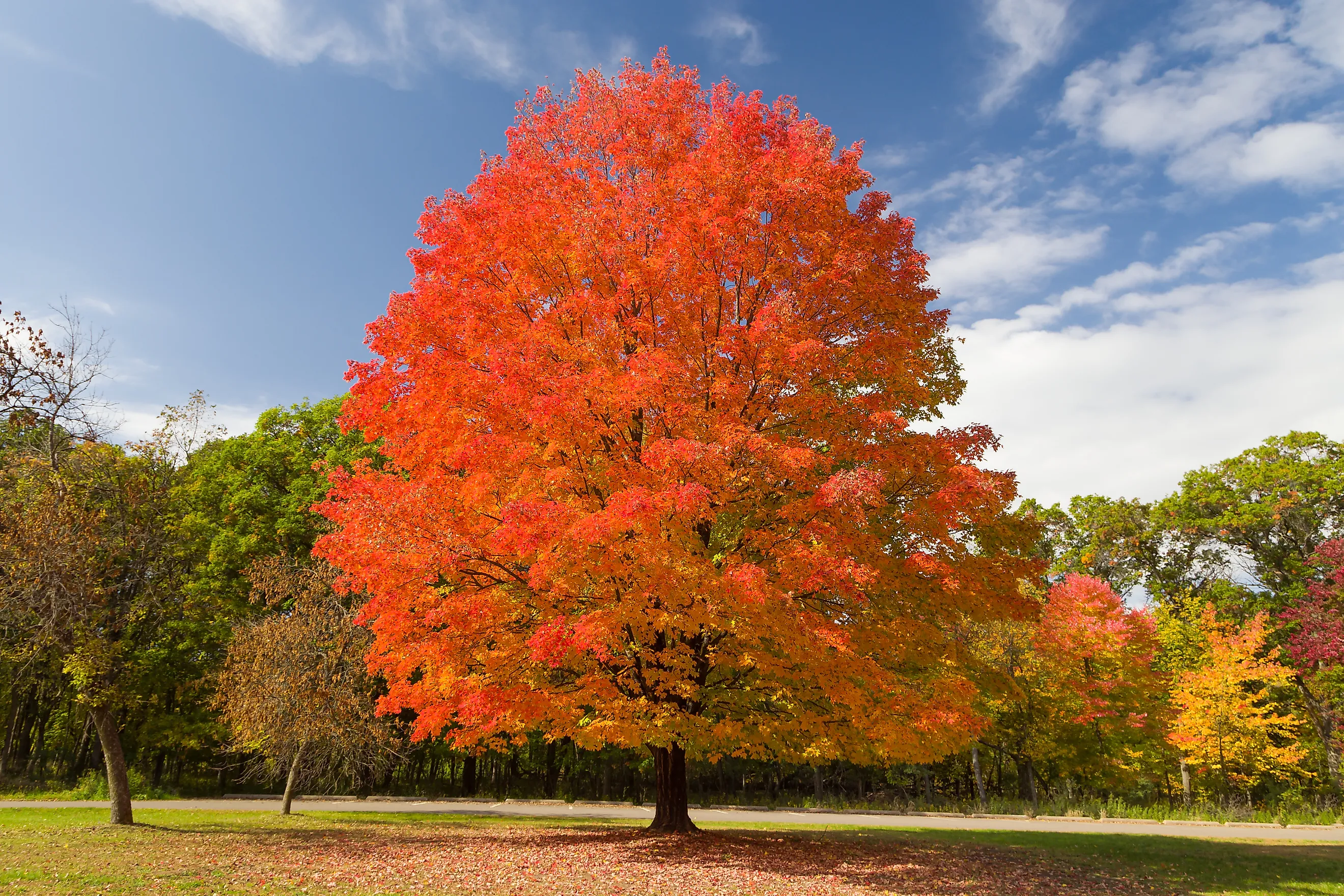
The Most Valuable Trees In American Forests
Some trees in American forests are worth enough that people steal them. Poachers cut figured bigleaf maple out of Olympic National Forest to sell to guitar makers, and in 2018 one crew started a fire there that burned about 3,300 acres. Other thieves saw burls off living redwoods inside a national park. The wood is worth that risk because Americans already pay for it every day, in the white oak barrel that flavors their bourbon, the walnut cabinet in the kitchen, and the spruce top on a guitar.
Prices depend on the wood’s quality, the buyer, and the cost of getting a log out of the forest. Black walnut, white oak, Hawaiian koa, Sitka spruce, and a few others stand out for the timber or specialty wood they produce, not for nursery prices or landscaping appraisals. Most grow on public and private forest land, including national forests where regulated harvesting is permitted.
Black Walnut

A walnut cabinet's deep brown color begins in the tree's heartwood, the darker wood inside the trunk. Black walnut is prized for furniture, cabinetry, and veneer, the thin sheets used to cover other materials. Large logs with long, straight sections and few defects are especially desirable. Knots, decay, and poor shape can reduce their value substantially, so identifying the species alone tells only part of the story.
Black walnut grows across the central and eastern United States, with some of its best growth on deep, fertile, well-drained soils. Stream valleys and lower slopes can support impressive specimens. That distribution makes it much more than an East Coast tree. Its edible nuts have a separate commercial use, but premium wood is the reason black walnut belongs in this discussion. A sound forest-grown trunk can offer a very different product from a heavily branched backyard tree.
White Oak

White oak has a buyer that many other hardwoods cannot easily satisfy: the barrel maker. Its heartwood contains structures called tyloses that block vessels in the wood, helping properly made barrels hold liquid. That property, together with its influence on flavor during aging, makes white oak especially important to whiskey production. The same species also supplies flooring, furniture, and cabinetry.
This is why white oak deserves a separate entry rather than sharing a broad "oak" heading with red oak. Both have commercial uses, but they are not interchangeable in every market. A log suitable for barrel staves serves a different purpose from one destined for ordinary lumber.
White oak grows widely in eastern and central American forests, often alongside hickories and other oaks. Its broad distribution does not guarantee a steady supply of premium logs: producing large, sound trees takes decades.
Black Cherry

Pennsylvania's Allegheny National Forest is an especially relevant place to understand black cherry's value. The surrounding Allegheny Plateau supports concentrations of large, high-quality trees suited to furniture and veneer production. Although black cherry grows across much of the eastern United States, it does not produce equally valuable timber everywhere. In less favorable locations, it may remain small or develop a poor shape. Buyers seeking fine wood care about that difference. A straight, high-quality log suitable for veneer can command a premium over material intended for less demanding uses. The species' commercial reputation therefore owes much to where and how it grows. Black cherry also produces small fruits eaten by wildlife, giving even trees with little timber value a useful role in the forest.
Sugar Maple

Sugar maple earns money in two distinct ways: through sap collected from living trees and through wood harvested for manufacturing. For this article, the wood is the relevant measure. Commonly sold as hard maple, it is used for furniture, flooring, and other products that benefit from its hardness and resistance to wear. Syrup income should not be added to a log's price as though the two were the same valuation.
Some sugar maples produce birdseye figure, a pattern of small, eye-like markings that makes the wood particularly attractive for decorative work. This is a feature of certain trees, not a separate species or a quality shared by every sugar maple. The species grows through northeastern and Great Lakes forests, extending into Canada. Within that broad range, ordinary commercial lumber and exceptional figured wood represent very different markets.
Bigleaf Maple

In Washington's Olympic National Forest, the search for valuable maple wood has led to criminal prosecutions. Timber thieves have targeted bigleaf maples containing figured wood, whose unusual grain patterns appeal to musical-instrument makers. One illegal harvesting operation in 2018 also started the Maple Fire, which burned thousands of acres. The case shows how demand for a particular kind of wood can damage far more than the trees being stolen.
Bigleaf maple grows in western forests, but the premium applies especially to specimens with desirable figure. An ordinary tree should not be assigned the price of exceptional instrument wood. Its commercial appeal also differs from sugar maple's: here, appearance can be a major selling point. The grain exposed when a log is cut helps determine whether the wood will suit a decorative instrument component, furniture veneer, or a less specialized product.
Sitka Spruce

A guitar soundboard needs wood that combines low weight with stiffness and good acoustic properties. Sitka spruce meets those requirements, making carefully selected material valuable to instrument makers. It is also used in piano soundboards. This specialty market provides a much clearer reason for including the species than a general claim that spruce trees are valuable because they grow close together.
Sitka spruce occupies the moist Pacific coastal belt, including the forests of southeastern Alaska. Tongass National Forest is closely associated with this large coastal conifer. Its wood also has practical uses in boats and other products where strength relative to weight matters.
However, instrument wood is a selective market. Grain, defects, and the dimensions of usable pieces affect suitability. A large spruce is not automatically an instrument-grade tree, and the value of selected soundboard material should not be applied to its entire trunk.
Hawaiian Koa

Hawaii's forestry agency describes koa as one of the world's most valuable hardwoods. Native only to the Hawaiian Islands, it has a long history of use in ocean-going canoes and other culturally important objects. Today, its wood is also sought for furniture and musical instruments, including ukuleles. Particularly attractive grain can make selected pieces desirable for decorative work.
Koa brings a different geography to this article. It grows in Hawaiian forests rather than the mainland national forests associated with many other entries. The greatest concentrations occur roughly 3,000 to 6,000 feet above sea level, although the species grows across a wider elevation range.
Its restricted natural distribution and demand for fine wood make the condition of remaining forests significant. Forest Service research has raised concerns about the scarcity and declining health of old-growth koa, reinforcing the importance of regeneration and careful management.
Coast Redwood

Coast redwood's commercial appeal comes partly from its naturally decay-resistant wood. Its heartwood has long been valued for uses where durability matters. But the tallest tree in a grove cannot be assigned a credible timber price simply by multiplying its size by a retail lumber price. Usable wood, defects, processing costs, ownership, and legal protections all affect what such a calculation would mean.
There is also a separate market for redwood burl, the irregular growths that can contain striking grain patterns. The National Park Service has documented thieves cutting burls from standing and fallen trees in Redwood National and State Parks. That wood can be used for ornamental furniture, veneer, and souvenirs. Removing it from living trees can expose internal wood and increase the risk of damage and disease. These protected coastal forests offer a place to see redwoods, not a supply of collectible wood.
What Makes One Tree Worth More Than Another?
Across these species, the largest tree is not necessarily the most valuable to a buyer. A sound walnut trunk, a white oak log suitable for barrels, or a maple with exceptional figure each meets a different need. Market prices reflect those uses, along with the expense of turning a standing tree into a saleable product. Living forests also provide wildlife habitat, carbon storage, and recreation that timber prices do not measure. Understanding the wood's value adds another reason to pay attention to these trees without reducing an entire forest to a lumber estimate.