The Colorado Rattlesnake Den With 2,000 Snakes On A Live Camera
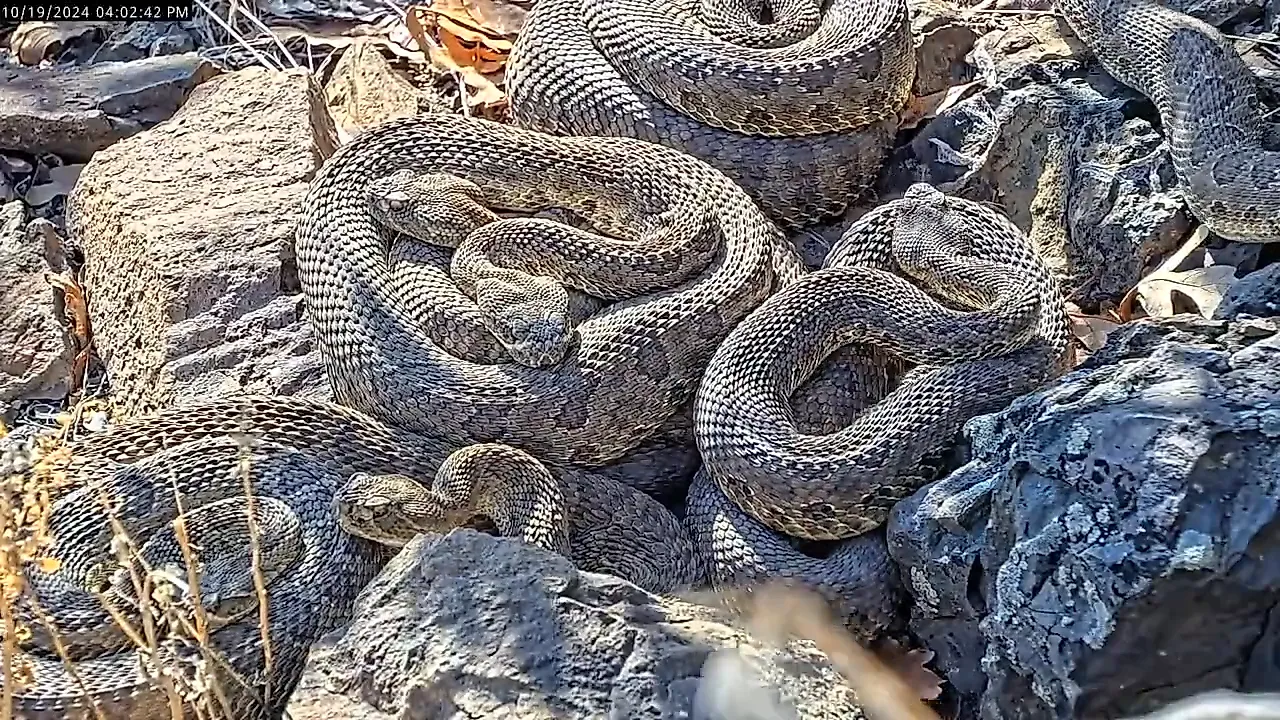
Somewhere on undisclosed private land in northern Colorado, a solar-powered camera points at a rock outcrop. From May to October it streams around the clock to anyone who wants to watch. The den complex behind it holds as many as 2,000 prairie rattlesnakes, though the area actually on screen peaks at a few hundred. In its first year the feed drew 2.5 million views and more than 180,000 people watched on a single day.
Two Thousand Is The Complex, Not The Screen
The headline figure needs one qualification, which the project leader supplies herself.
Emily Taylor, the Cal Poly biologist running the project, describes a den with as many as 2,000 rattlesnakes in the greater den complex, adding that the area on camera peaks at maybe a few hundred. Project RattleCam's own site says hundreds overwinter at the site.
Two thousand is the population of the whole rock system. Several hundred is what a viewer sees.
It Went Live In May 2024
The Colorado camera was the project's second installation rather than its first.
Cal Poly researchers installed the original RattleCam on the central coast of California in summer 2021, watching a small western rattlesnake rookery. The Colorado mega-den followed in May 2024 with a high-tech solar-powered system.
The project is a collaboration between California Polytechnic State University, Central Coast Snake Services and Dickinson College in Pennsylvania, largely funded by donations.
It Is A Rookery, Not Just A Den

The reason the camera runs through summer rather than winter is what happens there in August.
The site is a rookery, where pregnant female rattlesnakes gather to give birth and rear their pups. Viewers watch the births happen, with the last pregnant females typically delivering in early to mid-September.
Prairie rattlesnakes bear live young rather than laying eggs, which is standard for the genus. The pups stay surface-active into early October.
They Babysit Each Other's Young

One behavior the camera has documented repeatedly undercuts most assumptions about these animals.
A snake named Thea has been photographed resting with newborn pups that are not all hers. Max Roberts, a Cal Poly graduate student on the project, confirmed that babysitting has been seen many times on the RattleCam.
Communal care in a rattlesnake rookery is exactly the kind of thing that was difficult to establish before somebody pointed a camera at one for five months.
Scale Patterns Work Like Fingerprints

Identifying individuals without handling them is what makes the whole approach work.
The project tracks snakes by their scale patterns, which graduate student Owen Bachhuber describes as being as unique as a human fingerprint. No tagging, no capture, no disturbance.
Taylor's framing is that the livestream allows the team to collect data on wild rattlesnakes without disturbing them, facilitating unbiased scientific discovery.
Viewers Have Named Forty-Four Of Them

The audience is not purely passive, and that is deliberate.
Project RattleCam runs a Name a Snake community science contest, and viewers have named 44 identifiable individuals. People watching also tip off scientists to events the researchers miss.
That is a lot of observation hours. The YouTube channel has passed 4.4 million views and 350,000 hours of watch time across more than 21,300 subscribers.
The Research Says It Changes Minds

The second goal of the project has now been tested and published.
An open-access paper in Frontiers in Amphibian and Reptile Science, published June 2025 and co-authored by Taylor with two graduate students and five others, examined the impact of the livestreams alongside the technical side of running them.
Media coverage of the Colorado installation generated 83 news articles and added 13,761 YouTube subscribers between July and November 2024. Taylor reports viewers saying the stream showed them the snakes are not that bad.
Winter Is Where The Camera Fails

The feed stops in October for a reason that has nothing to do with funding.
The snakes hibernate beneath the rock outcrop the camera is mounted on, in what Roberts describes as a maze or matrix of fissures. His assessment of filming it is blunt: it is basically impossible to get a camera where you can see.
Winter viewing, he told the Denver Gazette, is not geographically possible. What happens below ground remains the part nobody can watch.
The Location Is Deliberately Secret

One detail is withheld from the audience watching the snakes in real time.
The den sits on private property in northern Colorado and the location is undisclosed, specifically to protect the animals.
Rattlesnake dens are destroyed when people find them, and a site holding up to 2,000 snakes from one interconnected population would be catastrophic to lose. Publicity and secrecy are being run simultaneously.
It Is Expanding East

Two cameras have become a model other researchers want to copy.
A Pennsylvania installation is planned, which carries the possibility of showing copperheads and other species including black bears. Taylor reports interest from colleagues with dens in Arizona, Idaho and elsewhere.
A newly published school curriculum now uses the livestream in science classes, which was not part of the original plan.
The Short Answer

Project RattleCam streams a prairie rattlesnake rookery in northern Colorado around the clock from May to October, on a solar-powered camera installed in May 2024. The wider den complex holds up to 2,000 snakes; a few hundred are visible on screen.
Researchers identify individuals by scale pattern without ever touching them, viewers have named 44 of them, and the camera has documented communal babysitting among females. In October the snakes drop into a matrix of fissures under the outcrop, and nobody sees them again until spring.