Why Louisiana Has Parishes Instead Of Counties
Out of the 50 US states, 48 are divided into counties. Alaska and Louisiana are the exceptions. Alaska uses boroughs, while Louisiana uses parishes. The reason goes back to the state's history as a predominantly Catholic region settled by the French and Spanish, who organized the land around the parish, a church district inherited from their Catholic tradition. When Anglo-Americans later tried to impose the county, Louisiana's French-speaking Catholics pushed back, and the parish won. This article traces how that happened, and why the word still defines the map of Louisiana today.
A colony under three flags

Spanish explorers reached the region first. In 1541, Hernando de Soto and his men became the first Europeans documented to cross the Mississippi River, though they left no lasting settlement. French claims came later. In 1682, René-Robert Cavelier, Sieur de La Salle, descended the Mississippi to its mouth and claimed the entire river basin for France, naming it Louisiana after King Louis XIV. Permanent settlement began in 1718, when Jean-Baptiste Le Moyne de Bienville founded New Orleans, naming it for Philippe, Duke of Orléans.
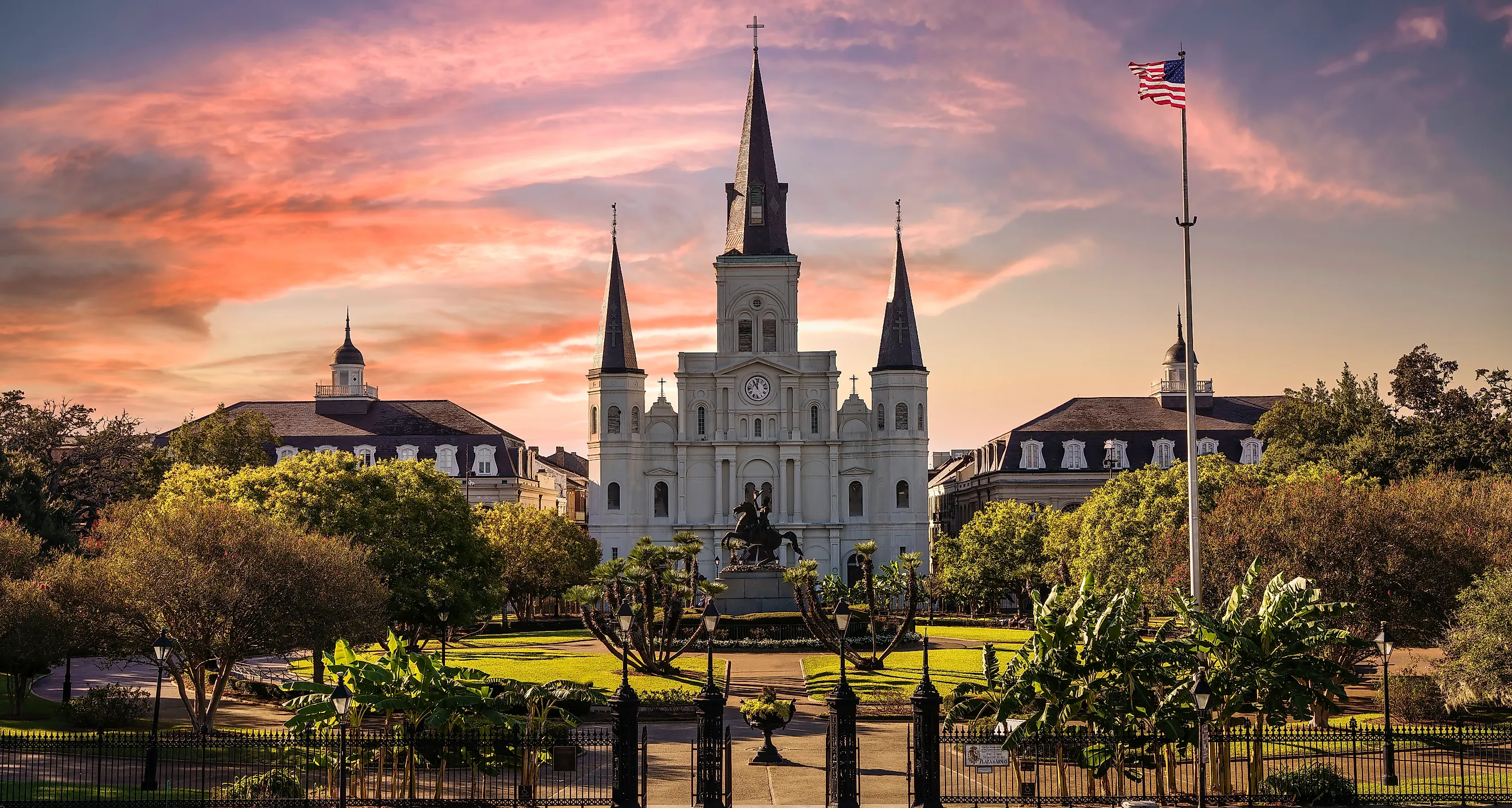
France governed Louisiana until 1762, when a secret treaty handed it to Spain near the close of the Seven Years' War. Spain held it until 1800, which is why the oldest buildings in the French Quarter carry Spanish Colonial features, with arched openings and wrought-iron grillwork, rather than French ones. Napoleon Bonaparte reacquired the territory for France in 1800 and sold it to the United States in 1803 in the Louisiana Purchase. By then, decades of French and Spanish rule had left the colony with something the incoming Americans did not expect: a settled way of organizing the land, built around the Catholic parish.
From church district to civil unit

The word parish comes through the Old French paroisse and, further back, Greek roots carrying the sense of a neighbor or sojourner. In Catholic use, it came to mean a district built around a single church and the people under its care, a structure the Church formalized at the Council of Trent in the mid-1500s. French and Spanish settlers, overwhelmingly Catholic, divided colonial Louisiana into these church parishes as a matter of course, with the distant Diocese of Quebec holding authority for much of the French period.
Those early parishes were ecclesiastical, not units of government. Civil administration arrived only after the United States took over. In 1805, the territorial government carved the Territory of Orleans into 12 counties whose boundaries roughly followed the old church parishes and borrowed their names. Two years later, in 1807, the territorial legislature created 19 civil parishes without abolishing the counties, so the two systems ran side by side for decades. Crucially, Louisiana's counties functioned only as electoral and judicial districts and never developed the local administrative machinery that counties held in other states.
Why Louisiana kept the parish

The 1812 state constitution, adopted when Louisiana joined the Union, confirmed this arrangement. Section 10 named "the counties of German Coast, Acadia, Lafourche, Iberville, Point Coupée, Concordia, Attakapas, Opelousas, Rapides, Natchitoches and Ouachitta," each forming a district that would elect a senator. Yet the same document referred to parishes elsewhere, using "county" mainly for elections and courts rather than as the primary administrative division. For a generation, the two words coexisted awkwardly.
The tension was as much cultural as legal. Many of Louisiana's French-speaking Catholic Creoles saw the county as an Anglo-American instrument, a way for the growing Protestant, English-speaking population to reshape a state whose institutions had been Catholic and French for a century. Debates over language, law, and voting power ran hot through the 1830s and 1840s, and the county sat squarely inside that fight. The familiar parish, by contrast, carried the weight of local tradition.
The question was settled by a new state constitution in 1845. That document made the parish the state's primary civil, judicial, and electoral division. Article 8 required that "Each parish shall have at least one Representative," with new parishes held to minimum size and population thresholds. When the constitution was ratified, the word "county" had vanished from it entirely. The same charter also swept away property requirements for voting and established free public schools. After 40 years of dual usage, the parish had displaced the county for good.
Parishes today

Louisiana has 64 parishes. The last to be organized were Allen, Beauregard, and Jefferson Davis, created by legislation in 1912 and taking effect over 1912 and 1913. All three carry the names of Confederate figures: Henry Watkins Allen, a Confederate general and wartime governor of Louisiana; P.G.T. Beauregard, the Confederate general; and Jefferson Davis, president of the Confederate States. A glance at the map shows two eras of parish-making. The older parishes in the southeastern delta have irregular, protruding shapes that trace the rivers, while the newer western parishes tend toward squarer, more regular outlines.
Catholicism remains a defining thread in Louisiana life. Roughly a quarter of the state's population identifies as Catholic, one of the largest shares of any Southern state, concentrated in southern Louisiana, Greater New Orleans, and Acadiana. Among them are the Cajuns, descendants of French Acadians exiled from Canada in the 1700s, known for their cuisine and their dialect. A dwindling number still speak Louisiana French or Louisiana Creole, languages now classified as endangered.
A unit that outlasted three flags
The parish endures as a reminder of the layered history behind Louisiana, a place shaped in turn by France, Spain, and the United States. Where the rest of the country adopted the county wholesale, Louisiana kept a word rooted in its Catholic colonial past. It remains the one civil division that ties the modern map directly to the churches that first organized the land.