The 10 US Cities With the Longest Summers
For this ranking, a thermal-summer month is one whose 1991-2020 normal mean temperature reaches at least 70°F, using NOAA and National Centers for Environmental Information climate normals. Only incorporated cities in the 50 states with populations above 50,000 qualify, based on US Census counts and estimates. One tropical outlier leads the list, and the rest cluster in metropolitan South Florida, where mild winters keep monthly means above the threshold for most of the year.
Honolulu, Hawaii

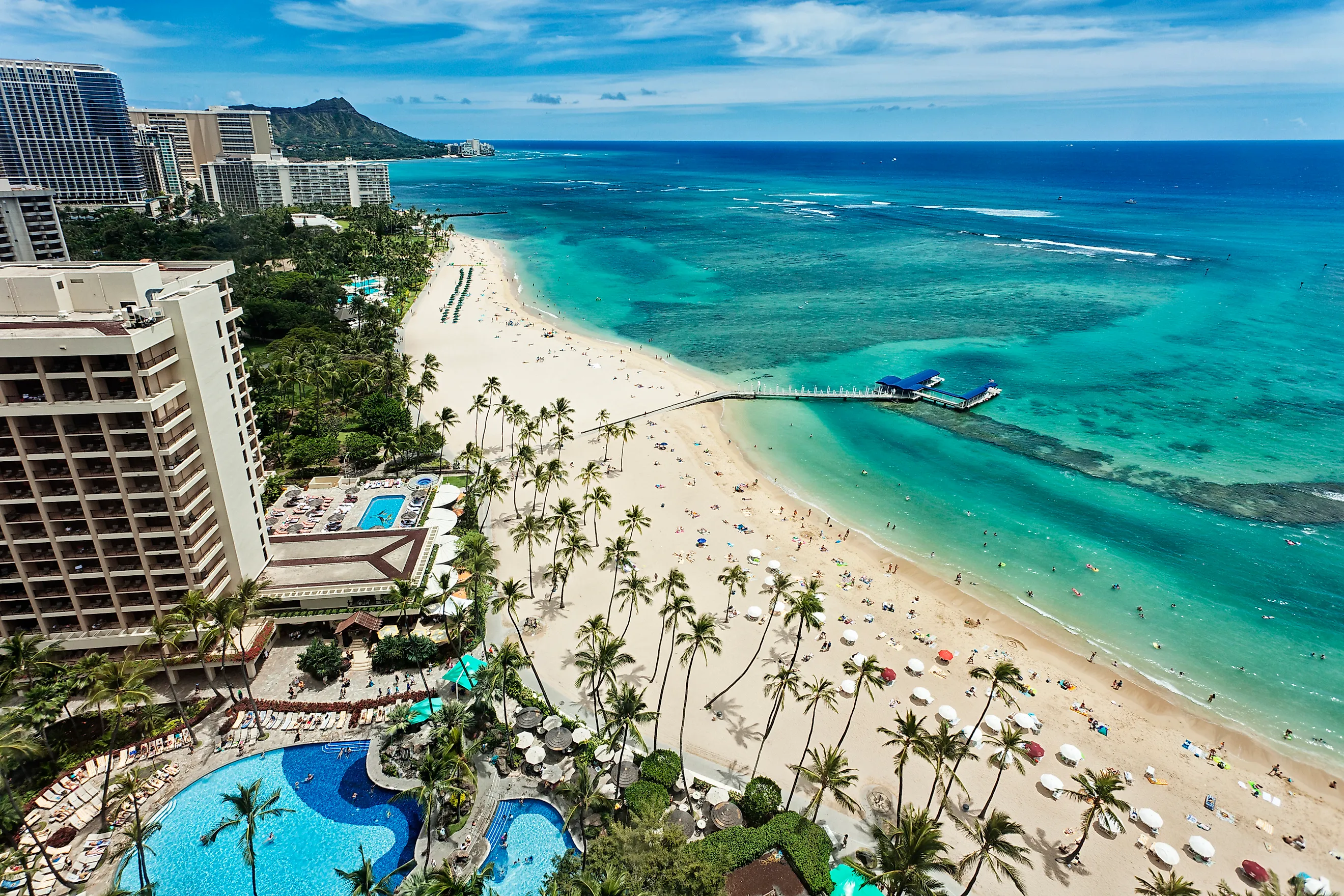
Honolulu is the one entry outside the continental warm belt, and by this study's measure it has the longest summer of any city on the list. Its NOAA 1991-2020 normals never fall below the threshold: the coolest months, January and February, hold a mean near 73°F, and no month drops under 70°F. That gives Honolulu a full 12 qualifying months, a distinction none of the Florida cities can match, each of which still has a sub-70°F January. The warmest month is August, with a mean around 83°F and normal highs near 89°F. Beside the surrounding Pacific, the annual range is unusually tight, so the difference between the coolest and warmest months is only about 10°F. Honolulu is governed as a consolidated city and county, incorporated in 1907, and the Census counted 350,964 residents in the urban core in 2020, far above the 50,000 requirement. Its place at the top of this ranking is a reminder that the longest American summers are set by mild winters, not by fierce midsummer peaks.
Miami, Florida

In Miami, only one month of the year falls below the 70°F line. NOAA's 1991-2020 normals at Miami International Airport put January's mean at 68.6°F, but February jumps to 70.7°F. Every remaining month stays above the threshold, including a December mean of 71.2°F. That produces 11 qualifying months, with only January left outside thermal summer.
Midyear temperatures are considerably hotter. July averages 84.1°F and August 84.2°F, while normal daytime highs exceed 90°F in both months. Miami's annual normal mean reaches 77.5°F, and NOAA calculates more than 3,000 cooling degree days above a 70°F base. Those figures reflect what visitors notice quickly: warm weather here is not simply an intense midsummer event. By February, temperatures have already crossed the study's summer threshold, and December readings still match the warm season found much farther north. Miami had 442,241 residents at the 2020 Census, comfortably clearing the project's city-size requirement.
Pompano Beach, Florida

Pompano Beach also has 11 qualifying months, documented at its own weather station rather than through a regional proxy. The Florida Climate Center, using NOAA's 1991-2020 normals for Pompano Beach Airpark, reports a January mean of 68.4°F. The February mean is 70.3°F, and the monthly means hold above 70°F through December, which has a mean of 71.0°F. Summer proper is steamy rather than merely warm: July averages 84.0°F and August 84.2°F, with normal highs just over 90°F. The annual mean is 77.2°F. Pompano Beach therefore stands on the warm side of this study's dividing line for nearly the entire year, with only a brief winter dip in January. The Census counted 112,046 residents in 2020, so this is not a small beach settlement slipping into the ranking on a technicality. It is a substantial incorporated city with one of the longest documented thermal summers in the country.
Pembroke Pines, Florida

Pembroke Pines is another 11-month case. North Perry Airport, a NOAA-observed station serving the city, has a 1991-2020 February mean of 70.2°F. The December mean is even warmer at 70.7°F, and the January mean is 68.1°F.
That slender January dip is the only interruption. March averages 72.7°F, April 76.4°F, and May 80.0°F. At the summer peak, August averages 84.6°F, including a normal daytime maximum near 92°F.
Pembroke Pines is especially useful for understanding why this ranking is dominated by South Florida cities. It sits inland rather than directly on the Atlantic, yet winter temperatures still remain high enough that the February and December means meet the same threshold used in coastal Miami. The city had 171,178 residents in the 2020 Census, well beyond the 50,000 cutoff. The climate data also make clear why a three-month definition of summer is not very descriptive here: nine additional weeks on either side of conventional summer can still deliver average temperatures that would look thoroughly summery across much of the United States.
Miami Gardens, Florida

Miami Gardens sits close to Miami-Opa Locka Executive Airport, whose NOAA 1991-2020 normals provide an excellent representation of the city's inland climate. The station's January mean is 67.8°F, and its February mean is exactly 70.0°F. March moves to 72.6°F, April to 76.1°F, and May to 79.7°F. December still averages 70.4°F, leaving January as the only month below the study's summer threshold.
Peak summer is far hotter than those borderline winter values suggest. August's normal mean reaches 84.0°F, supported by an average high of 91.1°F and low of 76.8°F. NOAA calculates an annual mean of 76.9°F at the station, along with more than 4,400 cooling degree days above 65°F. Miami Gardens itself counted 111,640 residents in 2020. City size together with a February-through-December warm season makes Miami Gardens one of the clearest illustrations of why South Florida cities, rather than the warmer-sounding metros of Texas and Arizona, fill this ranking once population and temperature are treated consistently.
Miramar, Florida

Miramar extends westward across southern Broward County, wide enough that no single station represents every neighborhood perfectly. North Perry Airport, immediately beside the city and used for the neighboring Pembroke Pines area, provides a useful NOAA-based local reference. Its February 1991-2020 mean is 70.2°F, and December averages 70.7°F.
The hot season then accelerates quickly. The May mean is 80.0°F, June 83.0°F, and August 84.6°F, the warmest of the year. Even November averages 74.7°F.
Miramar had 134,721 residents at the 2020 Census, so it easily satisfies the project's population rule. Its inclusion is a good illustration of why a science-based list becomes geographically repetitive: municipal borders do not create climate boundaries. Miramar, Pembroke Pines, Hollywood, and Miami Gardens occupy one continuous warm lowland where winter cold fronts are generally brief interruptions rather than a sustained cold season. Visitors arriving in late autumn can still encounter temperatures comparable with midsummer averages in many northern states, while February already returns to the study's summer threshold.
Hollywood, Florida

Hollywood's own NOAA climate station produces another ten-month warm season. Its 1991-2020 normal mean is 67.6°F in January and 68.9°F in February, and the March mean of 70.9°F is the first to clear the project's boundary. From there, temperatures remain above 70°F for the rest of the year; December still averages 70.1°F. The warmest month is August, at a mean of 83.3°F, with a normal high of 89.9°F and low of 76.7°F. November is hardly wintry either, averaging 73.9°F. The station's annual mean is approximately 76.1°F. Hollywood counted 153,067 residents at the 2020 Census, making it one of the larger cities in this South Florida cluster. Its temperature curve is especially revealing because there is no abrupt start or finish to summer. Temperatures cross the threshold in March, rise gradually to a late-summer peak, and decline through autumn slowly enough that the December mean stays above the study's cutoff.
Miami Beach, Florida

Miami Beach is a separate incorporated city on the barrier islands across Biscayne Bay from the mainland, and it comes one February short of an 11-month summer. Its own NOAA station records a January mean of 67.4°F and a February mean of 69.0°F. The March mean is the first to clear the line at 70.9°F, and every month through December then stays above it, with a December mean of 70.3°F. That gives the city ten qualifying months under the monthly method. The warmest month in the NOAA normal table is August, at a mean of 83.1°F, only about 16°F above January. Normal summer nights are especially warm, with July and August minimum temperatures around 78°F. Beside the ocean, the temperature range is narrower than in a desert city such as Phoenix, where summers run hotter but winters cool far more sharply. The 2020 Census counted 82,890 residents, comfortably above the 50,000 threshold despite the city's compact footprint.
Hialeah, Florida

Hialeah's dedicated climate station records a slightly cooler February than nearby Opa-locka, demonstrating how much a few tenths of a degree can matter in this ranking. The Florida Climate Center gives Hialeah a February 1991-2020 mean of 69.8°F, just missing the threshold. The March mean is 72.1°F.
The city then remains above 70°F through December, which averages 70.2°F. The July mean is 83.3°F and August 83.5°F, and October is still a very warm 79.2°F. Its annual normal mean is 76.6°F.
Hialeah therefore receives ten qualifying months rather than eleven when its city-specific station is used. That tiny distinction is scientifically important: swapping to the nearby Miami-Opa Locka Airport station would push February to exactly 70.0°F. For this article, the city station takes precedence where one exists. Hialeah's population of 223,109 in the 2020 Census also makes it one of the most populous entries here. Its long warm season is not a quirk of a small coastal resort but part of the everyday climate of a dense South Florida city.
Fort Lauderdale, Florida

Fort Lauderdale is a clear case of why station selection has to be disclosed. The Florida Climate Center's Fort Lauderdale cooperative station gives 1991-2020 monthly means of 66.7°F in January and 68.5°F in February. The March mean of 70.8°F begins a continuous run above the study threshold through November. December averages 69.3°F. That produces nine complete qualifying months at this particular station, although airport stations closer to the coast record somewhat warmer winter conditions.
Once spring starts, the numbers climb quickly: April averages 74.9°F, June 81.8°F, and August 83.3°F. The October mean is still 79.0°F, and November 73.2°F. The annual mean is 75.9°F at the cooperative station. Fort Lauderdale had 182,760 residents in the 2020 Census, easily meeting the population requirement. Its place at the edge of this group also shows how crowded the competition becomes in South Florida. A difference of one or two degrees during a handful of winter weeks can separate nine, ten, and eleven-month thermal summers within the same metropolitan region.
Where the Longest Summers Really Are
Honolulu aside, the list is not a quirk of the data; the South Florida cluster follows directly from the two rules of the study. The 70°F monthly threshold favors locations where winter temperatures barely dip, a description that fits both tropical Oahu and coastal South Florida. The 50,000-population floor then leaves out the tiny sub-tropical municipalities, such as Key West, whose small populations would otherwise spread the results across the map. What remains is Honolulu at the top with a 12-month summer, followed by a dense band of Miami-Dade and Broward cities separated by fractions of a degree. Among the Florida entries, the count is 11 qualifying months for Miami, Pompano Beach, and Pembroke Pines; ten for Miami Beach, Hollywood, and Hialeah; and nine for Fort Lauderdale at its cooperative station. The gaps between the Florida cities come down to a single winter month and the choice of weather station. The larger lesson holds across all ten: measured by the calendar rather than by peak heat, the longest American summers belong to the mild-winter tropics and subtropics, not to the desert Southwest, where fierce July heat is followed by genuinely cool Januaries.