US Cities With the Most Skyscrapers
A skyscraper, by the standard the Council on Tall Buildings and Urban Habitat uses, is a building of at least 150 metres, or 492 feet. By that measure the US has roughly 900 of them spread across 56 cities. One city holds more than a third.
New York's 324 towers outnumber the next seven cities on this list put together, and New York and Chicago between them account for about half the national total. After those two the numbers fall away sharply, and what is left is a set of very different explanations for why a skyline grows: finance, oil, flight paths, earthquakes, and in one case a river.
Counts move as buildings top out, and different sources disagree by a tower or two depending on cut-off dates. The figures below reflect completed buildings as of late 2026.
| Rank | City | State | Skyscrapers (150 m+) |
|---|---|---|---|
| 1 | New York City | NY | 324 |
| 2 | Chicago | IL | 137 |
| 3 | Miami | FL | 69 |
| 4 | Houston | TX | 40 |
| 5 | Los Angeles | CA | 32 |
| 6 | San Francisco | CA | 27 |
| 7 | Boston | MA | 26 |
| 8 | Seattle | WA | 23 |
| 9 | Jersey City | NJ | 22 |
| 10 | Dallas | TX | 20 |
1. New York City, New York - 324

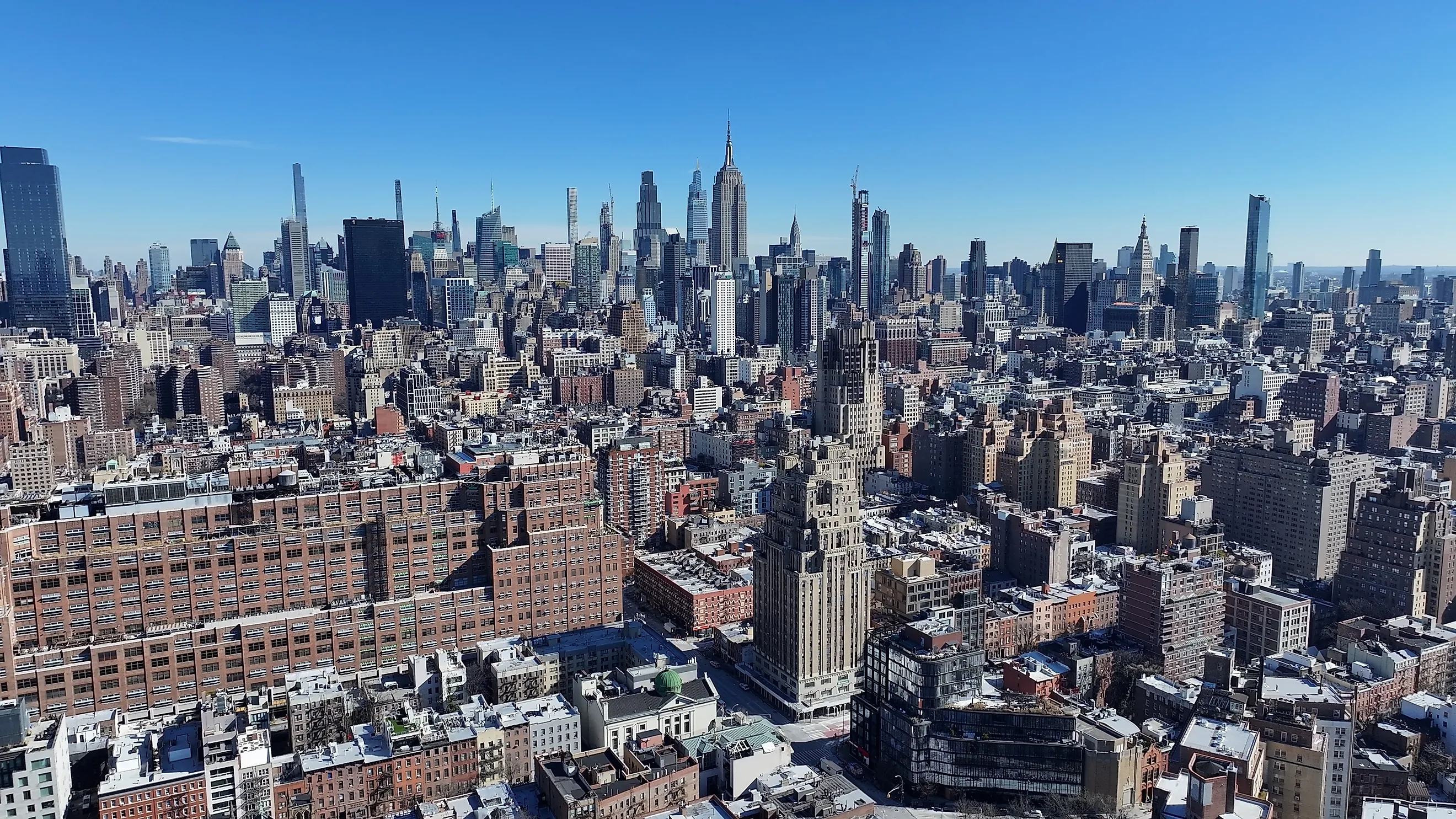
New York City holds about a third of every 150-metre building in the country. Alongside the 324 at that height it counts 102 above 200 metres, 18 above 300, and six above 400, which is a concentration of supertalls matched by only two cities on earth.

One World Trade Center, at 1,776 feet, is the tallest in the country. The towers cluster in Midtown and Lower Manhattan, with the 21st century adding the World Trade Center rebuild, the Billionaires' Row supertalls on West 57th Street, and Hudson Yards. Growth has since crossed the East River: Brooklyn's 1,066-foot Brooklyn Tower and the Long Island City cluster in Queens now carry the outer boroughs. Counting Jersey City and Fort Lee across the Hudson, the wider New York metro reaches 348.
2. Chicago, Illinois - 137

The form was invented here. The 1885 Home Insurance Building introduced the steel frame that made height structurally possible, and Chicago has never fallen below second place since. It counts 137 buildings above 150 metres, 38 above 200, seven above 300, and two above 400.

The 110-story Willis Tower, 1,451 feet and finished in 1974, is still the city's tallest, and Illinois claims five of the 15 tallest buildings in the country. Three booms built the skyline: the 1880s to 1930s, the 1960s to 1990s, and the 2000s onward. The last of those produced the Trump International Hotel and Tower and St. Regis Chicago, the tallest building in the world designed by a woman. Construction has pushed out of the Loop into Streeterville, River North, and the West Loop, with 400 Lake Shore Drive due in 2027.
3. Miami, Florida - 69

Miami is the only city in the top five whose skyline is mostly residential rather than corporate. It has 69 buildings above 150 metres and nine above 200, but none at all above 300, and the reason is regulatory rather than economic.

Federal Aviation Administration limits tied to Miami International Airport cap buildings at 1,049 feet above sea level, which is why the tallest is the 85-story Panorama Tower at 826 feet, completed in Brickell in 2017. The skyline stayed low until a residential boom in the mid-1990s stretched it from Downtown into Brickell and Edgewater, paused in the recession, and restarted in the mid-2010s. Florida's vertical growth is concentrated here almost entirely.
4. Houston, Texas - 40

Houston is the one city here with no single skyline. It has 40 buildings above 150 metres and 16 above 200, but they are split across Downtown, Uptown, the Texas Medical Center, Greenway Plaza, Westchase, the Energy Corridor, and Greenspoint.

That dispersal is a function of having no zoning code, almost uniquely among large American cities. Downtown's 1,002-foot JPMorgan Chase Tower is the tallest in Texas, and a seven-mile tunnel and skywalk network links much of the core. Uptown's 901-foot Williams Tower is frequently cited as the tallest American skyscraper standing outside a central business district, which only makes sense in a city built this way.
5. Los Angeles, California - 32

The second-largest city in the country ranks only fifth for height, and a single ordinance explains most of it. A 1904 rule capped buildings at 150 feet, roughly 13 stories, and stood for more than half a century. City Hall in 1928 was the lone exception.

When the limit lifted in 1957 the building began in earnest, running through to the 1990s and resuming with a residential surge in the mid-2010s. Los Angeles now has 32 buildings over 150 metres, 13 over 200, and two over 300: the 1,100-foot Wilshire Grand Center, the tallest in California, and the 1,018-foot US Bank Tower. Clusters run through Downtown, Century City, Koreatown, Westwood, and Hollywood.
6. San Francisco, California - 27

San Francisco builds tall on ground that moves, and the engineering shows in the count: 27 buildings above 150 metres but only five above 200, and a single one above 300.

That one is Salesforce Tower, 1,070 feet and finished in 2018, which displaced the Transamerica Pyramid after 46 years. Seismic requirements add cost and complexity to every floor above a certain point, and much of the Financial District sits on landfill that amplifies shaking. Measured by buildings over 300 feet rather than 150 metres, San Francisco has more than Los Angeles, which is a useful illustration of how much the threshold decides the ranking.
7. Boston, Massachusetts - 26

Boston has 26 buildings above 150 metres, six above 200, and none above 300, and the ceiling is partly written into law.

State shadow laws restrict how far new towers may cast shade across Boston Common and the Public Garden, and approach paths into Logan constrain heights elsewhere. The result is a compact financial core rather than a sprawling one. The tallest is 200 Clarendon, better known as the John Hancock Tower, at 790 feet in 1976; its early years involved windowpanes falling into the street, a failure that reshaped how tall buildings in Massachusetts are glazed.
8. Seattle, Washington - 23

Seattle has 23 buildings above 150 metres and five above 200. The tallest, the 933-foot Columbia Center, has held the title since 1985, which says something about where the city's recent growth actually went.

The 2010s boom in the Denny Triangle, driven largely by Amazon's campus, produced a dense band of towers rather than a single record-breaker. One clarification worth making: the Space Needle, which appears in every photograph of the city, stands 605 feet and does not meet the 150-metre threshold. It is an observation tower, not a skyscraper, and none of Washington's towers passes 300 metres.
9. Jersey City, New Jersey - 22
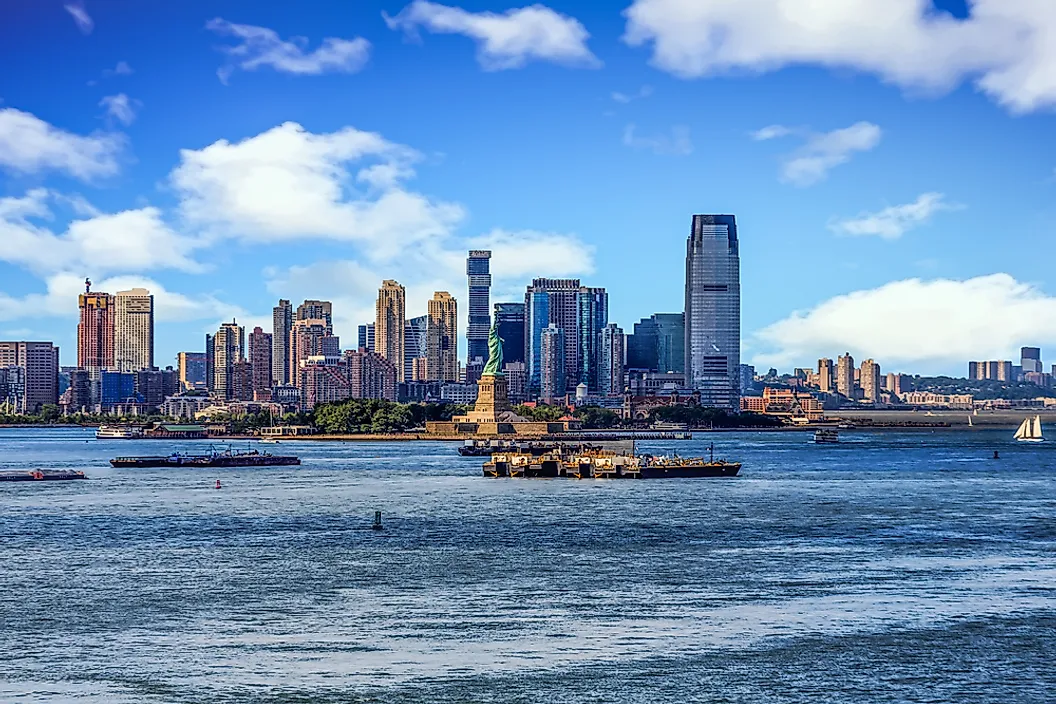
A city of about 290,000 people ranks ninth in the country, which only makes sense once you look across the water. Jersey City sits directly opposite Lower Manhattan, and its 22 skyscrapers exist because firms and residents wanted that address at a fraction of the price.

The waterfront strip earned the nickname Wall Street West as banks moved operations over in the 1980s and 1990s. The tallest is 99 Hudson, 889 feet and completed in 2019, which is also the tallest building in New Jersey. Counted on its own it ranks ninth; counted as part of the New York metro, it is simply the far bank of the same skyline.
10. Dallas, Texas - 20

Dallas closes the top 10 with 20 buildings above 150 metres and six above 200, giving Texas two cities on this list.

The tallest is Bank of America Plaza, 921 feet and completed in 1985, outlined at night in green argon tubing that makes it the most recognisable thing on the skyline. Reunion Tower, the sphere on a stalk that appears in most photographs of the city, is only 561 feet and is an observation tower rather than a skyscraper. Most of the core was built during the oil boom of the late 1970s and 1980s, and the skyline has grown slowly since.
What The Numbers Show
The distribution is the story. New York alone holds roughly a third of all American skyscrapers, and adding Chicago accounts for about half the national total. Everything after that is comparatively flat: the gap between third and tenth is 49 buildings, while the gap between first and second is 187.
The reasons differ in every case. Miami and Boston are capped by regulation, one by flight paths and one by shadow law. Los Angeles spent half a century under a height limit it has still not fully made up. Houston spread across seven business districts because nothing required it to concentrate. San Francisco pays an engineering premium for building on unstable ground. And Jersey City is on the list at all because Manhattan is expensive and close. Height follows money, but it follows rules just as closely.