The Tallest Buildings In The United States
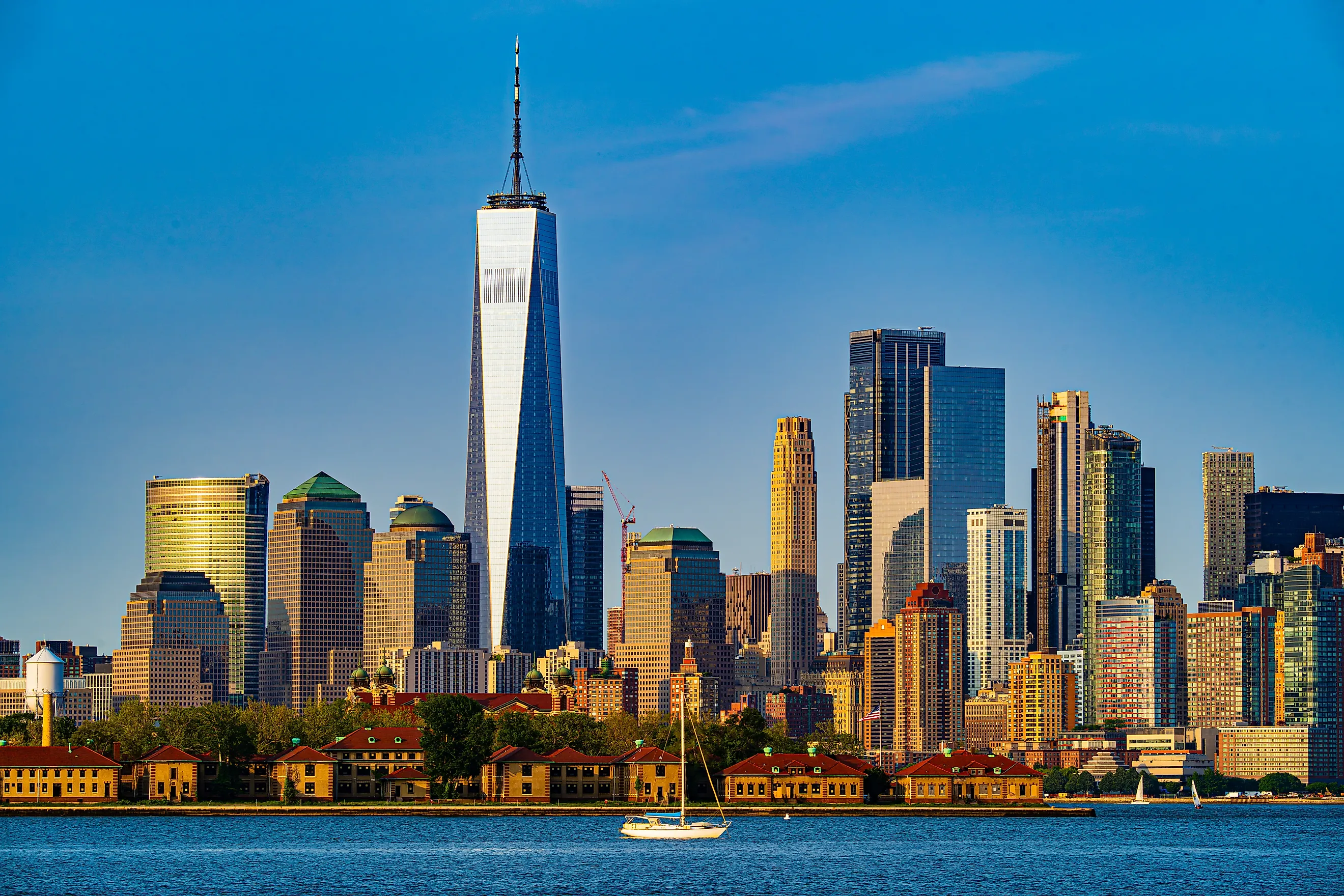
One World Trade Center is the tallest building in the United States, and at 1,776 feet it stands more than 200 feet taller than anything else here. This list ranks the country's 10 tallest by architectural height, the standard set by the Council on Tall Buildings and Urban Habitat, which counts a building's spire but leaves out antennas. New York City and Chicago hold every spot. The Empire State Building, the oldest here, opened in 1931. Chicago's Willis Tower went up in 1974, and the newest, 270 Park Avenue, opened in 2025. Six of the 10 rose in the last decade alone, built on transferable air rights, the extra buildable height developers buy from neighboring lots. Each building gets its own entry below, ranked tallest to shortest.
| Rank | Name | City | Height ft (m) | Floors | Completed | Primary Use |
|---|---|---|---|---|---|---|
| 1 | One World Trade Center | New York City | 1,776 ft (541 m) | 104 | 2014 | Office |
| 2 | Central Park Tower | New York City | 1,550 ft (472 m) | 98 | 2020 | Residential |
| 3 | Willis Tower | Chicago | 1,451 ft (442 m) | 110 | 1974 | Office |
| 4 | 111 West 57th Street | New York City | 1,428 ft (435 m) | 84 | 2021 | Residential |
| 5 | One Vanderbilt | New York City | 1,401 ft (427 m) | 93 | 2020 | Office |
| 6 | 432 Park Avenue | New York City | 1,396 ft (426 m) | 85 | 2015 | Residential |
| 7 | 270 Park Avenue (JPMorgan Chase Tower) | New York City | 1,388 ft (423 m) | 60 | 2025 | Office |
| 7 | Trump International Hotel and Tower | Chicago | 1,388 ft (423 m) | 98 | 2009 | Hotel/Residential |
| 9 | 30 Hudson Yards | New York City | 1,270 ft (387 m) | 103 | 2019 | Office |
| 10 | Empire State Building | New York City | 1,250 ft (381 m) | 102 | 1931 | Office |
270 Park Avenue and Trump International Hotel and Tower are tied at rank 7, both measuring 1,388 feet, which is why the table skips straight to rank 9.
One World Trade Center

One World Trade Center's roof tops out at 1,368 feet, matching the height of the original North Tower that once stood on the site. A 408-foot spire brings the building to 1,776-foot height. It is engineered to hold its sway to half a degree or less in a sustained 50-mph wind. Architect David Childs designed the tower on a 200-by-200-foot footprint, the same base dimensions as the original Twin Towers. A 400-ton tuned mass damper near the top counteracts wind sway.
The spire arrived in 18 separate steel sections, shipped by barge from Montreal through the St. Lawrence Seaway because the pieces were too large to move by road. Crews hoisted the final section into place on May 10, 2013. Hot-dip galvanized to survive nearly 1,800 feet of exposure, the spire also carries the building's broadcast antenna.
Central Park Tower

A cantilever juts from Central Park Tower's eastern side, built to keep neighboring 220 Central Park South from blocking its Central Park views. The addition earned the building a Guinness World Record for the tallest cantilevered structure ever built. Adrian Smith + Gordon Gill Architecture designed the 98-story tower to reach 1,550 feet on Manhattan's Billionaires' Row, making it the tallest residential building in the world.
As the tower climbs, its corners notch and set back in stages, a design choice that counteracts wind loads while carving out private terraces on the upper floors. The staggered profile let engineers push a residential tower past 1,500 feet on a site where a flat-faced facade would have blocked airflow.
Willis Tower

Willis Tower is built from nine steel tubes, each 75 feet square, bundled together in a 3-by-3 grid that rises to different heights and gives the building its stepped silhouette. Structural engineer Fazlur Khan's bundled-tube system cut steel use by roughly half compared to a conventional frame of the same height. It let Sears, Roebuck & Co. consolidate its offices into a single, 110-story headquarters when the tower opened in 1974. On clear days, the 103rd-floor Skydeck offers views up to 50 miles, reaching into Illinois, Indiana, Wisconsin, and Michigan.
Sears left the building in 1992, and insurance broker Willis Group bought the naming rights in 2009, the same year the Skydeck added the Ledge, four glass boxes that extend 4.3 feet beyond the building's face, suspending visitors on glass 1,353 feet above Wacker Drive.
111 West 57th Street

SHoP Architects gave 111 West 57th Street a footprint just 60 feet wide. That produces a height-to-width ratio of roughly 24 to 1, making it the most slender skyscraper on Earth. At its base sits Steinway Hall, a 16-story landmark built in 1925 by Warren and Wetmore as Steinway & Sons' showroom and recital space. Developers restored the hall instead of demolishing it, folding it into the tower's base and preserving its Beaux-Arts rotunda as a residential amenity space.
Keeping Steinway Hall standing forced a different foundation approach. Engineers drilled deep caissons to bedrock around the historic building's existing footings instead of driving straight down through the site. The workaround added years to the timeline, but it let a century-old recital hall and an 84-story tower share one address. The tower's stepped south facade earned it a second nickname, the Stairway to Heaven.
One Vanderbilt

One Vanderbilt rose out of a bargain with the transit authority. Developer SL Green funded $220 million in transit upgrades, including a new underground hall connecting the tower directly to Grand Central Terminal and the Long Island Rail Road's East Side Access tunnels. Architect Kohn Pedersen Fox designed the tower to rise 1,401 feet on a site that required threading foundations through active subway infrastructure below street level.
At the top, the Summit observation deck, designed by Snøhetta, occupies three floors starting on the 91st story. From there, a pair of external glass elevators called Ascent carry visitors another 120 feet above the terrace, to a platform 1,210 feet above 42nd Street. Each elevator is rated to carry up to 10,000 pounds.
432 Park Avenue

432 Park Avenue is built on a pure square, an idea that architect Rafael Viñoly traced back to a Josef Hoffmann wastepaper basket. The 93.5-foot-square footprint repeats floor after floor for all 85 stories, reaching 1,396 feet. The exposed concrete grid wrapping the tower does the structural work directly, giving the building a slenderness ratio of 1:15. The concrete grid itself is the facade.
Every 12 floors, two stories of the grid sit open, empty on purpose, letting wind pass through the tower instead of pushing against it. Structural engineer WSP Cantor Seinuk paired the open floors with tuned mass dampers near the top. The combination keeps a tower this thin from swaying.
270 Park Avenue (JPMorgan Chase Tower)

270 Park Avenue replaced the 52-story Union Carbide Building. Demolition began in 2019, and 97% of the materials were recycled or reused, a rate that set a record for a project of this scale. Foster + Partners designed JPMorgan Chase's new headquarters to run entirely on renewable energy from a New York State hydroelectric plant. That makes it the largest all-electric, net-zero-emissions office tower in North America.
The 60-story building hovers roughly 80 feet above street level on a fan-column structure with triangular bracing. Engineers needed that system because the foundation had to thread between Grand Central's tracks and the Long Island Rail Road's East Side Access tunnels below. JPMorgan Chase employees began moving in when the tower opened in October 2025, tied with Chicago's Trump International Hotel and Tower for seventh place on this list.
Trump International Hotel and Tower

Trump International Hotel and Tower rises in three setbacks, each aligned to a different neighbor. The first matches the Wrigley Building's cornice. The second points toward Marina City. The third relates to Mies van der Rohe's 330 North Wabash. Architect Adrian Smith designed the tower for a site that had previously held the Chicago Sun-Times building, torn down in 2004 to clear the riverfront location.
The building pulls water directly from the Chicago River to cool its interior, then returns it downstream, skipping the rooftop cooling towers most skyscrapers use. The 98-story tower opened to hotel guests in January 2008. Buyers pre-sold 572 of its residences for roughly $700 million before the tower even topped out, breaking the record for the world's highest residence, a title Chicago's own John Hancock Center had held since 1969.
30 Hudson Yards

30 Hudson Yards and its shorter neighbor, 10 Hudson Yards, lean in opposite directions by design. 30 Hudson Yards tilts toward the city, while 10 Hudson Yards angles toward the river. KPF designed the pairing that way on purpose. At 1,270 feet, the building anchors the commercial core of the Hudson Yards development, with KKR and Time Warner among its office tenants.
On the 100th floor, the Edge observation deck cantilevers 80 feet out from the building's face. It's a 765,000-pound structure assembled from 15 prefabricated steel-and-glass sections, bolted together on-site. Standing 1,131 feet above street level, Edge sits 50 feet higher than the Empire State Building's observation deck. It includes a glass floor panel that visitors can stand on and look straight down.
Empire State Building

The Empire State Building went up in 410 days. Contractors Starrett Brothers and Eken framed the steel skeleton at a pace of four and a half stories a week. The workforce peaked at 3,400 workers in a single day. The building's design changed 15 times before construction locked in the final 102-story plan. The finished tower opened on May 1, 1931, 12 days ahead of its already aggressive schedule.
The building's roof tops out at 1,250 feet, the figure that counts toward this ranking. A 1965 antenna addition brought the total tip height to 1,454 feet, but its architectural rank stayed the same. Builders used roughly 10 million bricks and 200,000 cubic feet of Indiana limestone to clad the tower. Materials arrived in precise batches to keep pace with a framing crew that never stopped moving.
Final Thoughts
10 buildings, two cities. New York City holds eight of the 10 spots, and Chicago holds the other two, Willis Tower and Trump International Hotel and Tower. Six of the 10 buildings went up since 2014, and all six are in New York. Willis Tower, completed in 1974, is still the third tallest building in the country, more than 50 years after it opened. The Empire State Building opened even earlier, in 1931, making it the oldest building on this list by more than four decades. One World Trade Center's 1,776 feet remains the number every other building on this list gets measured against.