9 Idyllic Small Towns In Indiana To Visit In 2026
In Vevay, a field of black tulips blooms each spring in front of a Second Empire mansion once owned by a Los Angeles tattoo artist. Down in Santa Claus, a water park shares a zip code with the farm where Abraham Lincoln grew up. Indiana's small towns hold that kind of range. Each of these communities earns its place, whether it's an immigrant church, a covered bridge, or a utopian experiment that actually happened. These are the towns in Indiana that reward a closer look in 2026.
New Harmony

New Harmony often ranks among the top Indiana towns on the strength of its history alone. It is a rare place that hosted not one but two utopian communities. The first were the Harmonists, German followers who sought to build a harmonious Christian community here in 1814. They later sold the town to the Owenites, a group that sponsored utopian settlements across the United States. In the decades since, New Harmony has preserved its early communal sites and added new ones, including the admission-free Harmonist Labyrinth and the award-winning Atheneum Visitors Center. From the visitor's center, one can reach the Roofless Church, an interdenominational place of worship built around sculpture gardens. New Harmony also makes for an easy nature escape at Harmonie State Park, which sits along the Wabash River.
Jasper

Jasper is a southern Indiana community that was initially founded by English Protestants but quickly gained a large population of German Catholics in the 1830s. These immigrants left behind a mixture of rustic German-style homes and mills in the Old Jasper district, as well as a hilltop nunnery that locals have long called the castle on the hill. In Old Jasper, one can see a recreation of the Jasper City Mill on the Patoka River and the Schaeffer Barn, a chestnut log barn built by German immigrants. In nearby Ferdinand, Monastery Immaculate Conception traces its community's founding to 1867. The current quadrangle dates to 1886, and its Romanesque Revival church was built between 1915 and 1924. The monastery offers tours, and its St. Benedict's Brew Works serves drinks on site. Another religious site worth a photo stop is the Providence Home Geode Grotto, designed by an Italian immigrant out of native Indiana geodes as a small artistic shrine.
Vevay

Vevay sits in Switzerland County, which takes its name from the Swiss families who put down roots here in 1802. The town itself is named after a Swiss town by its founder, John James Dufour, and today it combines that Swiss heritage with Hoosier pastimes. The Community Art Center of Switzerland County runs workshops and exhibits on community art, while the Swiss Wine Festival, held each August, taps into a long local history of wine production. The Musée de Venoge serves as both a historic French Colonial-style building and a center for cultural preservation and pioneer reenactments. Vevay celebrates racing at the Racing Performance Museum, which displays IndyCar and NASCAR vehicles during announced special openings. Across from Schenck Mansion, tattoo artist Kat Von D plants an annual field of roughly 15,000 near-black tulips that draws photographers during its short spring bloom.
Vincennes

Vincennes is the oldest town in Indiana, dating to 1732, when French fur traders set up a small fort. The region was captured by the British after the Seven Years' War and then fell into American hands in 1779. Today, Vincennes holds major historic sites, including George Rogers Clark National Historical Park, whose granite rotunda is one of the largest United States memorials outside Washington, D.C., and Grouseland, the former home of President William Henry Harrison. One of the town's best historic features is its collection of State Historic Sites, such as the red brick Old Territorial Capitol and the Old French House, a French Creole-style home built in 1809 that stands as a reminder of Vincennes's French heritage.
Madison

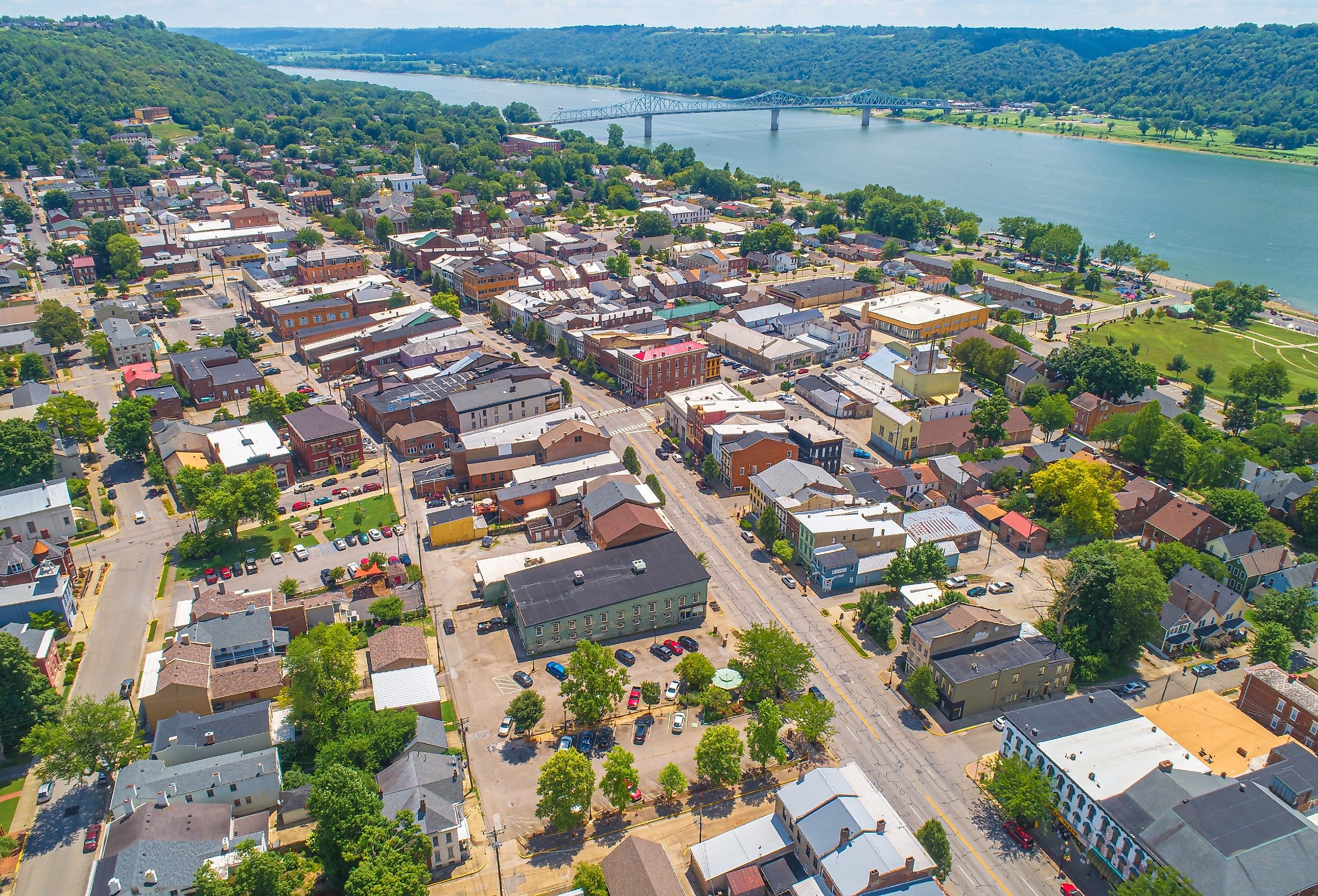
The Ohio River community of Madison has been called an outdoor museum for its variety of historic structures. Its historic district is the largest in the state, running more than 133 blocks. Within it, the Shrewsbury-Windle House and the Lanier Mansion are each individually designated National Historic Landmarks. Historic Eleutherian College is a separate landmark about 10 miles northwest, in Lancaster. Established by antislavery advocates in 1848, Eleutherian offered education to Black and white students, regardless of gender, before the Civil War. Another lesser-known structure is the Dr. W.D. Hutchings' Office and Museum, a restored 19th-century medical office holding surgical tools, medical records, books, and other artifacts. Madison also gives hikers the chance to see four waterfalls at nearby Clifty Falls State Park, established in 1920 to preserve the falls on Clifty Creek.
Rockville

Rockville stands apart from other historic Indiana towns because its best structures aren't buildings at all, but covered bridges. Parke County holds 31 of them, which is why it calls itself the Covered Bridge Capital of the World. Visitors can pick up free covered-bridge maps at Rockville's festival information booths and take guided bus tours during the Parke County Covered Bridge Festival, which begins on the second Friday of October each year. Near Rockville, the Crooks Covered Bridge, built in the late 1850s and later rebuilt, stands about five miles southeast of town, while the 1895 Billie Creek Covered Bridge sits in Billie Creek Village to the east. The Old Jail Inn welcomes overnight guests to former jail cells, and its downstairs Drunk Tank Winery serves wine tastings, wine slushies, and beer.
Santa Claus

Santa Claus is more than a community with an unusual name. It is one of the most festive towns in the state, with statues of St. Nick all around, including at the Santa Claus Museum and Village and at Holiday World and Splashin' Safari. That park is the town's main draw, pulling in roller coaster fans and families headed for the water rides. Santa Claus isn't only a summer stop, though. It sits close to a quieter historic landmark, the Lincoln Boyhood National Memorial, where Abraham Lincoln lived from ages 7 to 21, the formative stretch that shaped the future President. At the memorial, visitors can walk more than two miles of trails between the Pioneer Cemetery and the Living Historical Farm, while the separate Lincoln State Park, across State Road 162, offers about 10 miles of hiking.
Nashville

Nashville is often confused with the Tennessee capital, but it carries a much different feel as a quiet art town set among hills that roll out over its state parks. Its landscape matters geologically, too. The area was missed by the drifting glaciers of the last ice age, which is why its tall hills and ridges still stand, including the 1,058-foot Weed Patch Hill in Brown County State Park. The region's trails and trees, among them Indiana's state-threatened yellowwood, helped inspire painters such as T.C. Steele. The T.C. Steele State Historic Site sits in the forest with a collection of his work, while the Brown County Art Gallery downtown showcases local artists working in every style.
Monticello

Monticello is a lakeside retreat in north-central Indiana. Two reservoirs formed by hydroelectric dams on the Tippecanoe River, Lake Shafer and Lake Freeman, sit at its edges, so water activities run through the whole town. One can catch a movie at the Lake Shore Drive-In, open since 1949, or board the Madam Carroll for a cruise. At 135 feet long and 300 tons, that boat is the largest registered vessel in Indiana, and it hosts everything from live shows to dinner excursions. Monticello also offers the roller coasters of Indiana Beach Amusement Park on Lake Shafer and the calmer stretch of Bluewater Beach Park on the Tippecanoe.
Where Indiana Keeps Its History
What ties these towns together is how much of Indiana's past they still hold in plain sight. Jasper and Vevay preserve the German and Swiss communities that settled them, while New Harmony keeps the footprint of two failed utopias. Vincennes and Santa Claus each claim a piece of national history, one as the state's oldest settlement, the other as the ground where a future President came of age. Madison and Rockville turned their old architecture and covered bridges into everyday landmarks, and Nashville and Monticello show how the state's unglaciated hills and dammed rivers shaped where people gather now. Visit any one of them and the history isn't behind glass. It is the town itself.