The 15 Most Visited Cities In Europe
Cross-border travel within Europe bounced back hard after the pandemic. Tourist numbers in the major cities sit above their pre-2020 highs. London still tops the visitor charts. Paris and Istanbul follow close behind. A shared currency across most of the European Union and a tight rail network make hopping between any two cities easier than ever. The fifteen below pull in the bulk of the continent's international arrivals.
London, United Kingdom

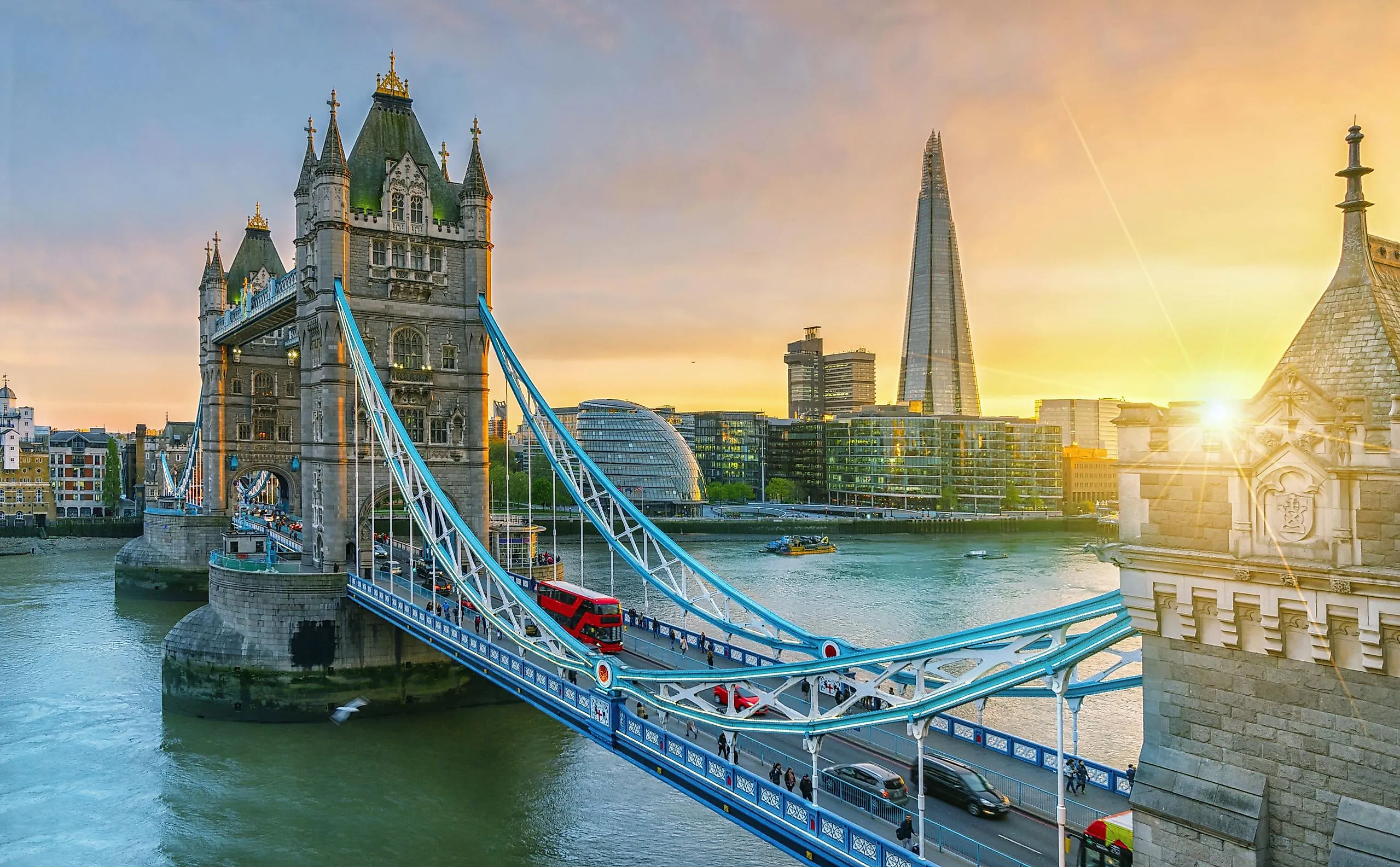
London leads the continent, pulling in roughly 20.7 million international visitors a year. The United Kingdom sits across the English Channel from the mainland and is no longer part of the EU after the 2016 Brexit vote, but the Eurostar trains keep running between London and Paris, Brussels, and Amsterdam in a few hours flat. The city itself runs on contrast. Westminster Abbey, Buckingham Palace, Big Ben, and the Thames bridges anchor the postcard view, while the West End theaters, the British Museum, and free entry at the National Gallery and Tate Modern do the cultural heavy lifting.
A few practical things to know: Heathrow remains one of the busiest and most strictly screened airports on the continent, and the Tube can get you almost anywhere for less than the price of a cab. Skip the chains and stick to the pubs, curry houses on Brick Lane, and the food halls at Borough Market. London is expensive, but the museums are free and the parks are vast.
Paris, France

Paris draws around 16.8 million international visitors a year, and the post-2024 Olympics infrastructure upgrades have lasted. The Seine is cleaner than it was a decade ago, the riverside expressways have been turned into pedestrian promenades, and most of the city's headline museums are open again after their pre-Games renovations. The Louvre, the Musée d'Orsay, and the freshly reopened Notre-Dame all sit within walking distance of each other, and the Eiffel Tower still does what it has always done.
Paris is not cheap, but it is not all gold-trimmed either. Plenty of decent hostels cluster around the Gare du Nord. The boulangerie on the corner makes a better baguette than any restaurant. A long walk along the Seine costs nothing, and the views from Sacré-Cœur in Montmartre are free at sunset. The French capital rewards travelers who slow down rather than tick boxes.
Istanbul, Türkiye

Istanbul takes the bronze with about 12.1 million visitors a year, and it is the only major city on the planet that straddles two continents. The Bosphorus splits the European and Asian sides, and a quick ferry ride across counts as crossing continents. It is the largest city in Türkiye, though Ankara holds the capital title. For travelers coming out of Western Europe, prices feel pleasantly low, and the food alone is reason enough to visit.
Once known as Constantinople, the city was for centuries one of the most powerful cities in the world. The Hagia Sophia, the Blue Mosque, and the Topkapı Palace all sit within a short walk of each other in Sultanahmet. The Grand Bazaar covers 60-plus alleys and 4,000 shops, and the Spice Bazaar is the better one for actually eating things. The Bosphorus dinner cruise is a tourist staple worth doing once.
Antalya, Türkiye

Antalya sees roughly 10.7 million visitors a year, most of them headed for the beaches along the Turquoise Coast. The Mediterranean climate is long and dry, the resorts are stacked one after another along the coast, and the dental-tourism scene has turned this city into an unlikely medical hub for European patients. Hadrian's Gate, a Roman triumphal arch in white marble at the old-town entrance, has carried carved reliefs honoring the Roman emperor Hadrian since 130 AD, the year of his visit to the city then known as Attaleia.
The beaches along the Mediterranean are the main pull. Lara Beach is the family-friendly long sandy stretch east of town. Konyaaltı is closer to the center with cliffs at one end. Damlataş Beach in Alanya, a couple of hours east, has a 15,000-year-old cave full of stalactites right next to the sand. Drinks and food run about a quarter of London prices, which is a major part of the appeal.
Rome, Italy

Rome pulls in around 9.7 million visitors a year, and 2025 was a Jubilee Year, which means the Holy Door at St. Peter's Basilica was open and millions of pilgrims came through. The Colosseum, Pantheon, Roman Forum, and Trevi Fountain do not need much introduction. The Vatican Museums and the Sistine Chapel sit inside the independent state of Vatican City, walkable from central Rome with no border check.
Food is the other main reason to come. Roman cuisine is built on five or six core pasta dishes (carbonara, cacio e pepe, amatriciana, gricia, pasta alla checca), and the best versions are not the ones with English menus out front. Stick to the Testaccio and Trastevere neighborhoods for the better trattorias. Gelato at Giolitti is the tourist favorite, but the smaller artigianale spots out toward Monti or San Lorenzo are usually better.
Prague, Czech Republic

The Czech capital welcomes around 9 million travelers a year, and the cheap-beer reputation is well earned. Pilsner-style lagers run about half what they cost in Berlin, and the medieval Old Town is small enough to walk in an afternoon. The Astronomical Clock in Old Town Square still does its hourly puppet show. The Charles Bridge is best crossed before 9 in the morning before the crowds arrive.
Prague is one of the more architecturally layered cities in Central Europe, with Gothic, Baroque, Art Nouveau, and Cubist buildings standing on the same block. The "City of a Hundred Spires" looks especially good viewed across the Vltava on a tram ride. The Jewish Quarter, Prague Castle, and the Strahov Monastery library are the next layer beyond the Old Town set pieces.
Amsterdam, Netherlands

Amsterdam draws about 8.5 million visitors a year, and the city has been actively trying to dial back the rowdier end of that traffic. The "stay away" advertising campaign aimed at British stag parties launched in 2023, several of the coffeeshops in the red-light district have closed, and cruise ships are being phased out of the central harbor by 2026. None of which makes the city less worth visiting; the museums, canals, and bike culture are still all here.
The Anne Frank House requires advance booking and sells out weeks ahead. The Rijksmuseum holds Rembrandt's Night Watch, while the Van Gogh Museum next door is its own day. Rent a bike and use it the way locals do. Amsterdam-Schiphol is one of the better-connected airports in Europe and a common Atlantic-crossing layover.
Barcelona, Spain

Barcelona logs roughly 6.7 million international arrivals a year. The relationship between the city and its tourists is openly tense; the 2024 "tourists go home" protests with water guns made global news, and the city government has pledged to phase out all short-term tourist apartment rentals by 2028. Visiting is still completely fine. Just rent through hotels rather than apartments, and lean into the parts of the city locals actually use.
The Sagrada Família reached its architectural completion on February 20, 2026, when the upper arm of the cross was installed atop the 172.5-metre Tower of Jesus Christ; the basilica is now the world's tallest church, surpassing Ulm Minster in Germany. Interior work and the Glory Façade are still expected to continue through the late 2020s and beyond. Park Güell, Casa Batlló, and Casa Milà fill the rest of the Gaudí circuit. The Gothic Quarter and El Born are the older medieval core. The Camp Nou stadium is in the middle of a multi-year rebuild, but FC Barcelona is playing matches at the Olympic Stadium on Montjuïc in the meantime.
Milan, Italy

Milan pulls in about 6.5 million visitors a year. The city co-hosted the 2026 Winter Olympics with Cortina d'Ampezzo in February. The Olympic preparations meant new rail links to the Alps and an aggressive push on pedestrian zones, both of which have outlasted the Games themselves. Half a millennium after the Italian Wars, Milan has settled into its role as the country's fashion and finance capital, with a skyline that mixes Renaissance churches and skyscrapers in roughly equal measure.
The Duomo, with its 135 spires, is the headline architecture. Da Vinci's Last Supper at Santa Maria delle Grazie requires booking three months in advance. The Galleria Vittorio Emanuele II, opened in 1877, is one of the world's oldest active shopping arcades and the place to be photographed pretending you can afford the boutiques. For dinner, Milanese cuisine leans on osso buco, risotto alla milanese, and cotoletta.
Vienna, Austria

The Austrian capital sees roughly 6.3 million visitors a year. Vienna has topped the Economist Intelligence Unit's most livable city rankings for several of the past years running, and the orderliness shows. The streets are clean, the public transport runs on time, and the coffeehouses still serve melange in china cups with a small glass of water on the side. Habsburg-era buildings line nearly every block in the central First District.
The Schönbrunn Palace and the Hofburg Palace are the imperial pair. The Belvedere holds Klimt's The Kiss. The Vienna State Opera runs nearly every night and sells standing-room tickets for a few euros. Mozart wrote much of his major work here, and Freud kept his consulting room a short tram ride away on Berggasse 19, now a museum.
Berlin, Germany

Berlin draws about 5.8 million visitors a year, and the clubbing reputation is real. Berghain remains the temple of techno, Sisyphos and About Blank pull crowds every weekend, and even the smaller bars stay open well past sunrise. The city is also where 20th-century European history compresses into a single walkable map: the Berlin Wall remnants at the East Side Gallery, Checkpoint Charlie, the Memorial to the Murdered Jews of Europe, and the Reichstag all sit within a few stops of each other.
Museum Island holds five major museums on a single small island in the Spree, including the Pergamon (under partial reconstruction through 2027) and the Neues Museum. The food scene has shifted in a major way over the past decade, with Vietnamese, Turkish, and Levantine cooking now anchoring the city as firmly as currywurst. Berlin is still one of the cheaper major European capitals, though prices have climbed steadily since 2020.
Madrid, Spain

The Spanish capital pulls in around 5.5 million international visitors a year, and the city has been the surprise European story of the past few years. While Barcelona pushes back against tourism, Madrid has been actively courting it, with a wave of new hotel openings and a rising profile as a financial alternative to London since Brexit. The Baroque Palacio Real, the former home of the Spanish royal family, anchors the western edge of the historic core. The Puerta del Sol, the symbolic center of the country, sits a few blocks east.
The Golden Triangle of museums (Prado, Reina Sofía, and Thyssen-Bornemisza) sits within a 10-minute walk. The Prado holds Velázquez's Las Meninas and Goya's late "black paintings." Reina Sofía holds Picasso's Guernica. Retiro Park covers 350 acres in the middle of the city. Eat late, drink late, and embrace the siesta.
Venice, Italy

Venice sees about 5.4 million visitors a year. As of April 2024, day-trippers now pay a five-euro access fee to enter the historic center on busier days, an attempt to manage the crushing weight of tourism on a city that is literally sinking under it. The city was traditionally founded in the 5th century as a refuge from Barbarian invasions and rose by the 12th century into one of Europe's great maritime powers.
The Piazza San Marco, St. Mark's Basilica, and the Doge's Palace are the headline trio. The Rialto Bridge is the famous crossing, but the Accademia and Scalzi bridges are quieter. Take a Vaporetto (the public ferry) instead of a private gondola if you want to actually get somewhere; gondolas are for the photo, ferries are for transport. Visit in winter for half the crowds and the eerie fog through the canals.
Moscow, Russia

The Russian capital held around 5.4 million international visitors a year before 2022, though the picture has shifted dramatically since the invasion of Ukraine. Western airlines have suspended flights, the visa process for most Europeans and Americans has become considerably more difficult, and Western credit cards no longer work inside the country. International visitor numbers have dropped substantially, and most current tourism comes from China, the Middle East, and other non-Western markets.
For the cultural record: St. Basil's Cathedral, with its candy-cane spires, anchors the southern end of Red Square. The Kremlin walls run along the western side, with the Lenin Mausoleum at the base. The Tsar Cannon, the Tsar Bell, and the Kremlin Armory all sit inside the Kremlin grounds. Napoleon and Stalin both wanted St. Basil's destroyed; it survives anyway. The Bolshoi Theatre, opened in 1825, still runs the Bolshoi Ballet at its six-tier auditorium.
Dublin, Ireland

Dublin rounds out the list with around 5.2 million visitors a year. Ryanair, headquartered just outside the city, runs cheap flights to nearly every airport in Europe, and Dublin is a common stopover on transatlantic crossings between North America and the continent. The city is small enough to walk in a couple of days, with Trinity College, the Book of Kells, and Temple Bar all within a short stretch of each other.
Phoenix Park, the largest enclosed urban park in Europe, runs twice the size of New York's Central Park and is home to a wild herd of fallow deer. The Guinness Storehouse at St. James's Gate is the most-visited tourist attraction in the country, with a pint included on the rooftop Gravity Bar. Get off the headline streets for the better pubs (Grogan's, The Long Hall, Mulligan's), and head out to the Wicklow Mountains, Howth, or Glendalough for day trips into the rest of the island.
Each city earns its spot on this list for a different reason. London is the business and theater capital. Paris and Venice are the romantic standbys. Istanbul and Rome carry the deepest history. Berlin and Amsterdam pull the younger crowd, while Madrid and Prague offer some of the best value for the money. Whether the goal is to tick off all fifteen on a long Eurotrip or pick one for a weekend, the rail and budget-flight networks make moving between them easier than ever. If you want to skip the headline cities entirely, the Scandinavian capitals (Copenhagen, Stockholm, Oslo) deliver some of the most pleasant summers on the continent with a fraction of the crowds.
The Most Visited Cities In Europe
| Rank | City | Country | International Visitors |
|---|---|---|---|
| 1 | London | United Kingdom | 20,715,900 |
| 2 | Paris | France | 16,863,500 |
| 3 | Istanbul | Türkiye | 12,121,100 |
| 4 | Antalya | Türkiye | 10,729,300 |
| 5 | Rome | Italy | 9,703,200 |
| 6 | Prague | Czech Republic | 9,038,900 |
| 7 | Amsterdam | Netherlands | 8,476,600 |
| 8 | Barcelona | Spain | 6,726,000 |
| 9 | Milan | Italy | 6,513,000 |
| 10 | Vienna | Austria | 6,303,800 |
| 11 | Berlin | Germany | 5,770,900 |
| 12 | Madrid | Spain | 5,512,600 |
| 13 | Venice | Italy | 5,406,800 |
| 14 | Moscow | Russia | 5,404,500 |
| 15 | Dublin | Ireland | 5,185,000 |
| 16 | Athens | Greece | 5,133,200 |
| 17 | Florence | Italy | 5,015,400 |
| 18 | Munich | Germany | 4,036,700 |
| 19 | Budapest | Hungary | 4,004,400 |
| 20 | St. Petersburg | Russia | 3,996,000 |
| 21 | Lisbon | Portugal | 3,790,500 |
| 22 | Heraklion | Greece | 3,399,600 |
| 23 | Brussels | Belgium | 3,074,100 |
| 24 | Copenhagen | Denmark | 3,037,100 |
| 25 | Krakow | Poland | 2,937,200 |
Source: Euromonitor