8 Whimsical Towns in France
France's small towns each carry a separate story. Saint-Paul-de-Vence has held the same medieval ramparts since the 1500s and drew Picasso, Matisse, and Chagall to its narrow streets between the wars. Carcassonne's double walls and 52 towers were rescued from demolition in the 19th century by the architect Eugène Viollet-le-Duc. Giverny was Claude Monet's home for the last 43 years of his life and is now the site of the gardens he painted obsessively for decades. The eight below cover the south coast, the Mediterranean foothills, and the Norman tidal flats.
Saint-Paul-de-Vence

Saint-Paul-de-Vence is a commune in the Alpes-Maritimes department of the Provence-Alpes-Côte d'Azur region, set on a hilltop overlooking the Mediterranean. Considered one of the oldest hilltop villages on the French Riviera, it was originally a medieval fortress. Today, the stone-walled Old Town is home to around 300 residents, while the remaining 3,200 or so live outside the medieval walls in the valleys below.
The village's villas and narrow cobblestone streets drew a steady stream of painters during the interwar period of the 1920s and 1930s, when the inn La Colombe d'Or (run by the painter and art collector Paul Roux) became their main gathering place. Picasso, Matisse, Modigliani, Soutine, Signac, and Léger all spent time in the village; Marc Chagall is the artist most closely associated with the area, having lived in nearby Vence from 1950 to 1966 before moving to Saint-Paul-de-Vence itself, where he is buried in the village cemetery. Chagall's "Moses Saved from the Waters," a colorful mosaic installed in the baptistery of the Notre-Dame-de-la-Nativité Cathedral in Vence, is regarded as one of his major late religious works. The artistic community still thrives, with a long list of galleries throughout the village and the nearby Fondation Maeght, a modern-art museum that opened in 1964.
Saint-Paul-de-Vence is pedestrian-only, with cars and bikes excluded from the historic core, so visitors explore its narrow streets on foot. Hidden sculptures sit in alcoves along the route through to the public square, where the Place de la Grande Fontaine sits at the center of the village. The 17th-century fountain was originally used for drinking water and washing, fed by the village's medieval aqueduct system. Visitors can also walk the rampart wall surrounding the Old Town, which has stood since the 16th century.
Carcassonne

On a rocky outcrop in the Aude department of southern France, Carcassonne is one of the largest medieval citadels in Europe, with two concentric rings of stone ramparts, 52 towers, winding alleys, and a dry moat. The cité has been a fortified position since the Roman period and was added to the UNESCO World Heritage List in 1997. The site fell into disrepair after the Pyrenees border with Spain shifted south in 1659, and a 19th-century restoration led by the architect Eugène Viollet-le-Duc rebuilt the towers, conical roofs, and crenellations now visible. The city is divided into the upper cité and the lower town (the Bastide Saint-Louis), separated by the River Aude. Most visitors head straight for the Château Comtal, the 12th-century counts' castle inside the cité, which is often cited locally as one of the inspirations Walt Disney took from his European travels (Disney's official position is that the Sleeping Beauty Castle was modeled on Neuschwanstein in Bavaria, but the Carcassonne connection is part of regional tourism lore).
The Saint-Nazaire Basilica holds 13th- and 14th-century stained-glass windows considered among the finest in southern France. Carcassonne's architecture reflects its layered history, from private mansions and religious buildings through museums, arts centers, and gardens. Saint-Vincent's Church in the lower town shows Languedoc Gothic architecture, with 15th-century stained-glass rosettes and 17th-century paintings by Gamelin, Mignard, and Subleyras. The Musée des Beaux-Arts houses a collection of European art ranging across the 17th century through the present day and offers group tours by appointment.
Mont-Saint-Michel

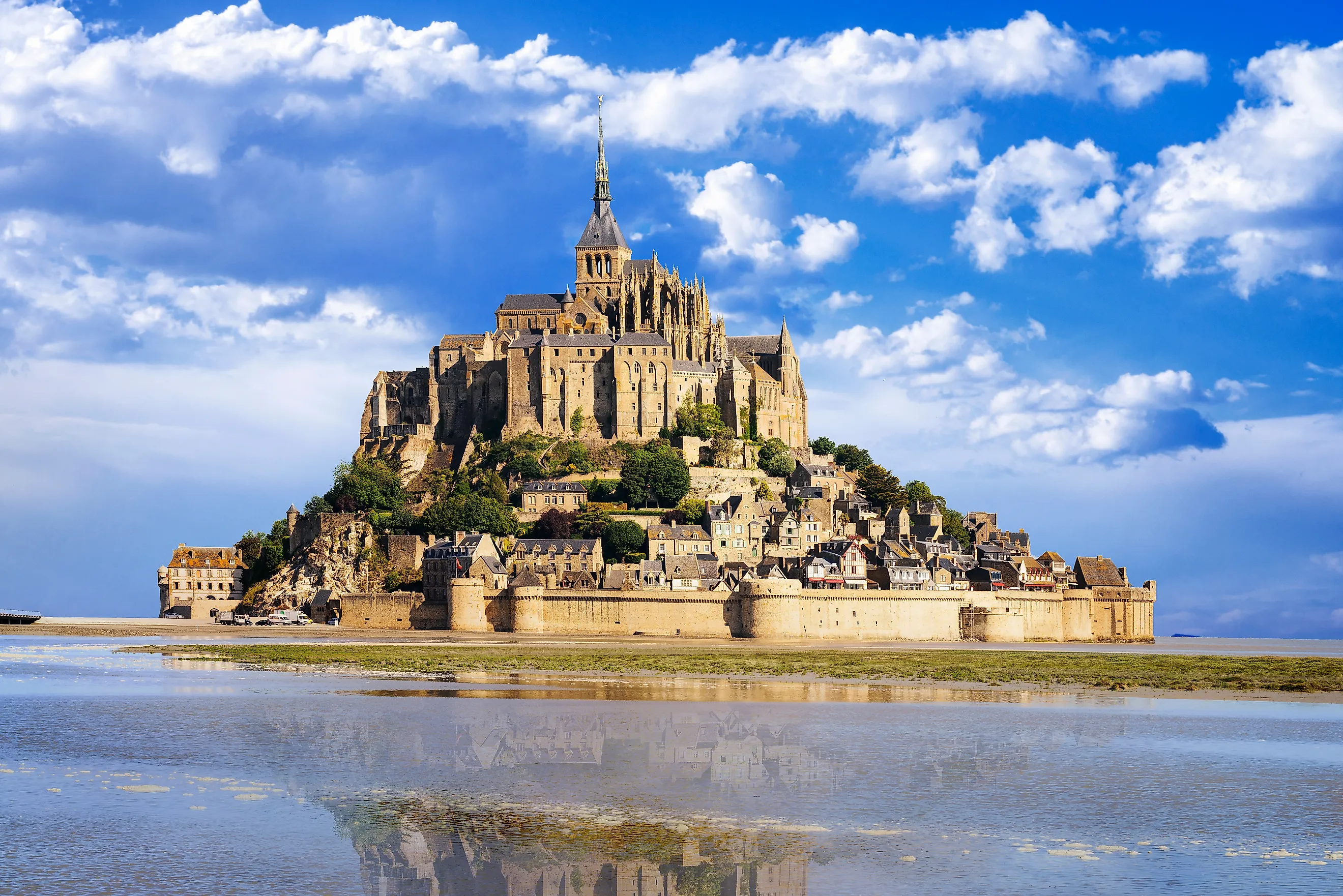
Considered one of France's most recognizable sites, Mont-Saint-Michel is a tidal island located at the mouth of the Couesnon River on the Normandy-Brittany border. The UNESCO World Heritage site is home to an abbey more than a thousand years old, surrounded by the bay at high tide and reachable by causeway at low tide. The island has been a pilgrimage destination since 708, when local bishop Aubert of Avranches built the first oratory after reporting that the Archangel Michael had pressed him to do so. In the 10th and 11th centuries, the Dukes of Normandy and the French kings supported the expansion of the Abbey, which has been widely cited as the visual inspiration for the kingdom of Corona in Disney's Tangled. Visitors can explore the abbey, the cloister, the monastery refectory, multiple shops, and the steep village streets, which remain lined with well-preserved historic buildings now converted into museums, restaurants, hotels, and shops, including the long-established La Mère Poulard restaurant, opened by Annette Poulard in 1888 and known for its omelets cooked over an open fire.
Giverny

Settled on the banks of the Seine, Giverny is a village in the Normandy region of northern France. After Claude Monet moved there in 1883 and word of his work spread, a wave of mostly American painters settled in Giverny starting in 1887, and over the next three decades more than 100 artists worked in the village under impressionist and post-impressionist influence. Giverny is best known as the site of Claude Monet's former home and gardens, where the artist lived from 1883 until his death in 1926.
Monet's water lily garden and home are now run by the Fondation Claude Monet, near the Musée des Impressionnismes Giverny, which covers the broader Impressionist movement. Monet's gardens are divided into two parts: the front garden, or Clos Normand, and the Japanese-inspired water lily garden on the other side of the road, reached via an underground passage. The community spent close to a decade restoring the property after Monet's stepdaughter Blanche died in 1947, and the gardens reopened in 1980. The wisteria Monet planted on the Japanese footbridge can still be seen growing there. Visitors can wander through the village and take guided tours of the property, walking the same paths Monet recorded in hundreds of canvases.
Pérouges

Pérouges is a preserved hilltop village in the Ain department, northeast of Lyon, where architecture from the Middle Ages, cobbled streets, and stone buildings with crawling vines fill the small intramural core. About 80 residents live within the medieval walls, while the broader commune holds roughly 1,200 more outside the city limits. Officially designated one of Les Plus Beaux Villages de France, Pérouges served as a filming location for the 1961 Bernard Borderie adaptation of The Three Musketeers, the production that put the village on the international tourism map.
Each year, during the second weekend of June, the village hosts a medieval festival with locals dressed in period garb and dozens of tents showcasing nobles, peasants, merchants, innkeepers, and bakers. The program runs animal shows, full-armor combat demonstrations, and an evening fire show. The parade is a procession of nobles, musicians, armed men, and knights, closing with misfits and beggars for the full effect.
After the Renaissance, Pérouges fell into disrepair until a restoration movement led by the Société du Vieux Pérouges began in 1911, with support from Édouard Herriot and the French Beaux-Arts administration. The town received official designation as one of the Most Beautiful Villages of France in 1988. Guided tours include the Sainte-Marie-Madeleine Church, set into the old city's ramparts, and the Maison des Princes, a 14th- and 15th-century mansion. A local museum within the mansion holds permanent exhibitions of medieval objects and archives.
Roussillon

Roussillon sits in the valleys of the Luberon region, on top of one of the largest ochre deposits in Europe. The houses along the village's winding streets are painted in reds, yellows, oranges, and pinks, with many different shades drawn from the local pigments. Ochre was mined commercially in the village from the 18th century through the 1930s but is no longer actively extracted; visitors can still walk the Sentier des Ocres trail through the abandoned quarry, which displays the geological strata that produce the colors. Le Conservatoire des Ocres et Pigments Appliqués, housed in an old ochre processing factory, runs exhibitions on the history of the pigment.
The geological explanation for the deposits is that the Luberon was once beneath a tropical sea, and the ochre color comes mainly from goethite, an iron-oxide mineral named in 1806 after the German writer and amateur mineralogist Johann Wolfgang von Goethe. The local legend is darker. According to a 12th-century troubadour razo, the married Lady Soremonde fell in love with the troubadour Guillem de Cabestany while her husband, Raymond of Castel Roussillon, was away hunting. When the lord discovered the affair, he is said to have killed Guillem, served his heart to Soremonde for dinner, and revealed what she had eaten; in anguish, she threw herself from the cliffs, and the local hills have been stained red ever since.
Despite its small size, Roussillon has more restaurants than year-round residents, with the town center holding the main concentration. Local fixtures include La Grappe de Raisin and Restaurant Omma, both known for the rustic ambiance and the regional Provençal kitchen.
Saint-Jean-Cap-Ferrat

A peninsula commune in the Alpes-Maritimes department, Saint-Jean-Cap-Ferrat was originally a fishing and farming village before the 19th century. As the surrounding Côte d'Azur developed as a wintering destination for European aristocracy, the area transformed into a favorite vacation spot for wealthy patrons, who built grand estates that prompted the growth of luxury hotels and shifted the local economy toward an upscale resort base.
The best-known of these estates is the Villa Ephrussi de Rothschild, an Italian Renaissance-inspired pink palace built between 1907 and 1912 by Baroness Béatrice Ephrussi de Rothschild. Now a historic monument, the villa houses private apartments designed in both Florentine and Venetian styles and a collection of period furniture, paintings, sculptures, and porcelain. The estate's gardens are organized into nine themed sections (French, Spanish, Florentine, Stone, Japanese, Exotic, Rose, Provençal, and Sèvres), each offering views of the coast and bay. Other historic villas include Villa Santo Sospir, decorated by Jean Cocteau in the 1950s. Visitors can experience the peninsula's coastal heritage by walking the mile-long interpretive trail at Pointe Saint-Hospice. The walk features six observation points and weaves through attractions including the Saint-Hospice Chapel and its accompanying bronze Madonna statue. The trail offers panoramic views toward Cap-Martin and Monaco.
Gordes

In the foothills of the Monts de Vaucluse, the hilltop village of Gordes greets visitors with cobbled streets and white limestone buildings cut into the mountainside. The alleyways and arcades hold a range of Provençal restaurants, accompanied by a lively art scene shaped by artists including André Lhote, Marc Chagall, Victor Vasarely, and Pol Mara, all of whom spent time in the village in the mid-20th century.
At the heart of the village stands the Château de Gordes, a Renaissance castle built on the foundations of a fortress that dates to 1031. Most of what is visible today was rebuilt between 1525 and 1541, and the building was classified as a French historic monument in 1931. The former medieval fortress is linked to one of the oldest noble families in the region. Just outside the village is the Sénanque Abbey, a Cistercian monastery founded in 1148 with 12th-century Romanesque architecture and a single bell tower. The abbey has survived for nearly nine centuries and is fronted by a lavender field that the resident monks maintain to support the community.
Gordes is also home to the Village des Bories, an open-air museum that preserves a hamlet of dry-stone huts, locally called bories. These stone huts are thought to have been temporary housing used for seasonal agricultural work. Gordes was awarded the Croix de Guerre in 1948 for the resistance work the village undertook during World War II, when it suffered significant damage from German retaliation in August 1944.
Eight Villages, Eight Different Frances
The eight communities above span four distinct French regions, each shaped by a different mix of geology, religious history, and 20th-century artistic migration. Saint-Paul-de-Vence and Saint-Jean-Cap-Ferrat run on the Riviera's interwar arts-and-aristocracy legacy. Carcassonne and Mont-Saint-Michel survive as the country's two most famous medieval restoration projects. Giverny and Gordes still trade on the painters who worked there. Pérouges and Roussillon run on the strangeness of their own geography. Each remains a place where the work of past centuries continues to shape what daily life looks like today.