8 Prettiest Downtown Strips In Washington
Washington's prettiest downtown strips do not follow a single blueprint. In Friday Harbor, Spring Street leads toward the water and the San Juan Islands, while Port Townsend's Water Street is lined with ornate 19th century buildings. Leavenworth turns Front Street into a Bavarian-inspired streetscape, and Roslyn's Pennsylvania Avenue carries the marks of its coal-mining past. Elsewhere, whales, galleries, historic theaters, and old storefronts give these main streets their own personality. Taken together, these Washington small town downtowns show how much character can into a few blocks.
Friday Harbor

In 1873, a natural spring bubbled up in the middle of the main pathway leading to the waterfront in Friday Harbor. The water was eventually siphoned off for drinking, but the sudden appearance of a natural spring inspired the name Spring Street, the main strip that today runs through this small town. On one end of this pretty street, Memorial Park honors 20th century service men lost in the World Wars and Korean War, shaded by rare, century-old Dutch Elms.
Across the street, Western Prince Whale Watching Adventures provides a front-row seat to observe local whale pods using Zodiac rafts. The high-speed boat tours explore the waters of the San Juan Islands and guests often see orca, humpback, minke, and gray whales. Whale enthusiasts who prefer to remain on dry land can check out The Whale Museum. The museum's Gallery of Whales teaches about the species and pods living in the area, and a full whale skeleton is on display highlighting the enormous size of these creations.
Along the pretty main strip, art galleries offer local made jewelry, crafts, and fine art. The Arctic Raven Gallery focuses on native fine art from people in the arctic and northwest coast. The gallery features prints and sculptures made from bone, stone, and even ivory produced by Inuit, Inupiat and Yup’ik natives. Further up the street, Wind Gallery and Studios offers locally made paintings, glass, and more from artists and artisans in the region.
Port Townsend

A 42-foot long skeleton of a gray whale sits on Union Wharf in Port Townsend. The whale died and washed ashore near Port Ludlow in 2019, and after scientists studied its decomposition, the reconstructed skeleton was installed as an open air art exhibit at the end of the wharf. The wharf is at the end of Taylor Street, just off Water Street, the main downtown strip running along the waterfront.
At the corner of Taylor and Water Street stands the stunning, Victorian-era, Hastings Building. The landmark building was constructed in 1889 and showcases the ornate architecture of the period. The Hastings Building is one of the many 19th Century buildings that makes Water Street one of the prettiest downtown strips in the state. Today the building is home to Mara's Gallery filled with an eclectic mix of decorative arts, paintings, and sculpture.
Further down Water Street, the Come Sew is a drop-in sewing studio providing equipment and coaching for sewing enthusiasts. Come Sew also hosts sewing groups and sew-a-long experiences. Would-be tailors can find distinctive fabrics up the street at District Fabric. The shop stocks natural fibers, silk, wool, leather, cotton, and velvet. The shop also has essential accessories like thread, buttons, and zippers.
For those seeking creative inspiration, check out the Jefferson County Historical Society Museum of Art + History. The former 1892 city hall building today presents the works of local artists and unique historical items like a horse-drawn hearse.
Langley

A bell mounted on the Langley waterfront comes with the instructions, "spy a whale, ring the bell." Orcas and Gray whales are the most common to see around the Puget Sound estuaries, but other species make appearances too. The Whale Bell is intended to notify others in the area so they might see the passing whales as well. The bell is mounted adjacent to Hope: The Wishing Whale, a bronze sculpture installed in 2020 by the Langley Arts Fund. The statue is in a small park intended to connect the waterfront with the pretty downtown strip on 1st Street.
Just off 1st Street, the Langley Whale Center is dedicated to celebrating the enormous creatures, sharing information about the lives of these marine mammals. The center provides guided tours of the facility with information on the species that frequent the area and their habitats. The center includes a Harbor Porpoise skeleton and bone specimens from other species.
There is more than just whales to see in this pretty downtown. The Clyde Theatre right on 1st Street was first built in 1937 during the Great Depression. Modern renovations have updated the seating, sound, and projectors, and in addition to new films, the theater hosts special events like the short films of Wandering Reel Traveling Film Festival, documentaries, and events featuring filmmakers. The pretty downtown strip is also home to small shops like the Moonraker Bookstore featuring new titles and select gifts like puzzles, as well as art galleries like Museo, a contemporary fine art gallery.
Coupeville

In the 1850s, settlers in Coupeville built two-story fortified blockhouses because of the perceived threat from native inhabitants. The Alexander Blockhouse, built in 1855, was moved in the 1930s from its original location on the John Alexander farm to where it stands now on the corner of Alexander and Front Streets. One of four remaining blockhouses on Whidbey Island, the unique building is an important part of local history overlooking the pretty downtown strip.
Next door to the blockhouse, the Island County Historical Society, maintains a museum featuring local artifacts and documenting the history of the island. In addition to rotating exhibits, the museum hosts events throughout the year including panel discussions, history presentations, and conversations about local culture and heritage.
Small, independent shops line both sides of Front Street. A Touch of Dutch features imported specialties from Europe including high quality toys, licorice candy, and packaged European foods. Kingfisher Bookstore stocks new titles and offers local authors' books on consignment. Their sister store, across the street, Kingfisher Arts & Letters, celebrates all things paper related, from stationary to notecards, plus essential paper accompaniments like fancy pens, ink, and paint.
The Coupeville Wharf extends 500 feet from shore, making it viable in low tides for mooring large vessels. Built in 1905, this historic structure is projected to be under water as early as 2050, but for now it is home to several shops like Penn Cove Outfitters offering local gifts and apparel. In With The Tide has coffee, pastries, and small bites.
Leavenworth

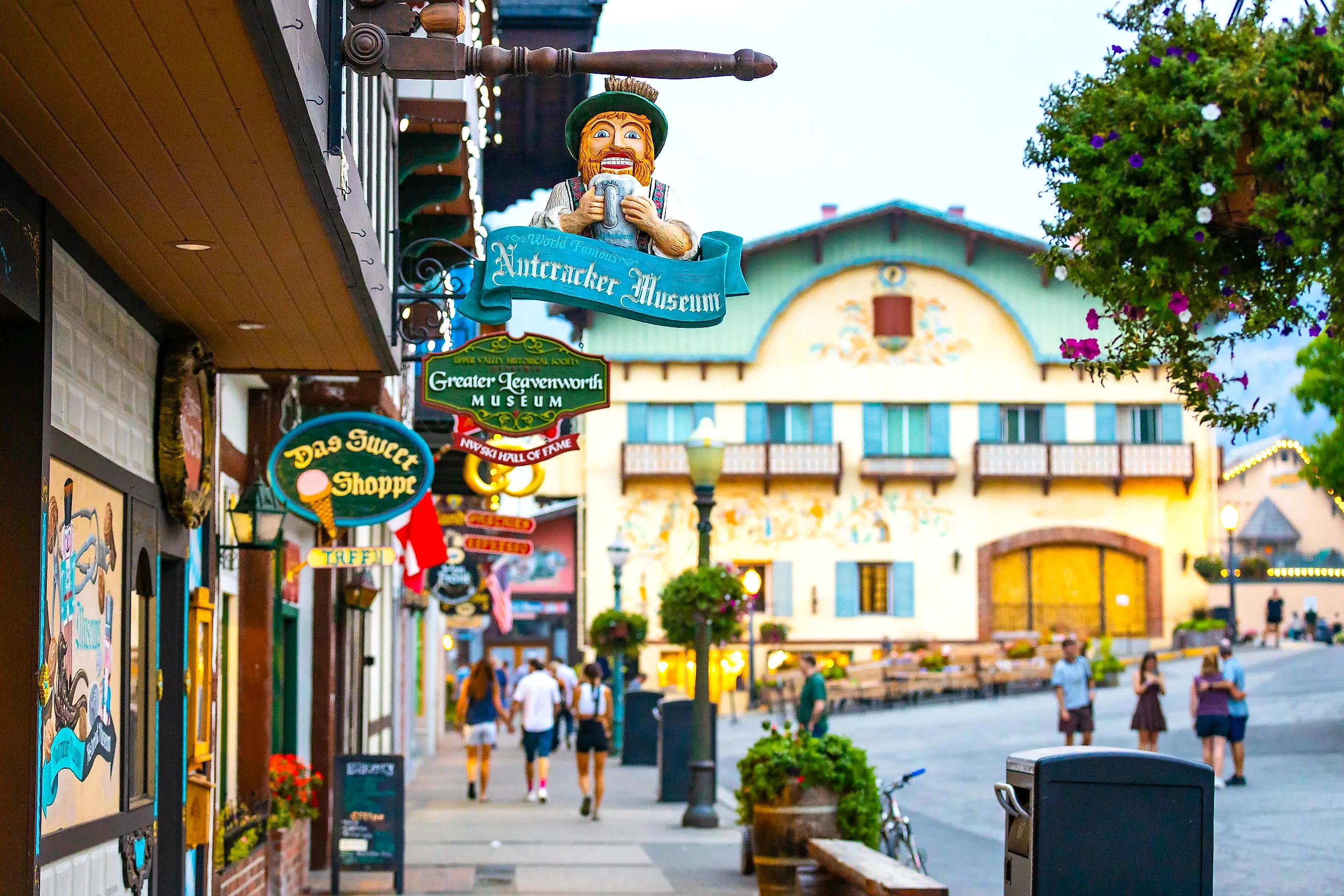
Heading away from the coast into the Cascade Mountains, Leavenworth is a Bavarian-style village intentionally designed as a tourist attraction. The former logging town was looking to reinvent itself, choosing to tightly control the architectural style of the buildings and mimic European alpine villages. The pretty strip along Front Street has buildings with balconies, parapets, thick heavy rooflines, and decorations designed to transport visitors to the Old World.
The restaurants and shops along this pretty strip embrace the quirky architectural choices, like at Stein, a family-friendly bar and restaurant. There are 55 taps pouring beer into liter steins or growlers, plus live events like comedy shows and local bands. A few doors down, The Soup Cellar offers dishes inspired by Old World traditions in a more casual setting. The menu includes a selection of Bavarian sausages.
If the town seems picture-perfect, stop in at Studio 1890 for a stylized, old-timey photograph. The photo studio has sets, costumes, and props in a variety of themes including the wild west, roaring 20s, and traditional Bavarian alpine clothing, and offers both digital copies and on-site printing.
This downtown strip has plenty of small shops too. Beyond the typical tourist-focused gift shops, there are places like The Wood Shop that offers up a huge selection of wooden toys including locally handmade wooden puzzles. On the other end of Front Street, Kris Kringl is a full-time Christmas store filled with holiday ornaments and decorations, for decking the halls or expanding a holiday village.
Roslyn

The discovery of coal in 1886 near Roslyn led to a population boom attracting laborers from two dozen ethnicities. Less than a century later in the 1960s, the last of the mines closed down, sinking the economy. By the 1970s, artists, musicians, and free thinkers -- people labeled hippies by the miners --reinvented the small town into a thriving arts community. Today, the town hosts the annual Roslyn Student Art Walk featuring local student art and interactive experiences. Live music is performed at the Roslyn Yard, an open lawn on the pretty downtown strip of Pennsylvania Avenue.
The Roslyn Historical Museum, on the western end of Pennsylvania Avenue, celebrates the many different ethnicities and nationalities of the coal miners who passed through the region. The museum also displays memorabilia from the television series Northern Exposure. The weird, 1990s-era television series, was set in a fictional Alaska town but filmed in Roslyn because of the mix of well-worn western architecture, similar climate, and easier accessibility. Fans of the show can take a self-guided walking tour of the buildings used as locations in the show.
Biking trails cut through this mountainous terrain around the town. There's a variety of skill levels, like Ewok, a 3.6 mile uphill challenge, or the wide, and flatter Coal Mines Trail. Either way, Roslyn Bike and Board has the equipment rentals needed to tackle these trails, from fat tire bikes to e-bikes.
Ellensburg

While the townspeople celebrated Independence Day in 1889, a fire broke out in downtown Ellensburg destroying ten blocks. At the corner of Pearl and 4th Street, the Davidson Building had just started construction when the fire, started in a grocery store a few blocks over, consumed the construction site. A year later the Italian-style building opened, now crowned with a statue of phoenix rising from flames. Today, the iconic building stands at the center of this pretty downtown strip on Pearl Street.
Several retailers have spaces in the Davidson Building, like Mountain High Sports, offering a curated selection of active adventure apparel, as well as accessories for outdoor recreation. On the Pearl Street side of the building, the Pearl Bar and Grill serves up craft cocktails and American gastropub cuisine.
Further along Pearl Street, in the historic Ramsey Building, the Clymer Museum and Gallery highlights the works of artist John Ford Clymer, a native of Ellensburg. In addition to Clymer's works, the museum also displays exhibits of contemporary Western artists. Like the Davidson Building, the Ramsey Building was completed shortly after the fire that destroyed the downtown.
On the opposite end of Pearl Street, Dick and Jane's Spot is an outdoor sculpture garden, as well as the home and studio of artist Jane Orleman, who lived with artist Richard "Dick" Elliott until his death. Considered outsider artists for their refusal to conform to institutional conventions, their home became a gallery, part garden, part art collection, showcasing a wide collection of sculpture and mixed media artwork.
Walla Walla

More than 120 wineries spread across the valley around Walla Walla, and numerous tasting rooms line Main Street, like the Mercer Wine Tasting Room, Mark Ryan Winery, and Henry Earl Estate Wines. In all, more than a dozen wineries have tasting rooms downtown. Four times a year, Walla Walla celebrates the valley's wines with Wine Weekends. The participating wineries host special events, open new vintages for the first time, and celebrate the local grapes.
On Thursday throughout the summer, the Walla Walla Sip & Stroll makes sampling wines easy with a single ticket that incldues tasting pours at participating downtown tasting rooms. The event fills downtown with visitors, and local shops and restaurants also offer discounts during the events.
There's more than just wine in downtown Walla Walla. The Distillery Collective focuses on craft spirits. Two distilleries, Hetterley’s Shot in the Dark Craft Distillery and DW Distilling, teamed up to offer locally crafted liquor like vodka, whiskey and brandy. The drinks can be sipped at the collective's tasting room in the Marcus Whitman Hotel. The historic hotel, built in the style of Italian Renaissance Revival architecture, opened in 1928 and provides a grand experience for sipping craft cocktails.
One of the more unique attractions in Walla Walla, and unrelated to the alcohol industry, is the Museum of Un-Natural History, also on Main Street. The museum displays a collection of surrealist sculptures and collages created by Gerald Matthews, a former actor-turned-artist. The inspiration for the museum came from when Matthews lived in Manhattan next to the American Museum of Natural History when he and his friends decided on the need for a museum celebrating the absurd.
Small Towns That Are More Than A Pretty Street
Washington's small towns have big offerings. The pretty streets in these downtowns are filled with things to do, whether sewing a new garment in Port Townsend or exploring the old sets of Northern Exposure in Roslyn. Make memories with an old-time style photo in Leavenworth. Grab a great book in Coupeville. Let everyone know a whale was spotted by ringing the bell in Langley. Although these small towns are good looking places to walk around, they are far more than just a pretty looking place.