The Largest Natural History Museums In The United States
The Smithsonian National Museum of Natural History in Washington, DC, holds 148 million specimens and objects, the largest natural history collection on the planet and more than three times the size of any other in the country.
Scientists estimate that natural history collections worldwide may hold as many as 3 billion specimens, and that the United States alone accounts for about 1 billion of them. Most of that material sits in cabinets and specimen jars the public never sees. What reaches the exhibit floor is usually a single object that makes a figure like 40 million easier to picture, such as the most complete T. rex ever found, or a meteorite that an Oregon tribe has the right to visit each year for a ceremony. The eight largest collections are spread across six states and the nation's capital, and one of them sits in the middle of the Pacific.
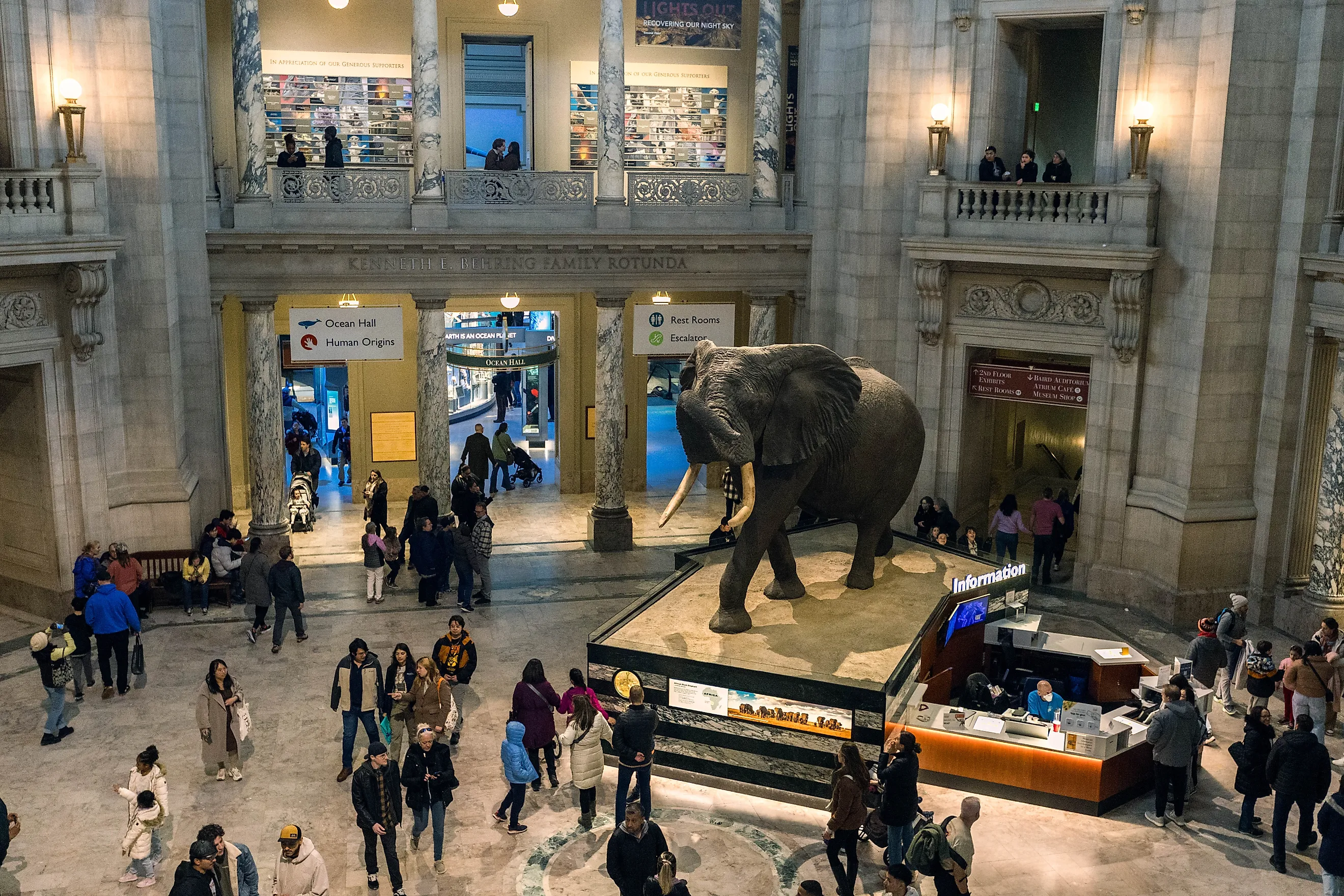
Smithsonian National Museum of Natural History, Washington, DC

The Smithsonian's natural history museum on the National Mall opened to the public on March 17, 1910, before its building was finished. Construction was still underway on what was then called the new U.S. National Museum Building. The building now covers 1.32 million square feet, and only 325,000 of them are public space, so less than a quarter of the museum's floor space is open to the people walking through it.
The public quarter holds the Hope Diamond, on the second floor in the Janet Annenberg Hooker Hall of Geology, Gems, and Minerals, and the David H. Koch Hall of Fossils, known as Deep Time, which follows the planet's history back 4.6 billion years. Admission is free, and the doors open every day of the year except December 25.
California Academy of Sciences, California

Across the country in San Francisco's Golden Gate Park, the second-largest collection belongs to an institution that keeps live animals in the same building as its preserved ones. The California Academy of Sciences holds nearly 46 million scientific specimens, and its public floor combines an aquarium, a planetarium, a rainforest, and a natural history museum under one roof. The rainforest fills a glass dome 90 feet across and four stories tall, with more than 1,600 live animals inside it, and the Academy rates it the largest exhibit of its kind in the world.
Florida Museum of Natural History, Florida

The third-largest collection is about to have a public face again. The Florida Museum of Natural History, on the University of Florida campus in Gainesville, closed its exhibit building for an expansion in March 2025 and reopens on Monday, November 23, 2026, the day after a members' preview. The former South Florida People and Environments exhibit returns as Florida Coastal Life, with a new pavilion overlooking the mangroves.
The Butterfly Rainforest is expected to reopen the same day, and its live butterflies stand in for the museum's signature holding. Of its 40 million specimens and artifacts, more than 10 million are butterflies and moths kept at the McGuire Center for Lepidoptera and Biodiversity, the largest collections-based research and education center in the world focused on those insects.
Field Museum, Illinois

Chicago's Field Museum sits just behind Gainesville with nearly 40 million objects, a collection that began with the 1893 World's Columbian Exposition. The museum was soon renamed the Field Columbian Museum for its first major benefactor, Chicago businessman Marshall Field, and when its current building opened on May 2, 1921, crowds lined up for miles.
Two skeletons headline the museum today, and from November 11, 2026, through March 31, 2027, Illinois residents can see both free on Wednesdays. SUE is the most complete Tyrannosaurus rex ever found and one of the largest. Máximo, a 122-foot titanosaur of the species Patagotitan mayorum, stands in Stanley Field Hall.
Natural History Museum of Los Angeles County, California

A baby, a juvenile, and a sub-adult Tyrannosaurus rex stand together in the Dinosaur Hall of the Natural History Museum of Los Angeles County, a growth series the museum says exists nowhere else. The hall holds more than 300 fossils and 20 mounted skeletons, and the Exposition Park museum and its sister site, the La Brea Tar Pits, together keep more than 35 million specimens and artifacts. Los Angeles County residents get in free from 3 to 5 p.m. on weekdays with tickets picked up on site, except on the first Tuesday of each month, when the museum is closed.
American Museum of Natural History, New York

The heaviest single object in this ranking sits on Manhattan's Upper West Side, inside a museum that spreads more than 30 million specimens and objects across more than 40 permanent exhibition halls and the newer Gilder Center for Science, Education, and Innovation. New York State residents with ID pay what they wish for general admission.
That object is the Willamette Meteorite, which weighs 15.5 tons and is the largest meteorite ever found in the United States. It rests on the lower level of the Rose Center for Earth and Space. The Clackamas people of Oregon's Willamette Valley knew it as Tomanowos. Under a 2000 agreement with the Confederated Tribes of the Grand Ronde, successors to the Clackamas, the tribe dropped its repatriation claim and gained an annual ceremonial visit to the meteorite, and a tribal delegation held that ceremony in New York in June 2026.
Bishop Museum, Hawaii

Charles Reed Bishop founded the Honolulu museum in 1889 in honor of his late wife, Princess Bernice Pauahi Bishop, and it is the only museum in this ranking built around the Pacific. The state has since designated it the State Museum of Natural and Cultural History of Hawaiʻi. Its scientists have acquired some 25 million items, more than 22 million of them biological specimens, and its holdings include documents and photographs about Hawaii and other Pacific island cultures.
Inside Hawaiian Hall, which Bishop had built on the campus in 1898, a complete sperm whale skeleton fitted with a papier-mâché body hangs above the central gallery, and koa wood display cases line the walls. Set into the floor is a stone image of the Hawaiian shark god Kāneikokala, which museum staff have been unable to move during later renovations.
Carnegie Museum of Natural History, Pennsylvania

Andrew Carnegie had founded Pittsburgh's natural history museum four years before his expedition pulled a dinosaur out of the ground near Sheep Creek, Wyoming, in July 1899. It became Diplodocus carnegii, better known as Dippy, and Carnegie paid for casts of the more than 80-foot skeleton that went to museums in Europe and Latin America.
The original stays in Pittsburgh. The museum's Kamin Hall of Dinosaurs displays Diplodocus carnegii alongside Apatosaurus louisae and Tyrannosaurus rex as holotypes, the original specimens on which each species is based, so the skeleton that defines T. rex for scientists stands in Pennsylvania.
The hall shows more than 230 objects, about three-quarters of them original fossils, and the museum describes its Jurassic dinosaurs, especially sauropods from Utah and Wyoming, as arguably the finest collection in the world. Its full holdings run to 22 million specimens and objects. The museum closes on Tuesdays.
Most of what makes these museums the largest in the country never reaches a gallery. In Pittsburgh, the dinosaur hall's 230-plus objects work out to roughly one for every 100,000 specimens and objects the museum keeps. In San Francisco, the Academy's research specimens sit on shelves in library-like stacks deep inside the same building that holds the rainforest dome. Even in Chicago, with SUE and Máximo on view, the Field Museum puts only a small portion of its nearly 40 million objects on display. A 2020 National Academies report put the holdings of all U.S. natural history collections at 800 million to 1 billion objects, and these eight institutions alone hold more than a third of them.