The State Parks With Giant Sequoias
This state park would not have existed were it not for a wounded bear running away from a hunter into a grove of the largest trees on Earth, leading to the first noteworthy European discovery of these trees.
Giant sequoias are lonely giants, only growing in a small section of land on the western slopes of the Sierra Nevada Mountains. Due to their rarity, they are protected in national parks, a national monument, and several state lands, including Calaveras Big Trees State Park.
If there were any doubt about the importance of giant sequoias to this park, one just needs to look at its name: the Calaveras Big Trees State Park.
Where the Giants Grow

Giant sequoias are only present in around 75 to 94 groves in a thin stretch of land that is less than 15 miles wide and 260 miles long, located entirely within California.
These trees originate from a time when the climate was much wetter and colder. Over millions of years, giant sequoias's range stretched across Nevada, Idaho, Wyoming, and Colorado, before prehistoric climate drying and the Ice Age cooling restricted them to thier currect groves in Sierra Nevada. They are exclusively found at higher elevations close to 4,000 to 8,000 feet and rely on a high degree of moisture from snowmelt to grow, at 15 to 20% soil moisture.

Giant sequoias can grow anywhere from 250 to 314 feet tall. As far as height goes, they are eclipsed by redwoods, but they are often listed as larger due to their circumference. These wide trees can have diameters of more than 30 feet, when measured at an average human height. This diameter, in turn, gives these trees huge volumes, such as the General Sherman Tree at 52,508 cubic feet, located in Sequoia National Park.
If a tree has the right nutrients and dense soil, its diameter can grow by 2 inches a year, with its height growing 1 to 2 feet annually for its first 10 years of life and then 4 feet a year from 10 to 50 years. It never truly stops growing, only limited by its available nutrients.
One of the most unusual traits of these trees is how they actually benefit from wildfires. Their bark is thick enough to avoid damage from most wildfires. The warmth from the fire opens up their cones, scattering seeds on the forest floor. The fire also clears away forest debris, allowing the seeds to hit the soil directly, enabling growth.
Stumbling Into History: A Grizzly Leads The Way

Native Americans were familiar with these trees for centuries, with the Miwok constructing villages along the foothills of Sierra Nevada, although other Native American groups would not even touch these trees due to believing they were sacred.
For white settlers, they had no idea that these giant trees even existed. The first mention of them was by hunters in 1833 who noted these trees, but this was little more than a footnote. What really put these trees on the map was a hunter named Augustus T. Dowd. In 1852, he was tracking down a grizzly bear, seeking to kill it through the Sierra Nevada Mountains, when he stepped into a grove of trees that shocked him.
At first, no one believed this hunter until he showed a group of observers the grove personally. The news spread rapidly, and the tree he first noted, known as the Discovery Tree, was unfortunately cut down and its stump was used as a dance floor. It took 22 days to cut down this vast tree. A second tree called the Mother of the Forest was also stripped of its bark in 1854 for display, and it in turn died.
From Lumber To Legacy: The History Of The Park

The discovery of these trees set off a demand to protect the giant sequoias. The earliest success came in 1864 with Abraham Lincoln setting aside Yosemite Valley and the Mariposa Grove as a public trust under the state of California.
This precedent would pave the way for future national park expansion, which would bear fruit a few decades later with the establishment of Sequoia National Park and General Grant National Park in 1890. Yosemite National Park would be established that same year and would gain control of the Mariposa Grove from the state of California in 1906.

The Calaveras area was by no means less beautiful than the national parks, as conservationist John Muir would note that it was "a flowering glade in the very heart of the woods." However, it would take longer to fully protect than the national parks, with local groups known as the Calaveras Grove Association and Save the Redwoods League consistently lobbying for decades. They were up against several lumber companies, including the Whiteside family.
One such advocate for the trees was Laura White, who would write a letter to California Governor George Pardee in 1906 stating, "Idiots, criminals, and the insane come and go regularly every few years...but the Big Trees, if they go, may never be reproduced on earth. How can we secure these Groves for perpetuity? This is the question tormenting my soul."
On July 5, 1931, the Whiteside family agreed to sell their land in the North Grove to the Save the Redwoods League and several prominent donors such as John D. Rockefeller Jr. for over $265,000. This land was given to California's state park system, forming the Calaveras Big Trees State Park. The park would be expanded in 1954 with the purchase of the South Grove from the Pickering Lumber Company, bringing its total size to just under 6,500 acres.
The Giants of the Calaveras

The biggest sequoia in Calaveras Big Trees State Park is Louis Agassiz, with a height of about 262 feet, a width of about 22 feet, and an overall volume of 30,580 cubic feet. It gets its name from the Swiss-American biologist.
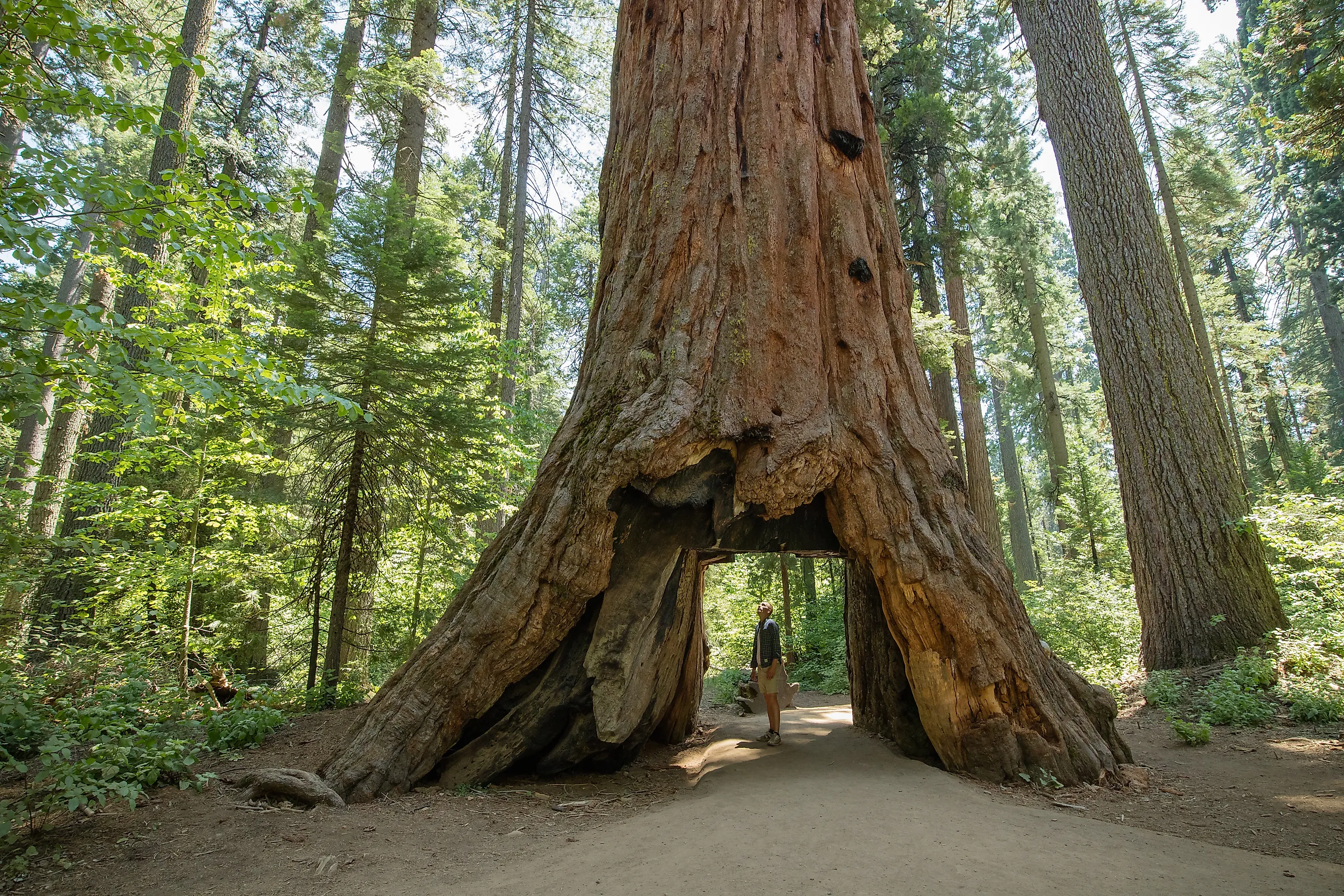
Overall, the park protects more than 1,000 giant sequoias, which range in age from 1,000 to 3,000 years old, with names such as Abraham Lincoln, George Washington, Maid of Honor, and the Pride of the Forest. Its second-largest tree, Smith Cabin, had a width of 19.80 feet, but was taller than Louis Agassiz at 268.50 feet. Another tree, The Pioneeer Cabin Tree, was best known for its hollowed-out trunk where people could walk through it. However, it collapsed in 2017 due to a winter storm.
Today, hikers can see the North Grove via a 1.7-mile North Grove Trail, while for the South Grove, one can take a 5.5-mile loop trail. The giant sequoias aren't the only interesting landmark here in the park. One can see volcanic basalt rocks via the Lava Flows Trail, deposited by volcanic eruptions from the Sierra Nevada Mountains.
The First And The Last Of The Protected Groves

The Calaveras Big Trees State Park stands out as both the origin of the giant sequoia craze in America and one of the last of the groves to be officially protected from logging and human development.
In a sense, this shouldn't be surprising, as this park brought in a lot of measures to gain attention, such as cutting down and stripping trees to take on big publicity tours. Today, the Calaveras Big Trees State Park enables tourists to walk in the footprints of the hunters that came before, and to take in the awe-inspiring sights that inspired conservationists to keep these ancient trees from disappearing from the earth.