13 Most Peaceful Small Towns In Illinois
Nearly half of Illinois' visitors never make it past Chicago, which leaves the quiet 90% of the state blessedly quiet. Out there, Illinois keeps a village of 500 where two total solar eclipses crossed paths, a Swedish utopia preserved mid-sentence on the prairie, and a stone hamlet so untouched the entire village sits on the National Register. Peace here is not an absence; it is the main attraction, with bald eagles wintering over the Mississippi bluffs and main streets where parking is never the story. These 13 towns keep the volume down on purpose.
Makanda

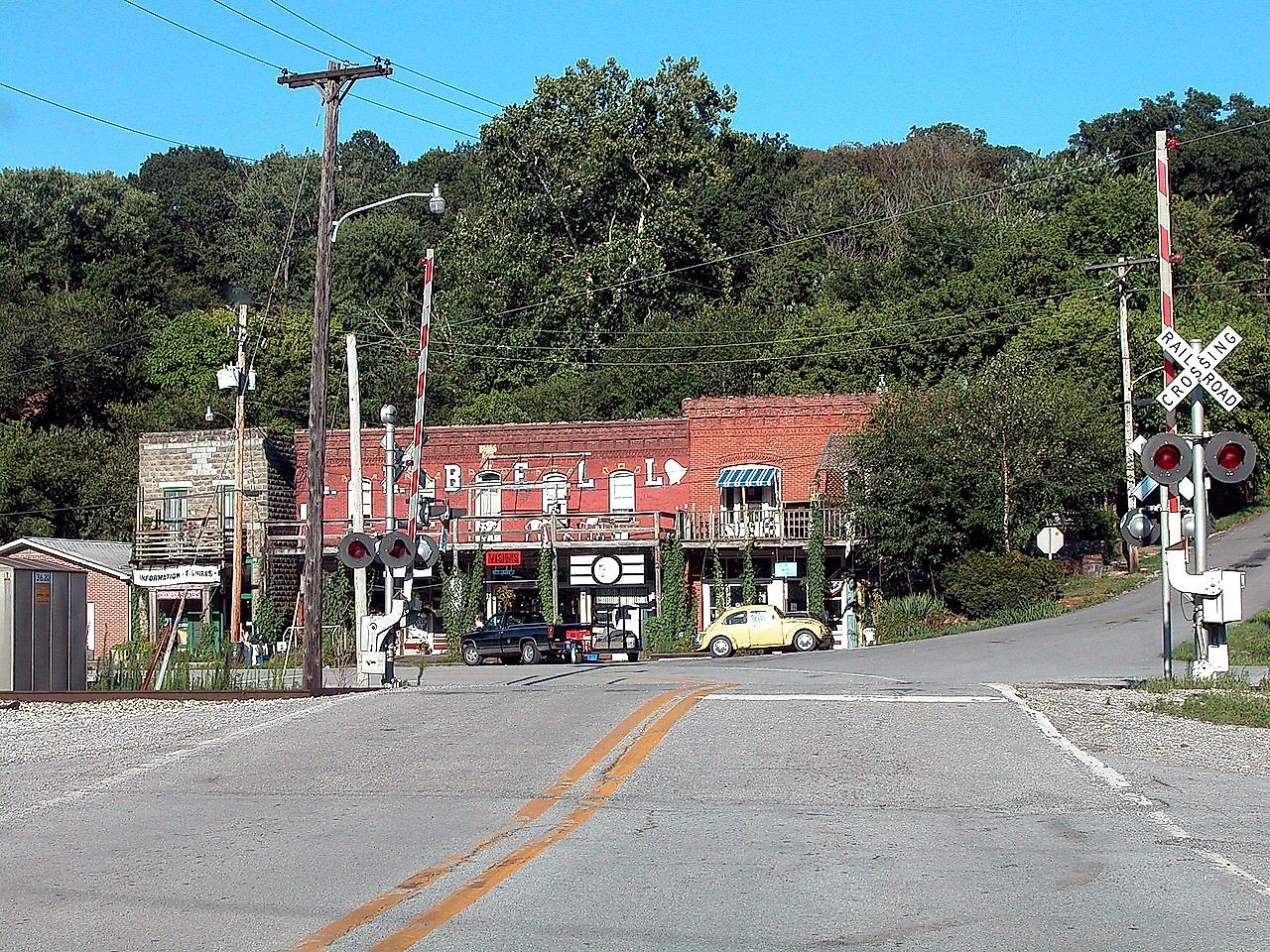
Makanda, population about 500, is the Eclipse Capital of America: the paths of the 2017 and 2024 total solar eclipses crossed directly over this Shawnee Hills village, making it the only place in the country to stand in deep totality twice in seven years. The universe picked a fitting spot. Makanda's one-block boardwalk of studios and oddball art has been southern Illinois' quietest creative colony for decades, and the town gate to Giant City State Park opens onto 4,000 acres of sandstone bluffs whose block-like "giant city streets" gave the park its name.
The hills around town carry the Shawnee Hills Wine Trail, the heart of Illinois' first federally recognized wine region, with Blue Sky Vineyard pouring award-winning reds at the edge of the national forest, and the Rolling Oak Alpaca Ranch adding the gentlest livestock encounter in the state. Peace, wine, alpacas, and a front-row seat to the cosmos: Makanda runs the full tranquility stack.
Elsah

Elsah hides in a crease of the Mississippi bluffs on the Great River Road, a village of 1850s stone cottages so completely preserved that the entire community is listed on the National Register of Historic Places, one of the first whole villages in the country to earn that distinction. There are no stoplights, no chains, and barely 600 residents; there are garden gates, limestone walls, and the sound of the river.

The hilltop campus of Principia College keeps a low scholarly hum above the village, and in winter the bluffs become grandstands for bald eagles riding the river wind. Drive the River Road at sunset, walk the two quiet streets, and understand why painters keep setting up easels here. Elsah does not do events; Elsah is the event.
Galena

Galena is the state's time capsule, with roughly 85% of its buildings inside a National Register historic district, red brick stacked up the hillsides above the winding Galena River. This lead-mining boomtown gave the Union nine Civil War generals, including Ulysses S. Grant, whose 1860 home still stands as a state historic site, furnished as the family left it. The trolley tours cover the headlines; the side streets reward wandering.
The quiet half of Galena is the better half. The Galena River Trail runs 8.8 easy miles along the water for bikes and boots, Grant Park's benches face the steepled skyline from across the river, and winter mornings belong to whoever gets to Main Street before the shops open. Few towns this photographed stay this calm.
Bishop Hill

Bishop Hill is what happens when a utopia outlives its prophet and keeps the furniture. Founded in 1846 by Swedish dissident Erik Jansson and his followers, the colony built communal brick halls, a church, and the landmark 1854 Steeple Building on the open prairie before the experiment dissolved, and the whole settlement now stands as a state historic site with about a hundred residents living among the monuments.
Today "Utopia on the Prairie" runs on craft shops, Swedish bakeries, and a festival calendar that peaks with the harvest celebration each September, when folk dancers and wagon rides fill the colony grounds. The silence between events is the real inheritance: flat light, brick facades, and a prairie horizon the founders would still recognize.
Nauvoo

Nauvoo spent the 1840s as one of the largest cities in Illinois, the Mormon capital on a bend of the Mississippi, before the faith's great exodus west emptied it almost overnight. What remains is one of the most atmospheric historic districts in the Midwest: the restored brick homes and workshops of the old flats, costumed interpreters at the blacksmith and bakery, and the gleaming Nauvoo Temple, rebuilt in 2002 on its original footprint above the river.
The modern village of fewer than a thousand keeps gentler traditions, led by Baxter's Vineyards, founded in 1857 and the oldest winery in Illinois, still pouring a few blocks from the temple. Sunset here is a civic ritual: the whole town seems to drift toward the bluff to watch the Mississippi go gold.
Casey

Casey, the "Small Town with a Big Heart," proves peaceful does not mean solemn. This village of under 3,000 holds about a dozen Guinness World Records for oversized objects, led by the World's Largest Rocking Chair, 56 feet and 46,000 pounds of it, alongside a 28-foot key, a giant mailbox you can climb inside, and enormous wind chimes that actually chime. The whole collection began as one craftsman's scheme to give travelers a reason to stop, and it worked without costing the town its quiet.
Between photo ops, Casey is simply a tidy prairie town: a walkable few blocks of shops and cafes, friendly porches, and the 9-hole Casey Country Club for an unhurried afternoon round. It is the rare place where the loudest thing in town is a wind chime the size of a grain silo.
Grafton

Grafton sits where the Illinois River gives itself to the Mississippi, a meeting of waters you can watch from a riverside bench on Main Street. One of the oldest river towns in the state, it lives at barge speed: ferries crossing, herons working the shallows, and the limestone bluffs of the Great River Road rising on either side of a village of about 600.
Next door spreads Pere Marquette State Park, the largest state park in Illinois at roughly 8,000 acres, with bluff-top overlooks, a grand 1930s stone lodge, and trails that empty out on weekdays. Winter brings the show: hundreds of bald eagles settle along this stretch of river from December through February, turning Grafton into the state's most reliable eagle-watching seat. Bring coffee and binoculars; the river handles the programming.
Alton

Alton stacks its 1800s brick streets up the Mississippi bluffs and keeps the strangest resume on the river. The cliffs north of town wear the Piasa Bird, a huge recreation of the winged monster the first French explorers found painted on these bluffs in 1673, and downtown honors hometown son Robert Wadlow, the tallest person in recorded history at 8 feet 11 inches, with a life-sized bronze that makes every visitor feel briefly tiny.
The peace is riverine. The National Great Rivers Museum at the Melvin Price Locks explains the Mississippi while barges thread the chambers below, Riverview Park's benches hold the best water views in town, and winter eagles patrol the bluff line. Ghost hunters keep the 19th-century McPike Mansion on their circuit, but even Alton's hauntings are the quiet kind.
Petersburg

Petersburg, a Menard County seat of about 2,200, guards the most consequential ghost town in America: Lincoln's New Salem State Historic Site, the reconstructed log village where a young Abraham Lincoln clerked a store, carried the mail, surveyed land, and read borrowed books through the 1830s before leaving for Springfield and history. Walking the timber cabins at dusk, split-rail fences and all, is as close as the country gets to meeting Lincoln before anyone knew the name.
The town square keeps its own literary pedigree, as the boyhood home of Edgar Lee Masters, whose "Spoon River Anthology" gave voices to the graves of exactly this countryside; Masters now rests in Oakland Cemetery at the edge of town, near Ann Rutledge of Lincoln legend. Quiet squares, older stories: Petersburg is peace with footnotes.
Fulton

Fulton announces its heritage from the Mississippi levee, where the De Immigrant, an authentic Dutch windmill shipped from the Netherlands and raised by the town's Dutch descendants, grinds flour above the river with its 100-foot sails. The adjacent Windmill Cultural Center explains the engineering, and the whole town leans into its roots each spring when Dutch Days brings wooden shoes, street scrubbing, and folk dancing to the riverfront.
The rest of the year, Fulton is a river town running at walking pace: the levee path for sunset strolls, Heritage Canyon's recreated 1800s village built down inside an old limestone quarry, and winter eagle watching below Lock and Dam 13. A working windmill turns out to be an excellent metronome for a slow weekend.
Danville

Danville earns its slot not for its size but for what surrounds it: this Vermilion County seat is the doorway to the quietest water in east-central Illinois. Lake Vermilion spreads a 1,000-acre reservoir for paddling and lazy boating minutes from downtown, and Kickapoo State Recreation Area nearby turned old strip-mine land into a chain of 22 clear ponds threaded with hiking and mountain-bike trails, one of the earliest parks in the nation built on reclaimed mining ground.
In town, the Vermilion County War Museum fills a stately former library with over 5,000 artifacts spanning the nation's conflicts, a contemplative afternoon rather than a loud one, and the golf course along the Vermilion River handles the slow hours. Danville's peace is the earned kind: land that healed, water that stayed.
Fox Lake

Fox Lake is the village at the heart of the Chain O'Lakes, the linked waters that have served as Chicagoland's escape hatch for a century, and it still runs on boat time. Cruises and rentals push off from Ben Watts Marina, anglers work the channels at dawn, and Lakefront Park gives the boatless the same sunset for free. On a weekday morning, the loudest sound on the water is a loon with opinions.
Chain O'Lakes State Park anchors the north end of the system with marsh trails, paddling routes, and winter cross-country skiing, keeping the wild edge of the chain honest. The little downtown covers the essentials, a classic cinema and a local brewery among them, but the lakes are the town's living room, and the furniture floats.
St. Charles

St. Charles proves a Fox River town can keep its calm with a quarter of Chicagoland next door. The river is the organizing principle: Pottawatomie Park spreads lawns, paddleboats, and fishing banks along the east shore, the riverside paths link the bridges for unhurried loops, and herons commute the channel like it was zoned for them.
The 1926 Arcada Theatre gives the downtown its marquee glow with a year-round slate of concerts in a lovingly aged movie palace, and the St. Charles History Museum fills in the river town's story. Come on a weekday, take the west bank path at golden hour, and the Fox will make its case for slowness better than any brochure.
Where Illinois Keeps The Quiet
Peace in Illinois is not one landscape but a habit the state keeps in its smallest places: a village that hosted the cosmos twice in Makanda, a utopia holding its pose at Bishop Hill, eagles running the river shift above Grafton and Elsah, and a chair in Casey big enough to rock the whole premise. None of these 13 towns asks much beyond a slower walking speed. Give them a weekend and they return the favor with the rarest souvenir in the United States: a lowered heart rate.