7 of the Friendliest Towns To Retire In Spain
Retirement in Spain is an attractive idea, but finding the right balance of community and livability requires a little digging. Across the country, smaller communities are the best option. There you can still find historic streets, beaches or mountain scenery, plus public spaces where neighbors still gather for festivals and cultural events. For retirees, that can mean spending mornings at a waterfront café, joining an evening concert in the town square, or becoming a familiar face at a local museum or cultural center. Travel through Andalusia's whitewashed hill towns down to the Atlantic coast of Galicia, exploring communities with plenty of opportunities to become part of local life.
Nerja

Nerja is a mix of the sociability of a small Andalusian town with the beaches and mild climate of the Costa del Sol. The Balcón de Europa, a palm-lined promenade overlooking the Mediterranean, is an obvious place for an evening stroll, while nearby streets lead past cafés and restaurants through the old center. Retirees can spend beach days at Burriana Beach or explore quieter coves along the coast. Just outside town, the enormous Cave of Nerja contains stalactites, stalagmites, and prehistoric remains spread through a series of underground chambers.
The cave is also part of Nerja's cultural life. The annual Cave of Nerja Festival brings music and performing arts to the area, adding to a calendar that includes processions, fairs, and other community celebrations. With a population of only around 22,000, Nerja is large enough to provide an active social scene without losing the everyday familiarity that makes smaller towns attractive in retirement.
Ronda

Ronda's setting looks almost impossible. Its old and newer districts face each other across the El Tajo gorge, connected by the 18th-century Puente Nuevo nearly 100 meters above the Guadalevín River. Retirees can follow paths and overlooks around the gorge, visit the remarkably preserved Arab Baths, or explore the courtyards and gardens of the Palacio de Mondragón, once a residence of Ronda's Moorish rulers.
Community life becomes especially visible during the Feria y Fiestas de Pedro Romero, held around the beginning of September. Concerts, dancing, folklore, and other public celebrations bring residents into streets and gathering spaces across town. Ronda also hosts recurring events such as Ronda Romántica and its May fair. With roughly 34,000 residents, the town has museums, restaurants, and a busy cultural calendar while remaining compact enough for retirees to encounter familiar faces during regular walks through the center.
Altea

Whitewashed houses rising above the Mediterranean give Altea one of the most recognizable skylines on Spain's Costa Blanca. At the top of the old town stands the blue-domed Church of Nuestra Señora del Consuelo, surrounded by narrow lanes, small galleries, restaurants, and viewpoints over the coast. Downhill, retirees can walk the waterfront promenade or spend an afternoon along Altea's beaches before returning to the old quarter for dinner.
Culture provides another route into the community. Palau Altea hosts theater, concerts, dance, and other performances throughout the year, while summer brings the long-running Mostra d'Artesania, when artisans gather around Plaça de l'Església to display their work. These activities suit retirees looking for recurring opportunities to get out of the house rather than attractions visited only once. With fewer than 25,000 residents, Altea combines an active cultural calendar with the scale of a town where the same cafés, galleries, and public spaces can quickly become part of a daily routine.
Xàbia

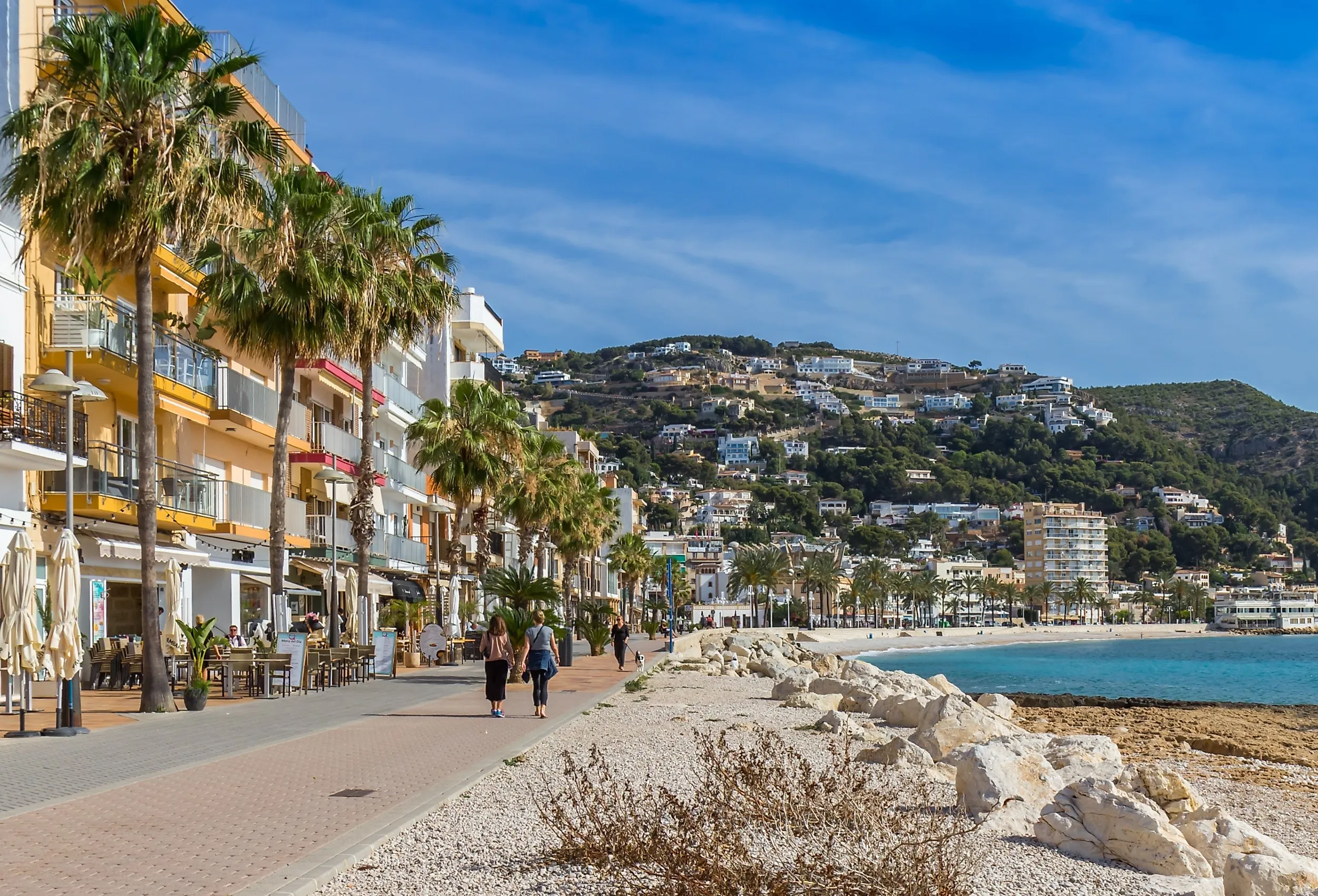
Xàbia, also widely known as Jávea, gives retirees three distinct areas to explore without leaving town. Its historic center surrounds the fortress-like Church of San Bartolomé, with stone façades, a municipal market, and narrow streets providing a markedly different atmosphere from the coast. At the port, restaurants and a waterfront promenade face the Mediterranean, while Arenal Beach supplies a broad sandy shoreline lined with cafés. Beyond the built-up areas, trails and viewpoints around Montgó Natural Park offer hiking and expansive coastal scenery.
The town's calendar also creates plenty of opportunities to meet neighbors. During the Fogueres de Sant Joan, Xàbia fills with parades, music, communal meals, fireworks, and bonfires marking the arrival of summer. Other neighborhood celebrations take place around the port and historic center during the year. With roughly 30,000 residents and several recognizable gathering areas, Xàbia provides retirees with both an established international population and plenty of ways to participate in longstanding Valencian traditions.
Ciutadella de Menorca

Ciutadella offers island retirement without the scale of a major resort. Once Menorca's capital, the town retains a maze of stone streets opening onto squares and historic buildings. The Cathedral of Santa María de Ciutadella, constructed beginning in the 13th century, anchors the old center, while the nearby Plaça des Born provides a natural gathering point. Below the historic district, the narrow old harbor is lined with restaurants and boats. Retirees can also make easy excursions to nearby coves such as Cala en Turqueta and Cala Macarella.
Few events demonstrate Ciutadella's community character better than the Festes de Sant Joan each June. Horses and riders take a central role as crowds gather for processions, traditional games, music, and celebrations rooted in centuries of local custom. The festival is not a manufactured visitor attraction but one of the defining events on the local calendar. Ciutadella's roughly 30,000 residents therefore share a town where historic public spaces and enduring traditions remain central to community life.
Sitges

Sitges may be the liveliest place of all on this list, particularly suitable for retirees who want a full cultural calendar alongside the Mediterranean. The palm-lined seafront provides an easy daily walking route, while the old quarter rises around the Church of Sant Bartomeu i Santa Tecla. Art lovers can visit the Cau Ferrat Museum, created from artist Santiago Rusiñol's former home and studio, and the neighboring Maricel Museum, whose collections range from medieval art to modern works. Beaches sit only steps from the historic center.
There is also little danger of running out of community events. The Festa Major fills the streets with traditional dances, processions, music, fireworks, and human-tower performances each August. The Miramar Cultural Center hosts exhibitions and other programming, while Sitgestiu brings summer concerts and cultural activities. Sitges has around 33,000 residents, allowing it to maintain the amenities and cultural activity of a larger destination while remaining considerably smaller than nearby Barcelona.
Baiona

Baiona provides a cooler Atlantic alternative to Spain's Mediterranean retirement destinations. The Galician town wraps around a sheltered harbor, where retirees can walk the waterfront promenade and watch fishing boats and yachts move through the bay. The medieval Fortress of Monterreal occupies a peninsula beside town, with paths around its walls overlooking the Atlantic and nearby Cíes Islands. Baiona's compact old quarter adds stone arcades, small squares, and tapas bars within an easy walk of the marina.
Its strongest expression of community life arrives during the annual Festa da Arribada. The celebration commemorates the Pinta reaching Baiona in 1493 with news of Columbus's first voyage to the Americas. Streets fill with historical costumes, artisans, performers, food stalls, and public celebrations that involve much of the town. With only around 12,000 residents, Baiona offers retirees a distinctly small-town environment where the harbor, historic center, and recurring community traditions remain closely intertwined.
Finding Community In Spain's Smaller Towns
The friendliest retirement destinations are not necessarily the places with the largest expatriate populations or longest lists of amenities. Nerja and Altea provide Mediterranean routines built around promenades and public squares, while Ronda and Baiona offer distinctive alternatives away from Spain's best-known retirement coasts. Xàbia, Ciutadella, and Sitges add especially active festival and cultural calendars. In each case, markets, cultural venues, and waterfronts give retirees recurring opportunities to participate in community life rather than simply observe it.