7 Spain Towns Where Time Stands Still
A handful of Spanish towns left their old quarters exactly as the centuries built them. Baeza still moves through a Renaissance street grid that looks much as it did in the 1500s. Alquézar wakes up each morning under a church that began as a Muslim fortress. Tossa de Mar lives inside the stone walls it raised in the 1200s. Frías has worn the title of smallest city in Spain since 1435. Each one lets you walk straight into the past for an afternoon.
Baeza

Drop into Baeza and you land in one of the best-preserved Renaissance townscapes in all of Andalusia, good enough to earn UNESCO World Heritage status. The Cathedral of Santa María holds down the old quarter, raised over the town's former mosque and built up across the 13th to 16th centuries in a run of Gothic, Mudéjar, and Renaissance work, the kind of layered building that belongs to the Iberian Peninsula. Its Puerta de la Luna pairs a 13th-century Gothic-Mudéjar doorway with a 14th-century rose window, and the bell tower rises on the base of the old minaret. Step inside for stone arches, carved altar sculptures, and paintings that have watched over the town for centuries. Outside, walkers can follow the path named for Antonio Machado, the poet who arrived in 1912 to teach French and ended up writing some of his best-known verse here. The route threads past monuments and countryside, and it doubles as a primer on what kept Machado scribbling. Save an afternoon for the Museum of Olive Culture at Hacienda La Laguna, a few miles out in Puente del Obispo, where 19th-century pressing machines still stand and the tasting counter pours the green gold this region is famous for.
Alquézar

Alquézar sits up in the Huesca province of northeastern Spain, and its skyline belongs to one building. The Collegiate Church of Santa Maria la Mayor started life as a Muslim fortress before it became a Christian church, and you can read both chapters in the stone. It holds a medieval watchtower, 15th-century murals, and a Museum of Sacred Art packed with objects spanning the 12th to 15th centuries. Four hundred years of architecture stack up in one structure, which makes it a postcard of the Reconquista written in walls. Down in the Río Vero Canyon, the Vero River Cultural Park protects prehistoric cave paintings, a museum, and an archaeological park with replicas of Neolithic shelters. Adventurous travelers head into the Sierra y Cañones de Guara Natural Park for hiking, climbing, white-water rafting, and cliff diving in the gorges.
Aínsa

Aínsa shares the Huesca province with Alquézar, and it opens a door straight into the high country. Its neighbor is Ordesa y Monte Perdido National Park, so a day trip can take in valleys, canyons, big elevation, and waterfalls deep in the Pyrenees Mountains. Back in town, the 12th- and 13th-century main square shows off old brick and semicircular arched doorways that lead right up to Aínsa Castle. Builders worked on this Romanesque and Gothic fortress across the 11th to 17th centuries, starting it as a military stronghold against Muslim powers. Climb the high walkways and the views make the strategy obvious, because anyone approaching this hill could be spotted from a long way off. It is the rare castle where the defense plan still reads clearly six centuries later.
Tossa de Mar

Tossa de Mar hugs the Catalonia coast in northeastern Spain, and the water is the first thing that grabs you. Platja Gran sits right in the center of town, an easy bay beach with thick sand and a swimming crowd. Walk a little farther and the coves open up, each one set into a cliff-backed pocket of clear water. The showpiece is the Vila Vella, the fortified Old Town from the 1200s that still stands inside its original walls. Cobblestone lanes lead you past seven towers and the ruins of the older Sant Vicenç church, which dates to the 15th century. The newer Sant Vicenç Parish Church went up in the 18th century in Late Baroque style. Step in for the arched ceiling, the Rosary altarpiece, and a few statues rescued from the older church.
Olite

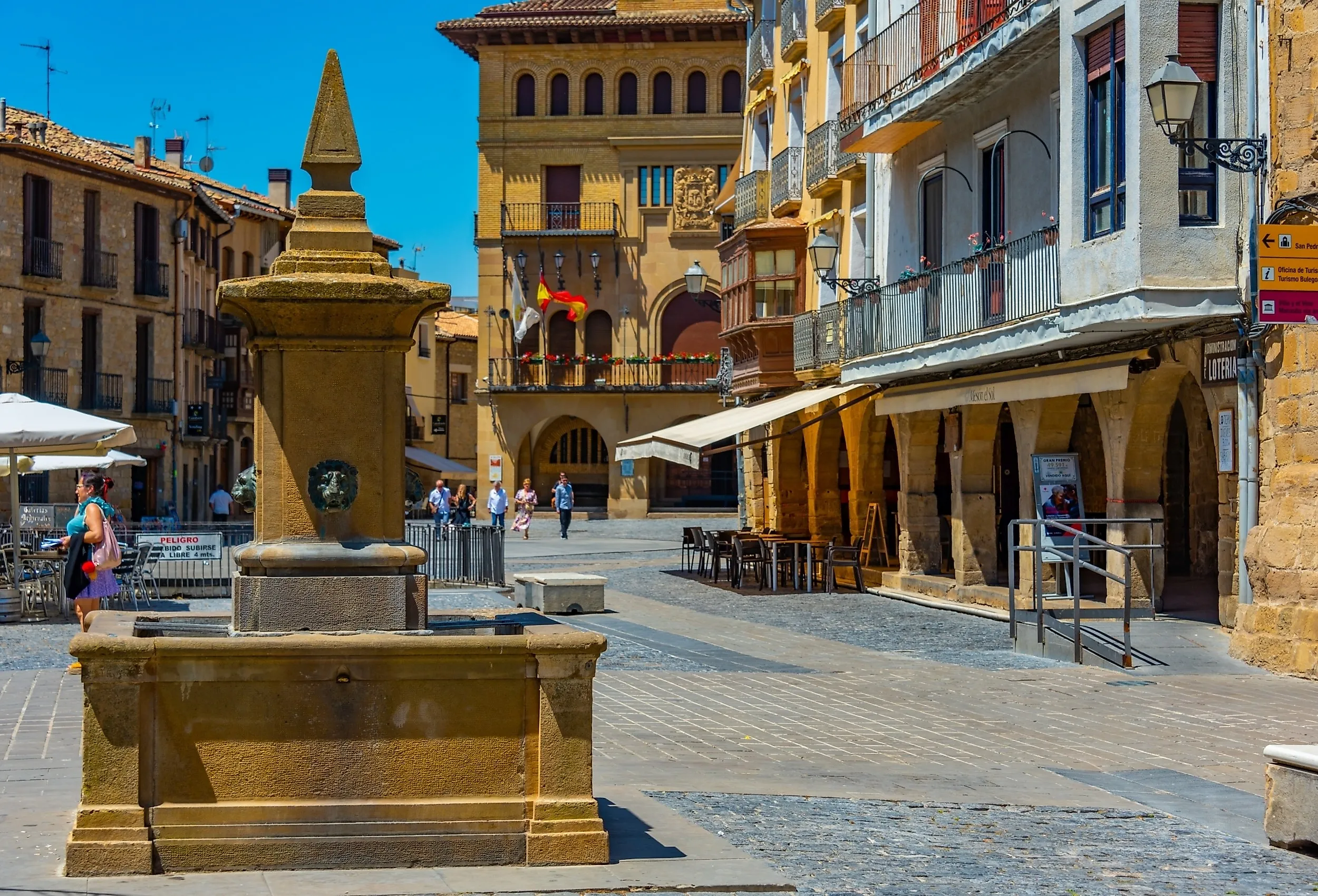
Olite sits in the Navarre region of northern Spain, and it hands you a turreted royal castle to wander. The Royal Palace grew out of a 13th-century fortress and reached its peak under King Charles III, who turned it into the seat of the Court of Navarre in the early 1400s. French Gothic design shapes the whole complex, which splits into the Old Palace and the New Palace. Climb the Cuatro Vientos tower for a sweep over the town, the moat, and the vineyards rolling out beyond the walls. Down at ground level, the gardens and royal chambers make it easy to swan around like minor royalty for an hour. The Church of Santa María la Real brings more French Gothic muscle, led by a huge rose window and a façade of biblical sculpture. The Kingdom of Navarra commissioned art this elaborate to broadcast its own power, and it still works on a visitor today. Wineries around town run tours that roll through the vineyards in off-road vehicles, pour food-and-wine pairings, and walk you through how the local reds and rosés get made.
Sigüenza

Sigüenza holds down the center of Spain in the province of Guadalajara, and its castle comes with an unusual perk. Once an Arab citadel and later home to royalty and high clergy starting in the 12th century, it now operates as a Parador hotel. Book a night and you sleep inside one of the best-preserved medieval fortresses in the country, surrounded by original walls, towers, and arched stone vaults. The Sigüenza Cathedral pulls together Romanesque, Gothic, and Renaissance work raised across the 12th to 16th centuries. Inside rest the tombs of a prominent bishop, a cardinal, and a knight, alongside a museum of paintings, sculptures, and 17th-century tapestries. The Diocesan Museum occupies a 16th-century palace and shows religious paintings and altarpieces covering eight centuries. It also keeps ancient pieces gathered from Greece, the Americas, and the land right around Sigüenza.
Frías

Frías earns its bragging rights as the smallest city in Spain, a title King John II granted back in 1435. It clings to a rocky hill in the north-central province of Burgos beside the Ebro River and the Obarenes Mountains. The town traces its roots to the 9th century and hit its stride in the 12th, and the Church of San Vicente Mártir still keeps some of its 1100s stonework. Inside wait vaulted ceilings, stone arches, paintings, and baroque and neoclassical altarpieces. Up on the high rock stands the Castle of the Dukes of Frías, built across the 12th to 16th centuries, which you enter over a drawbridge above the moat. Look for the preserved windows and the Romanesque capitals carved with fine detail, then climb to the keep for a view over the town and the mountains. The crowd favorite is the bridge over the river. Locals have long called the Ebro crossing Roman, though the structure standing today is medieval and carries a defensive tower added over time. Stone arches, ancient origins, and that stout tower make it worth the short walk down from the old town.
Why These Spanish Towns Still Stop the Clock
Centuries of settlers and rulers passed through this corner of Europe, and each one left walls, churches, and castles behind. The towns kept the bones of all of it, plus the canyons, vineyards, and beaches that surround them. You can taste oil and wine made by the same methods used hundreds of years ago. You can step into a church older than your entire country. The calendar keeps moving, but in these seven towns it is easy to lose track of which century you are standing in.