10 Prettiest Small Towns In Spain
Twelve stone windmills march up a ridge in Consuegra toward a castle that Cervantes readers know by heart. Down in La Rioja, the wine town of Haro packs its most famous bodegas into a few blocks by the train station. On Mallorca, a wooden tram from 1912 still rattles riders through the orange groves of Soller. At the very tip of mainland Europe, kitesurfers chase the wind off the beaches of Tarifa. These are ten of the prettiest small towns in Spain. Each one rewards a slow afternoon on foot.
Haro

Haro is known as the "Capital del Rioja," and not for any administrative reason. It earns the title through its concentration of bodegas (wineries), and the town is home to nearly half of the vineyards that go into Rioja's Denomination of Origin wines. A trip into Haro is a walk through Spain's most prized wine country, where Tempranillo grapes give Rioja's reds their distinctive color and palate. With a population just over 12,000, Haro is small enough that everything sits within walking distance.
Though small, the architecture in Haro has an epic scope. The Los Agostinos Hotel occupies a restored former convent. The town also has cultural highlights like the Museo al Aire Libre (Open Air Museum), with murals and statues set out in public view. It sits in north central Spain, around 60 miles south of Bilbao and its international airport, easily reachable by car or public bus. Haro also has a major train stop. The Barrio de la Estacion ("Station Quarter") is where most of the bodegas cluster, making for a perfect wine tasting walking tour the moment you step off the train. Some of the best wineries include Bodegas Muga (1932), which runs hot air balloon rides that give visitors a view across the whole Rioja region.
Consuegra

If you have ever heard of Don Quixote, the Spanish novel that Miguel de Cervantes published in 1605 and that many call the first modern novel, then Consuegra belongs on your list. It is the town widely considered to have inspired the setting of the story. There is even a Don Quixote Route, linking several key locales from the novel by car or train. Don Quixote is said to hail from La Mancha, an arid region in central Spain that covers several provinces, including the area around Consuegra in Toledo, which had a population just under 10,000. The countryside here is dotted with ancient castles and windmills, the same windmills that Don Quixote famously mistakes for giants before riding out to do battle with them.
The castle to see is the Castillo de la Muela, which stands atop the Cerro Calderico ridge. Twelve windmills, the Molinos de Viento de Consuegra, line the ridge leading right up to the castle gate. Gazing across the countryside from up here gives you the full sweep of Spanish pastoral beauty. Spend some time downtown in the Plaza de España, reflecting on the day in a town whose roots reach back to Roman times, long before Don Quixote's era.
Soller

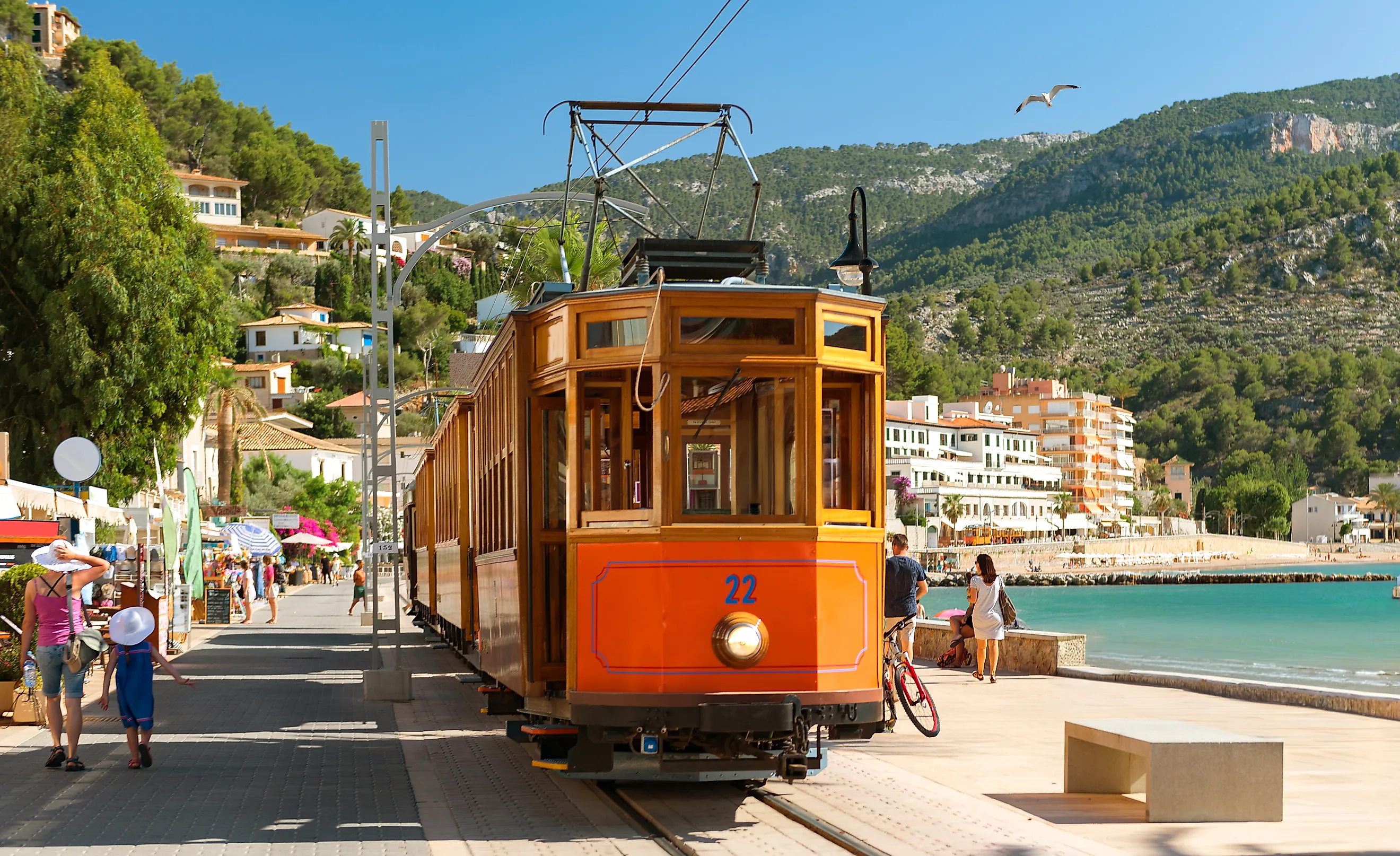
As the endpoint of one of the best train rides in all of Spain, Soller is a standout destination on the island of Mallorca, in the Mediterranean Sea. The name Soller is believed to come from the Arabic word "suyar," meaning "golden bowl." The town is also called the Valley of Gold for the orange groves that surround it. This modest yet prosperous citrus town of about 14,000 has plenty to offer once you arrive on the Ferrocarril de Soller, a wooden train dating to 1912.
In the old train station, you can view permanent collections of works by Picasso and Miro as you begin to explore. Saturday is market day in Soller, held in the Placa de Constitucio, where you can pick up local oranges during harvest season alongside other fresh produce and crafts. The town is also full of historic architecture, so be sure to visit the Church of Saint Bartomeu. Then ride a vintage tram down to the waterside shops and the deep blue of Port de Soller.
Tarifa

If you like wind sports like kitesurfing, head down to Tarifa, often called Europe's windiest town, where the Atlantic Ocean meets the Mediterranean Sea in a tight bottleneck. It sits not far from the Rock of Gibraltar, one of the original "Pillars of Hercules." The meeting of land masses and seas produces strong currents in both the air and the water. Tarifa is the southernmost point of mainland Europe, on the Iberian Peninsula and the European side of the Strait of Gibraltar, looking across to Tangier in Morocco. It is known for a rugged landscape and a bohemian streak, and its older buildings carry a deep Moorish influence.
Take a stroll through Old Tarifa and its ancient buildings woven around eight distinct squares. One of them, Santa Maria Square ("La Ranita"), holds a historic fountain and once served as a bullfighting arena. Make sure to explore Tarifa's beaches, like Playa de Los Lances, with its fine white sand. Enjoy dinner at Pachamama for a true taste of southern Spanish cooking and seaside atmosphere. The Hotel Arte Vida Tarifa captures the town's laid-back style, with a popular bar and a great base for kitesurfers, in this town of just over 18,000 people.
Cadaques

The old fishing village of Cadaques, once a haven for pirates thanks to its sheltered bay, is called the "Pearl of Costa Brava" for the bright white sheen of its buildings, which is hard to miss when approaching from the Mediterranean Sea. The population sits right under 3,000 but swells during tourist months, when places like Cafe de Habana fill with visitors drawn to the old Spanish atmosphere and the live Catalonian music. This town on the northeastern coast in Catalonia was the longtime home of Spanish artist Salvador Dali, and his house is now open to the public as the Casa-Museo Salvador Dali on Portlligat Bay.
Cadaques has been a retreat for artists and creatives for years, and it is full of buildings with classic Spanish detail: glossy blue art nouveau tiling around doors and windows, terracotta roofs and floors, iron-railed balconies over the bay, and tightly packed blocks with narrow alleys. The privately owned Casa Blaua is a fine example of the best in Spanish home design. Definitely walk the main harbor path, especially the Passeig Maritim, the central promenade, where a famous statue of Dali watches over the town he championed.
Noia

Noia is a port town set into one of the many inlets on the northwestern coast of Spain in Galicia province, at the confluence of the Tambre and Traba rivers. This is an ancient fishing port, known for shellfish harvested from the bay and the river inlet (the "ria"), usually in autumn, then sold at the Mercado de Abastos (local market). The central zone, called the Old Town, is a medieval district reaching back at least 1,000 years. Over time it has grown into a modern holiday retreat and home to about 15,000 people. La Praia de Testal is a popular beach here, and several more beaches lie within a 45-minute drive, offering a solid glimpse of the Galician coast. Many residents commute to the larger Santiago de Compostela nearby. The central square is the Alameda de Noia, with the well-kept Felipe Castro Gardens, ideal for pictures or a slow stroll. Like many ancient Spanish towns, Noia has several ornate churches, including the Igrexa de San Martino de Noia, originally built in 1434.
Trujillo

Trujillo hosts the National Cheese Festival (Feria del Queso), which brings dozens of vendors and hundreds of Spanish cheeses to the central square, the Plaza Mayor, each spring. It makes for the tastiest time of year to visit, though a photographer should know that Spaniards say "Di patata!" ("Say potato!") to coax a smile. About 9,000 people live here. Trujillo's history stretches back to Roman times, when its granite hill made an ideal fortification. It lies in the western Caceres province and sits on the westbound Highway N-521 into Portugal, which has long carried cultural exchange across the border.
Trujillo holds many historic buildings worth visiting for a taste of old Spain, such as the Palace of Orellana Pizarro. It was rebuilt in the 16th century atop older tower ruins from the 14th and 15th centuries by a relative of the famous conquistador Francisco Pizarro, the conqueror of Peru. This Renaissance and Baroque building carries you straight back to Spain's Golden Age. Miguel de Cervantes, the author of Don Quixote, is said to have stayed in Trujillo around 1582. Today the palace serves as a Catholic center. In the Plaza Mayor, visit the bronze equestrian statue of Francisco Pizarro from 1927, a landmark that ties Trujillo to the conquistador's family estate.
Barbate

The town of Barbate, on the Atlantic coast in southern Cadiz province, stands out as the "Tuna Capital of the World," most famous for its bluefin tuna fishing. Visit the Museo del Atun to learn how generations of fishermen here practiced the net-fishing technique known as "Almadraba," a method with roots going back thousands of years. The temple of tuna restaurants in Barbate is El Campero, where you can try bluefin tuna, which Spaniards call atun rojo (red tuna) for the deep color of the meat.
Top features of the town include a string of popular beaches along the Costa de la Luz ("Coast of Light"), a name that refers to the white sands and the brilliant sunlight over the area. The Barbate River meets the Atlantic here and is a significant waterway, irrigating much of the farmland in the wider region beyond the town of 22,000.
Valencia de Don Juan

Valencia de Don Juan lies along the Esla River in northwestern Spain in Leon province. This lively old town has an active bull ring, the Plaza de Toros Martinez Zarate, which draws crowds during September. Like many medieval Spanish towns, it has a notable castle, Coyanza Castle, along with a modern twist on the castle theme: the private home La Centinela, built by the "Gaudi of Coyanza," architect Santiago Nava. Locals call it "Batman's House," a playful pastiche of neo-gothic elements dating to 1990. Valencia de Don Juan also sits at the center of Leonese wine country. You can explore a local bodega like Francisco Giganto Martinez, which produces young red, rose, and white varieties. The town also has a popular water park, Mundo del Agua ("World of Water"), with pools, slides, and water attractions for the public. With just over 5,000 people, it is small enough to feel intimate and lively enough to stay fun.
La Orotava

No survey of Spain's beautiful towns is complete without the Canary Islands, a Spanish archipelago in the Atlantic Ocean off the western coast of Africa. Here the town of La Orotava reigns in the north of the island of Tenerife. La Orotava is renowned for its public gardens, especially the Hijuela del Botanico. For a night's stay with even more garden surroundings, try the Jardin Secreto Hotel (Secret Garden Hotel), set in a building from the 1700s. The Canary Islands were formed by volcanoes in the Atlantic Ocean. La Orotava is an entry point into Teide National Park, where Mount Teide rises as the third-tallest volcanic structure on Earth measured from the ocean floor, at roughly 24,600 feet. Its peak is the highest point on Spanish soil and a UNESCO World Heritage Site. With a population above 42,000, La Orotava is robust for its remote setting. It has carefully preserved its distinctive Canarian architecture, on display throughout an appealing downtown that rewards the curious visitor.
The Beauty In Spain's Small Towns
Spain reveals itself through its smaller towns. The country moved through eras of grandeur, of world power, of vast gold and overseas conquest, and it has since settled into something quieter. In towns with less noise than the big cities, the enduring elements rise to the surface: the beauty of the land, the cultivation of wine grapes and oranges, the celebration of arts and music, and the refinement of coastal life along both the Atlantic Ocean and the Mediterranean Sea. The best way to see Spain may be through the blue-tiled windows of its prettiest small towns.