12 Main Streets Where Florida Comes Alive
Beyond Florida's theme parks and resort beaches lies a set of downtown main streets where oysters are fresh and historic architecture is among the oldest in the state. St. George Street in St. Augustine has carried foot traffic since the 1700s, and the old City Gate still stands guard at its north end. Duval Street in Key West passes Sloppy Joe's Bar, which opened the day Prohibition ended, and ends a block from the Southernmost Point Buoy. Market Street in Apalachicola is still a working waterfront, with raw oysters served in a converted auto service station. These 12 main streets are where Florida truly comes alive.
Key West

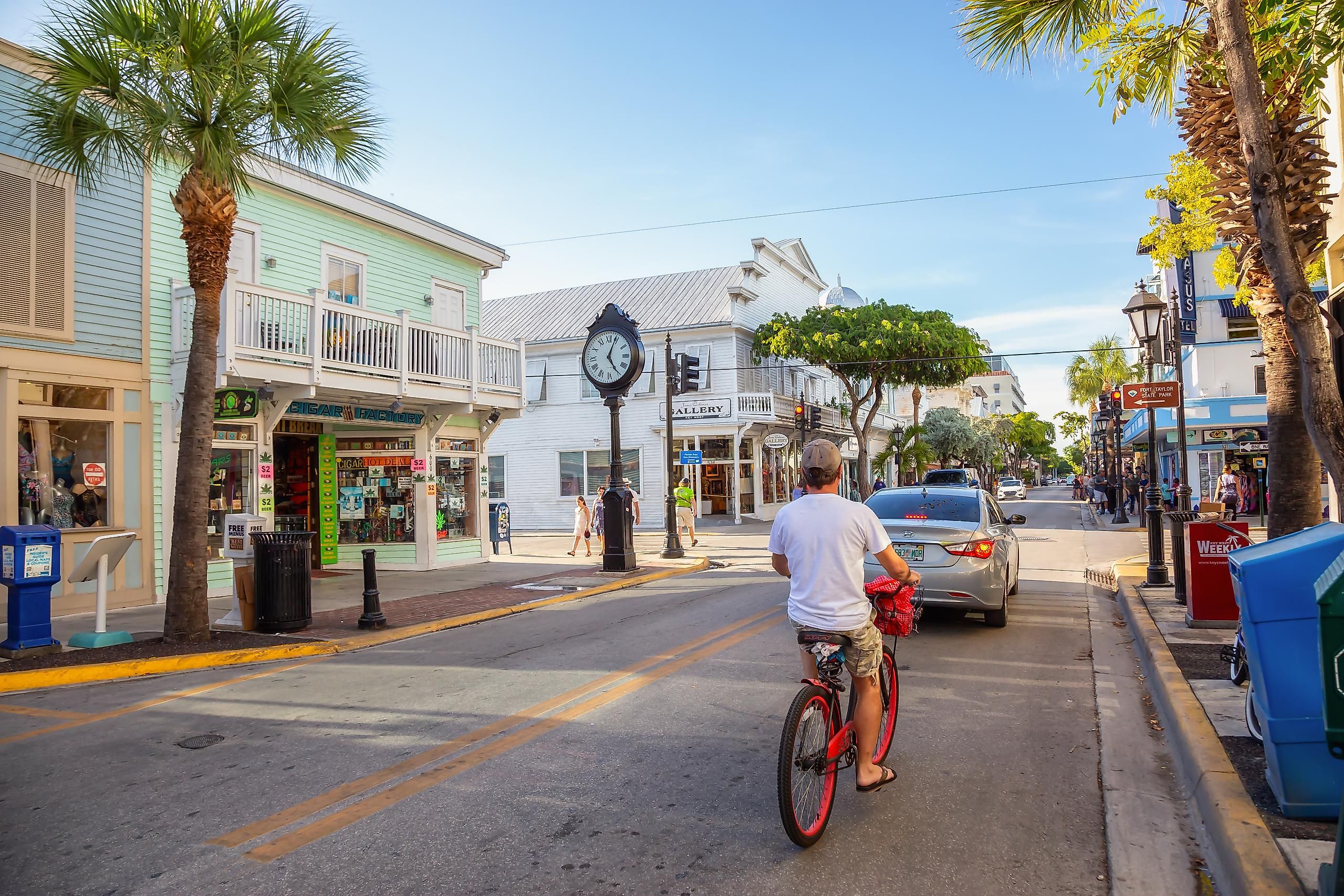
Visitors snap photos beside the Southernmost Point Buoy in Key West, although the famous landmark is not actually the southernmost point. The beach at Fort Zachary Taylor State Park sits roughly 500 feet farther south toward Cuba, and the buoy itself stands a block west of the south end of lively Duval Street. During Prohibition, Cuba's proximity made Key West a prime location for importing illegal liquor. The Southernmost House, a Queen Anne Victorian built in 1897 at the south end of Duval Street, served as a speakeasy before becoming an inn that has hosted five United States Presidents.
Ernest Hemingway called Key West home during the 1930s, and the Hemingway Home and Museum still has his swimming pool, fed by an underground saltwater well, and the only one of its kind for a hundred miles. Duval Street is lined with bars and restaurants, including one of his favorites, Sloppy Joe's Bar, a post Prohibition-era hot spot that stays open until 4 a.m.
Naples

Along the west coast of Florida, palm trees line 5th Avenue in downtown Naples. The town was founded in the 1880s as a resort community with a 16-room hotel opening in 1889. At the old train depot, the Naples Depot Museum displays a 1922 Ford truck once used to carry train passengers to the downtown hotels, plus a vintage Lionel model train layout and a small-scale train that visitors can ride around the property.
The lively downtown is steps from the white sandy beaches of the Gulf of Mexico at one end and Naples Bay at the other. Historic Tin City sits along the bay shoreline with a riverwalk, gift shops, and waterfront bars featuring outdoor tables. A block off 5th Avenue on Park Street, the Naples Art Institute hosts gallery exhibitions, workshops, classes, and outdoor art fairs. For dinner, Bha! Bha! Persian Bistro has some of the most unique flavors in southwest Florida, a Mediterranean menu infused with Persian pomegranate and pistachio.
Venice

Venice started off as a homestead until the arrival of the railroad allowed land speculators to plan out a new city. In 1925, the Brotherhood of Locomotive Engineers bought the land and retained city planner John Nolen, and much of his plan was built during the Florida land boom. The original street network is still visible today, with Venice Avenue running through the center of town right to the beach.
At Venice Beach, parking is free, and the concession stand is a landmark designed by architect Cyril Tucker with engineer William Lindh. The 1964 pavilion's roof is a hyperbolic paraboloid, a saddle shape the city likens to a sail. A few blocks inland, The Island Bookshop carries children's books, genre fiction, and literary novels, while the Venice Theater stages plays, concerts, musicals, and improv shows. Each year, the Downtown Venice Art Festival brings more than 100 artists to Venice Avenue for a two-day show.
Tarpon Springs

Wealthy northerners arrived in Tarpon Springs by railroad beginning in 1887, and Victorian residences remain a legacy of the boom years when the town served as a warm winter haven. The area around Tarpon Avenue is a lively strip of shops, restaurants, and museums. The Replay Museum holds 100 fully restored arcade and pinball machines, all free to play with admission, and the space can be booked for private events like birthday parties. A few doors down, Bear Haven Land Company Vintage Toys deals in antique collectible toys, much of it still in original packaging.
Arts are also a big part of Tarpon Springs culture. In Craig Park, the annual Tarpon Springs Fine Arts Festival features more than 150 artists over two days, alongside local artisans, all-day music, and food. At the north end of the park stands the Ama of Tarpon Springs statue, a bronze mermaid by French sculptor Amaryllis Bataille installed in 2014, overlooking Spring Bayou.
Winter Park

A tall canopy of shade trees covers Winter Park's brick-lined streets like Park Avenue. The city grew rapidly in the early 1880s after the arrival of the railroad, with tourists coming to enjoy the local lakes during winter months. At the center of town is Central Park, 11 acres of greenery, pathways, and fountains. Each March the park and the avenue beside it fill with the Winter Park Sidewalk Art Festival, one of the oldest outdoor art shows in the country, featuring more than 200 juried artists competing for tens of thousands in cash prizes.
Park Avenue has plenty of restaurants, including The Glass Knife, best known for its French-style pastries in flavors like Crème Brûlée, Orange Creamsicle, and PB&J. A few blocks away, the Albin Polasek Museum and Sculpture Gardens celebrates the 20th century sculptor. Polasek immigrated in 1901 and headed the Sculpture Department at the Art Institute of Chicago in 1916 before retiring here in 1950, and the museum preserves his work across three and a half acres on Lake Osceola.
DeLand

Industrialist Henry Addison DeLand earned a fortune selling baking soda before founding DeLand. He bought an existing homestead near the St. Johns River, laid out a road lined with oak, orange, and magnolia trees, and funded a church and a hotel before losing a small fortune in the "big freeze" of 1894-1895. At the center of the lively downtown, the Museum of Art-DeLand serves as a cultural hub with permanent collections, visiting exhibitions, opening receptions, and artist talks.
Each autumn, the Fall Festival of the Arts takes over Woodland Boulevard with 150 artists and a main stage in Pioneer Park, where poets compete in three rounds of the Fall Festival Grand Slam. A town this rich in history is bound to have a few lurking ghosts. The DeLand Ghost Tours depart from the Historic Artisan Downtown Hotel and cover a mile of haunted stops, among them the Athens Theatre, a 1922 vaudeville house that now hosts concerts, musicals, and the occasional supernatural apparition.
New Smyrna Beach

Scottish physician Andrew Turnbull named New Smyrna Beach in 1768 for Smyrna, his wife's birthplace, an ancient Greek city on the Aegean coast of what is now Turkey. The colony he founded failed, and survivors fled to St. Augustine. The town's fortunes reversed when industrialist Henry Flagler, a founder of Standard Oil, brought the Florida East Coast Railway down the coast. Today, the Flagler Tavern sits a block from the beach on Flagler Avenue, a one-time speakeasy that now offers live music and outdoor tables on a large covered deck.
Further along the avenue, Third Wave Cafe & Wine Bar has an outdoor garden dining room and a menu drawing on Mediterranean cuisines. Across the causeway, Canal Street is decorated with murals. At the center of the arts district is the Hub on Canal, which spans two historic buildings and provides studio space to dozens of local artists. Nearby, the New Smyrna Beach Museum of East Coast Surfing displays historic surfboards, artifacts, and memorabilia honoring the legends of East Coast surfing.
St. Augustine

Established 42 years before Jamestown, Virginia, Spanish admiral Pedro Menéndez de Avilés founded St. Augustine in 1565, and many buildings in the historic downtown still date to the 18th century. Among the National Register sites is the Villa Zorayda Museum, a Gilded Age home that Franklin W. Smith, a Boston hardware merchant, built in 1883 and modeled on the Alhambra in Granada, Spain. Self-guided audio tours cover the Moorish Revival architecture and the collection inside.
St. George Street is a colonial-era main street built in the 1700s, now a pedestrian-only stretch lined with storefronts. The old City Gate still stands guard at the north end, added in 1808 as a defense against ongoing attacks. Today, visitors are more likely to encounter an ice cream shop than a colonial battlefield. The Sweet Spot serves ice cream, candy, and "super shakes" in mason jars topped with all sorts of sweet confectionery, while the Medieval Torture Museum displays more than 100 devices and interactive exhibits.
Fernandina Beach

Centre Street in Fernandina Beach begins at the harbor waterfront and continues east until it becomes Atlantic Avenue, the stretch of A1A that Florida designated the Jimmy Buffett Memorial Highway in 2024. The historic district at the north end of Amelia Island has long been a summer destination. The Greek Revival Lesesne House, built around 1860, is the last of the grand residences that once lined Centre Street. It remains a private home today.
Centre Street's Palace Saloon is Florida's oldest continuously operating bar, open since 1903 in a building that went up in 1878 as a dry-goods store. It served as a gentleman's bar drawing socialites like the Carnegies and Rockefellers, who vacationed nearby at Cumberland Island, Georgia. The saloon claims to have been the last bar in the state to close when Prohibition took effect. Between April and October, the Sounds on Centre series brings blues and classic rock to the downtown street. North of downtown, the Amelia Island Lighthouse stands guard over sandy shoals. Rebuilt here in 1838, it is the oldest surviving lighthouse in Florida.
Monticello

Heading inland, Monticello was named for Thomas Jefferson's home after the creation of Jefferson County in 1827. The 1909 Jefferson County Courthouse sits at the center of this lively main street, at the intersection of Jefferson Street and Washington. Designed by Edward Columbus Hosford, the Classical Revival building drew its inspiration from Jefferson's home and is made of concrete slabs cast on site. The downtown strip has several vintage shops with curated collections, among them Soulshine Vintage, which emphasizes women's apparel.
Across from the courthouse, the Monticello Opera House opened in 1890 with a 311-seat theater on its second floor. The building sat idle for decades and narrowly avoided demolition in the 1970s, and a local nonprofit restored it to stage plays, dinner theater, and classes. The biggest event in town is the annual Monticello Watermelon Festival, a multi-day celebration of the community's agricultural heritage since 1949. A watermelon parade moves through the downtown, a classic car show brings in vintage vehicles from across the state, and a watermelon queen is crowned.
Apalachicola

Once a busy port for shipping lumber in the 19th century, Apalachicola's remaining working waterfront now focuses on shellfish, shrimping, and oyster farming. Billions of feet of cypress and pine harvested upstream floated downriver to be transferred to ships here. By the 1920s, the supply of wood had dwindled, and the economy shifted to fishing. Market Street is a good place to find seafood. The Station Raw Bar is a converted auto service station serving raw and cooked oysters, shrimp, and other seafood.
The town also hosts the Florida Seafood Festival, which draws thousands for oyster eating and shucking competitions, blue crab races, live music, and arts and crafts exhibitors. At the northwest end of Market Street, the old Mill Pond once processed lumber that floated down Scipio Creek and is now lined with berths for recreational boats. For visitors who prefer to remain on land, the Scipio Creek Boardwalk overlooks the Apalachicola estuary, which is notable for its birds and other wildlife.
Rosemary Beach

A neo-traditionalist planned community along the Emerald Coast, Rosemary Beach celebrates walkable downtowns and classic architecture. The architects Andres Duany and Elizabeth Plater-Zyberk consulted on the master plan, creating an ocean-oriented street grid similar to nearby Alys Beach and Seaside. In all three developments, they hoped to recreate the dense village feel of traditional towns. Main Street connects the Gulf of Mexico with Barrett Square, and shops and restaurants line the narrow roadway.
The Sugar Shak sells buckets of bulk candy by the pound, along with chocolate confectionery and ice cream. The Hidden Lantern Bookstore on Barrett Square offers a curated selection of biographies, bestsellers, and children's books and hosts author events and readings. Each Sunday, the 30A Farmers Market sets up in Barrett Square with local vendors selling produce, fresh-baked bread, and locally grown fruit. The Pearl Hotel sits on the corner of Main Street overlooking the Gulf. Its ground-floor restaurant, Havana Beach Bar & Grill, serves local seafood and craft cocktails, and the rooftop lounge upstairs has the better view.
A Walkable Side of Florida
Each of these downtowns rewards a slow walk with a museum, a festival ground, and a decent bar, usually within the same few blocks. The art calendar carries much of the year in Winter Park, DeLand, and Venice, while Centre Street in Fernandina Beach and Market Street in Apalachicola sit on working waterfronts. Florida lives on its Main Streets, and these towns provide a dozen ways to explore the state from a local's perspective.