11 Off-The-Beaten-Path Towns In Florida
The clams on your plate in Cedar Key were pulled from the water you can see from the table. One road reaches that town and dead-ends at the Gulf. Apalachicola sells oysters off boats tied up a block from where you buy them. Lake Wales keeps a 205-foot marble bell tower on the highest hill in the state. These are towns that feed you and surprise you without a resort in sight. Here are eleven a Southerner can still claim for a quiet Saturday.
Cedar Key

One road reaches Cedar Key, and it dead-ends at the Gulf. State Road 24 crosses a string of low bridges over the salt marsh before it runs out at a fishing town of about 700 people on Way Key. The cedar forests that gave the islands their name fed Northern pencil factories through the late 1800s, when Eberhard Faber and the Eagle Pencil Company ran mills here and the Florida Railroad made this its western terminus. The trees were cut out by the early 20th century, and the town turned to the water for its living.
Today Cedar Key produces roughly 90 percent of Florida's farmed clams, the industry that local fishermen built after a 1995 statewide ban on large-scale net fishing ended the old way of working the Gulf. The naturalist John Muir ended his thousand-mile walk from Kentucky here in 1867 and recovered from malaria under a live oak on the shore, an episode he recorded in A Thousand-Mile Walk to the Gulf. The Cedar Key Museum State Park holds the shell and artifact collection of Saint Clair Whitman, and an 8,000-acre swath in and around town is protected as the Cedar Keys Historic and Archaeological District. Hurricane Idalia in 2023 and Hurricane Helene in 2024 hit the waterfront hard, with Helene driving a record storm surge over the docks, so call ahead to confirm what has reopened before a visit.
White Springs

White Springs sits on the banks of the Suwannee River in Hamilton County, and most people pass it at 70 mph on I-75 without noticing. The town's centerpiece is Stephen Foster Folk Culture Center State Park, a riverside park honoring the composer who made the Suwannee River famous without ever setting foot in Florida. A 97-bell carillon tower fills the grounds with music throughout the day, and trails along the river bluffs give paddlers and hikers a version of north Florida that looks nothing like the coasts.
Each Memorial Day weekend, the park hosts the Florida Folk Festival, the longest-running state folk festival in the United States, dating to 1953. More than a dozen stages operate simultaneously across the grounds, drawing traditional musicians, storytellers, and artisans. Big Shoals, just upstream, holds Florida's only Class III rapids, a rare stretch of the Suwannee that turns white over limestone outcrops and draws kayakers who want something more than flatwater paddling.
Micanopy

Founded in 1821, Micanopy is the oldest continuously inhabited inland town in Florida, and it moves as though it is aware of that status. The entire downtown commercial district runs along a single block of Cholokka Boulevard, lined with antique shops inside old wooden buildings shaded by live oaks draped with Spanish moss. Its standing nickname, "the Town That Time Forgot," says most of what needs to be said about the pace here.
The Micanopy Historical Society Museum, housed in a former warehouse on Cholokka Boulevard, covers seven exhibits spanning the Second Seminole War through the town's more recent history. Just north of the boulevard, Paynes Prairie Preserve State Park spans more than 21,000 acres of wet prairie and pine flatwoods, where wild bison and horses cross open ground visible from the highway. The La Chua Trail on the park's north end makes a roughly 3-mile round trip to an observation deck over the prairie basin, though portions past the elevated boardwalk have been closed for years due to deep flooding from the Alachua Sink. Serious birders still travel long distances to use it. Back in town, the Micanopy Fall Festival each October brings antique dealers, food vendors, and live music to the boulevard for a weekend.
Monticello

The Jefferson County Courthouse sits at the center of a roundabout in downtown Monticello, and everything in town seems to radiate outward from that circle. Named for Thomas Jefferson's estate and built in 1909, the courthouse anchors a downtown of pre-1920 buildings, making Monticello one of the most intact historic streetscapes in the state. Ghost tour operators have claimed it as the "South's Most Haunted Small Town," and cemetery scavenger hunts run on reservation throughout the fall.
The Monticello Opera House, built in 1890, hosts live performances in its original second-floor theater, which has famously good acoustics. Each June, the Watermelon Festival, which has run since 1949, fills the courthouse square with a parade, an antique car show, live music, and seed-spitting contests. Beyond the downtown square, Jefferson County's canopy roads, corridors of arching oaks that tunnel over rural state highways, are reason enough for a slow drive through the surrounding countryside.
Cassadaga

The Southern Cassadaga Spiritualist Camp, founded by George Colby in 1894 after a spirit guide reportedly led him to the property, covers 57 acres of Volusia County and has operated without interruption ever since. More than 40 certified mediums live and practice within the camp, each having completed a minimum of four years of formal training before certification. There are no traffic lights anywhere in town, and the oak-shaded streets of Victorian-style homes give Cassadaga a feeling of operating outside the usual rhythm of the surrounding region.
The Colby Memorial Temple on Stevens Street holds Sunday services open to the public, and guided walking tours of the camp depart Thursday through Saturday afternoons. Across the street, the Cassadaga Hotel, built in 1927, operates independently from the camp with tarot readers, reiki practitioners, and Sinatra's, a well-regarded Italian restaurant on the ground floor.
Inverness

A lonely Scotsman is said to have named Inverness after gazing at the blue waters of Tsala Apopka Lake and seeing a resemblance to the headlands of his Scottish homeland. The city that carries that name is the county seat of Citrus County, and its centerpiece is the 1912 Citrus County Courthouse, a red-brick building with a copper cupola that sits diagonally on its block and now houses the Old Courthouse Heritage Museum. Inside, a permanent exhibit holds a 2,000-year-old Native American bowl, the only intact example of its kind found in Florida, along with the courtroom set used when Elvis Presley filmed his 1961 movie Follow That Dream on location.
The Withlacoochee State Trail, a 46-mile paved path converted from a former railroad line, passes through town on North Apopka Avenue and offers cycling and hiking through the surrounding lake country. For those drawn to the area's military past, Fort Cooper State Park, listed on the National Register of Historic Places, preserves the site of a Second Seminole War fortification on the shore of Lake Holathlikaha and holds an annual battle reenactment each April. Back in the downtown core, the Crown Hotel, Inverness's original general store dating to the 1800s, is now Crown Court, an assisted living facility that preserved the historic building's exterior along the streetscape.
Dunnellon

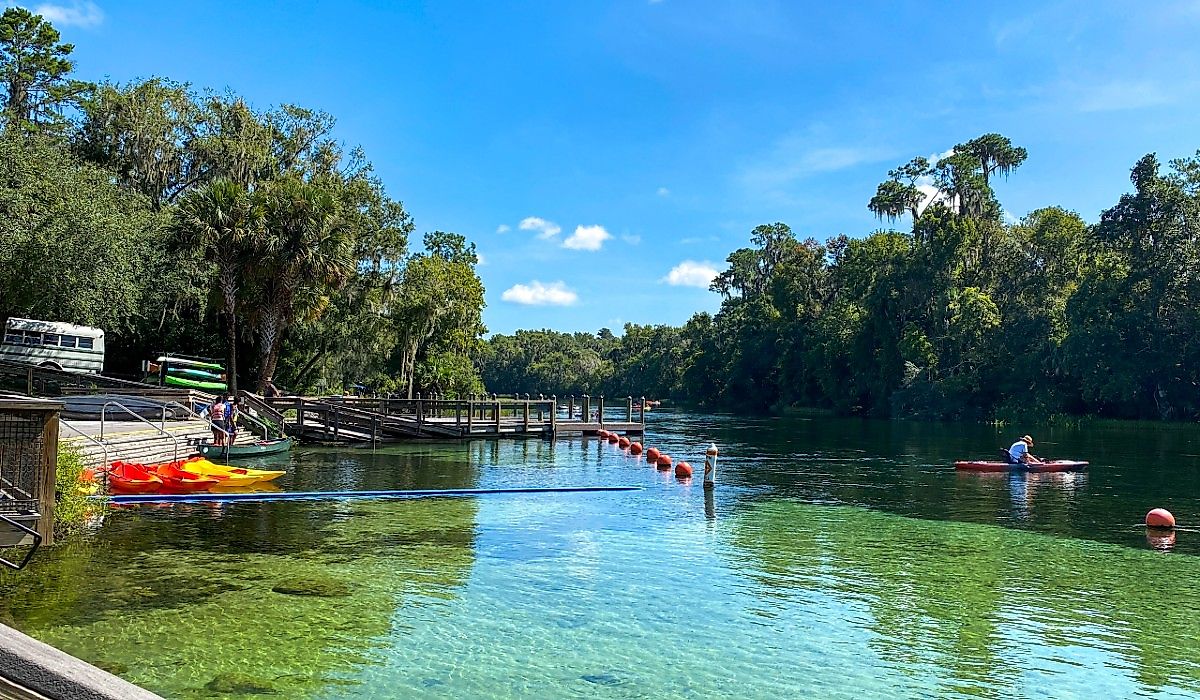
Dunnellon describes itself as the "Treasure of the Nature Coast," and the claim is grounded in a specific geographic fact: the Rainbow River, one of the clearest spring-fed rivers in North America, meets the tannin-dark Withlacoochee River at the edge of downtown. The Rainbow runs about 6 miles from its headwaters to that confluence, and the color contrast at the junction is visible from the riverbank restaurants. Rainbow Springs State Park, which preserves the headsprings just north of town, pumps around 400 million gallons of 72-degree water into the river per day and surrounds the spring with ornamental gardens and manmade waterfalls left from its days as a privately owned attraction.
The river draws tubers by the thousands in summer, with KP Hole County Park offering rentals and shuttle service for the four-hour float downstream. For those who prefer to stay dry, Swampy's Bar and Grille and the Blue Gator Tiki Bar both sit on the water and serve fresh fish with river views. Away from the water, the Dunnellon Boomtown Historic District preserves a cluster of 1880s and 1890s buildings from the era when phosphate was discovered here in 1887, briefly making the town one of the wealthiest small cities in the Southeast.
Apalachicola

Apalachicola reached its peak as the Gulf's third-busiest port, behind New Orleans and Mobile, in the decades before the Civil War, when steamboats carried cotton down from Georgia and Alabama to waiting ships. The commercial district along Water and Market streets preserves more than 900 buildings in the National Register Historic District, including Greek Revival homes, Victorian storefronts, and old cotton warehouses converted into galleries and restaurants.
The John Gorrie Museum State Park on Sixth Street honors a local physician who discovered the cold-air process of refrigeration in 1849 while treating yellow fever patients, securing a US patent for an ice machine in 1850. He spent the rest of his life largely unrecognized for it. A short walk toward the water leads to Up the Creek Raw Bar, where Apalachicola Bay oysters are back on the menu after a difficult stretch. The bay closed to all wild harvesting in 2020 following a collapse driven by upstream water diversion and prolonged drought, and a closely regulated, limited-entry season only reopened in January 2026. The annual Florida Seafood Festival at Battery Park, held each November and the state's oldest maritime event, draws thousands with oyster-shucking contests, Blue Crab Races, a Blessing of the Fleet, and a parade down the waterfront.
Everglades City

The road into Everglades City ends at the edge of the Ten Thousand Islands, where the Barron River empties into a labyrinth of mangrove islands stretching south toward Florida Bay. The town's designation as a Florida Trail Town reflects the paddling, fishing, and hiking infrastructure concentrated here, and the Marjory Stoneman Douglas Visitor Center serves as the western gateway to Everglades National Park, with naturalist-led boat tours departing for the islands on a regular schedule.
The Museum of the Everglades, housed in a restored 1927 laundry building on the National Register of Historic Places, covers more than 2,000 years of human history in the region. On the dining side, Camellia Street Grill handles the serious dinner crowd, while Havana Cafe, a small Cuban-American spot run by a local family, draws regulars for coffee and lunch. On the river, the Everglades City Rod and Gun Club, where President Harry Truman lunched in 1947 at the ceremony marking the opening of Everglades National Park, still stands, its original hunting lodge decor intact.
Punta Gorda

Punta Gorda sits where the Peace River meets Charlotte Harbor. Along the waterfront, there's a 2.5-mile Harborwalk that connects Laishley Park to Fishermen's Village through a continuous path lined with shrimp boats, public art, and open-air restaurants. More than 30 murals cover the exteriors of downtown buildings, depicting everything from the city's early railroad history to the notable guests of the old Hotel Charlotte Harbor, including Thomas Edison and W.K. Vanderbilt.
Along the riverbank, the Peace River Botanical and Sculpture Gardens combine 30 acres of large-scale outdoor sculptures with five distinct ecosystems, including mangroves and tidal flats, all accessible via 15,000 square feet of boardwalk. Out on the water, Charlotte Harbor draws anglers year-round for tarpon, snook, and redfish, while the Peace River itself attracts fossil hunters who work the limestone riverbed for shark teeth and megalodon fragments.
Lake Wales

Lake Wales sits near the geographic center of the Florida peninsula on the Lake Wales Ridge, a string of sandy scrub hills that represents the highest ground in the state. That topography is what made Bok Tower Gardens possible. Edward Bok, the Dutch-born editor of Ladies' Home Journal and a Pulitzer Prize winner, commissioned Frederick Law Olmsted Jr. to landscape Iron Mountain in the 1920s and built a 205-foot Gothic Revival and Art Deco carillon tower at the summit, now known as the Singing Tower, which holds 60 bells and performs concerts daily.
Downtown Lake Wales developed from the same 1920s civic vision that shaped Bok Tower, with Mediterranean Revival commercial buildings along Stuart Avenue and a historic depot that now anchors the Lake Wales Heritage Museums. A few blocks away, Spook Hill is an optical illusion where cars left in neutral appear to roll uphill, drawing curious visitors since the 1950s. The Crooked Lake Prairie Preserve, a short drive from town, protects several habitats, including one of the few remaining examples of Florida dry prairie, a grassland ecosystem more endangered than the Everglades.
Why These Towns Hold the Line
These eleven towns survived because they had a reason to exist that had nothing to do with tourism. Apalachicola moved cotton and now moves oysters. Cedar Key farms clams where it once cut cedar. Micanopy has kept its single antique-lined block since 1821, and the mediums of Cassadaga have held services since the 1890s. A working economy and a long memory are harder to franchise than a beach, which is exactly why a Southerner can still find an unhurried Saturday in any of them. The coasts get the crowds. The interior kept the state.