11 Prettiest Downtown Strips In Nevada
Nevada's historic main streets offer a striking mix of weathered frontier grit and modern culture. Against a backdrop of dramatic Nevada mountain ranges, these small towns blend relics of the nineteenth-century silver boom with glowing neon and local art. Here, you can discover authentic buckaroo culture, traditional Basque and pioneer food, and unforgettable desert festivals. Grab your favorite cowboy hat and prepare to explore eleven of the prettiest downtown strips in the West.
Virginia City

You would never guess it from its quiet atmosphere today, but Virginia City was once one of the wealthiest mining boomtowns in America. Perched 6,200 feet above the desert basin, this sprawling city climbs the rugged hillsides beneath Mount Davidson. During the Comstock Lode peak, more than 25,000 residents lived here, building grand opera houses, luxury hotels, and thriving businesses. Today, wooden boardwalks and ornate storefronts continue to reflect this silver-era grandeur.
Strolling along these walkways, visitors can sample handcrafted treats at Grandma's Fudge Factory, where all candies are made in-house, cooked in large copper pots over an open flame. For evening entertainment, Piper's Opera House still hosts live concerts, while thrilling ghost tours explore the legendary Washoe Club, arguably one of the most haunted places in the American West. Those planning a trip in August can experience the annual Art Walk on the Comstock, a festival featuring more than 100 local makers celebrating Old West heritage.
Genoa

Genoa's Main Street is one of the oldest town centers in Nevada. Established as Mormon Station in 1851, it holds the title of the first permanent settlement in Nevada. Today, sweeping Carson Valley ranchlands surround this quiet crossroads, while the scenic eastern slopes of the Sierra Nevada Mountains grace the town's periphery. Pioneers once traveled this exact route along the Overland Emigrant Trail, and the street still functions like an open-air museum, lined with old Victorian buildings and towering cottonwoods. At one end of the thoroughfare stands the Genoa Courthouse Museum. Just steps away, visitors can admire the beautifully preserved Pink House, a historic home turned restaurant and cocktail bar that features elegant period decor and a beautiful outdoor patio. At the opposite end sits the legendary Genoa Bar & Saloon. Established in 1853, it is recognized as the state's oldest continuously operating drinking establishment. Those visiting during the final weekend of September can experience the beloved annual Genoa Candy Dance. Founded in 1919 to raise money for the town's first street lights, this century-old tradition now draws thousands of visitors, transforming the area with over 400 craft vendors and thousands of pounds of locally handmade fudge and sweets.
Gardnerville

Basque immigrants began settling throughout the Gardnerville region in the late nineteenth century, during the area's ranching and sheepherding years, and that old-world influence still shapes much of the town today. Snow-capped Sierra peaks rise behind flower-lined sidewalks and old brick storefronts, creating an easy setting for downtown strolls.
Spend the morning browsing treasures at Cheshire Antiques, a massive collection spread across two historic buildings. Afterward, enjoy lunch across the street at J.T. Basque Bar & Dining Room. This longtime gathering spot is housed inside a Victorian building with a fascinating history dating back to the 1870s, including being completely relocated from Virginia City in 1896. During the summer months, Third Thursday Wine Walks bring residents into the heart of town to sip and shop, while evening strolls here always make for magical moments beneath the dramatic sunset views of the valley's most prominent granite sentinel, Jobs Peak, which towers at an impressive 10,633 feet.
Pioche

Pioche's central strip tells the story of an infamous frontier boomtown, holding a poetic, dark beauty within its canyon walls. Set against rolling desert hills, this protected district preserves the legacy of a community where violent silver rushes and larger-than-life characters shaped the past. Thompson's Opera House stands as a premier local landmark and one of the region's oldest remaining performance halls. It debuted in 1873 as a community meeting space, later hosting grand dances and silent films while Pioche grew from a rough camp into a prosperous town. Today, visitors can attend scheduled performances or check locally for visitor-center access inside the restored opera house. Just steps away, the historic marquee of the neighboring Gem Theater makes for a great photo moment; though you cannot enter it today, a local nonprofit is actively working to restore this 1937 cinema icon. Nearby, the old Pioche Firehouse and the Million Dollar Courthouse continue to safeguard the history of this rustic Wild West destination. Visitors can admire the vintage western decor at the Historic Silver Café before heading up the road to Boot Hill Cemetery, where legends from a rough-and-tumble era still linger.
Eureka

Eureka once earned the gritty nickname "Pittsburgh of the West" due to its massive industrial smelting era. Workers discovered rich silver-lead deposits here in 1864, causing Eureka to quickly grow into the region's second-largest city, filling its broad avenue with beautiful hotels, theaters, and saloons. Framed by the rugged Diamond Mountains, the downtown strip is a hub where coffee lovers can stop at the Eureka Depot, a coffeehouse and eatery housed inside an elegant vintage building. Anchoring the neighborhood is the beautifully restored Eureka Opera House, which continues to host live community performances beneath its original, grand horseshoe balcony. The towering, notoriously haunted Jackson House Hotel still welcomes brave travelers along the Loneliest Road in America, while the Eureka Sentinel Museum and the active 1880 Eureka County Courthouse preserve local stories of the silver boom years.
Ely

Ely's Aultman Street brings a burst of color and culture to the high desert. Founded as a lonely stagecoach stop in 1878, the town exploded as a major copper mining center in the early twentieth century, quickly transforming into a melting pot for immigrants arriving from across Europe. Today, that rich heritage is proudly displayed across a vibrant commercial district, where large-scale murals convert old brick buildings into an outdoor gallery framed by the pine-covered peaks of the Egan Range. The Ely Mural Walking Tour brings this history to life, taking visitors past towering downtown landmarks like the six-story Hotel Nevada and the nearby Nevada Northern Railway. A must-visit stop along the main drag is Economy Drug, where an authentic 1950s-style soda fountain features retro decor and still serves milkshakes and lime rickeys. Travelers can also browse local artwork inside the Ely Art Bank, explore the beautifully restored multi-ethnic immigrant cabins at Renaissance Village, or plan a trip around the annual Bristlecone Arts in the Park festival, a massive celebration of arts, crafts, and food held every August at Veterans Memorial Park.
Caliente

Caliente's main boulevard beautifully embodies the frontier-era spirit. Long before the railroad tracks were ever laid, the valley was settled in the early 1860s by Ike and Dow Barton, the two formerly enslaved Arkansas men who fled west in search of freedom and a new beginning. Their pioneering ranching operation became the first chapter of a resilient community built entirely on determination and ingenuity. Caliente's main strip possesses an almost surreal quality, anchored by its iconic Spanish-inspired Mission Revival railroad depot, which stands in contrast to the surrounding high-desert canyon walls and blue skies. Built in 1923, the grand Caliente Railroad Depot remains the crown jewel of the town center. Right across the tracks, travelers can grab a morning pick-me-up at The Barrow Brew Co., a mobile coffee truck and local favorite, celebrated for its artisanal drinks and welcoming vibe. Afterward, visitors can step inside the nearby, free Box Car Museum to browse local artifacts. For a scenic escape, the Rainbow Canyon awaits just minutes south of the main drag along State Route 317.
Boulder City

Boulder City's downtown promenade on Nevada Way uniquely blends 1930s engineering history with architectural beauty. Meticulously designed by federal planners during the construction of the Hoover Dam, this district stands as a living monument to the workers who built America's greatest modern marvel. Walking a block down to Arizona St., visitors are drawn to the stately Boulder Dam Hotel, which anchors the entire neighborhood with its pristine colonial architecture. Inside, it houses the Boulder City/Hoover Dam Museum and the Boulder City Art Guild & Gallery, showcasing fine art and pottery created by Southern Nevada artists. The district stays lively well into the evening, especially during the massive Art in the Park festival, which transforms the surrounding public green spaces into one of the state's largest outdoor art events each fall.
Tonopah

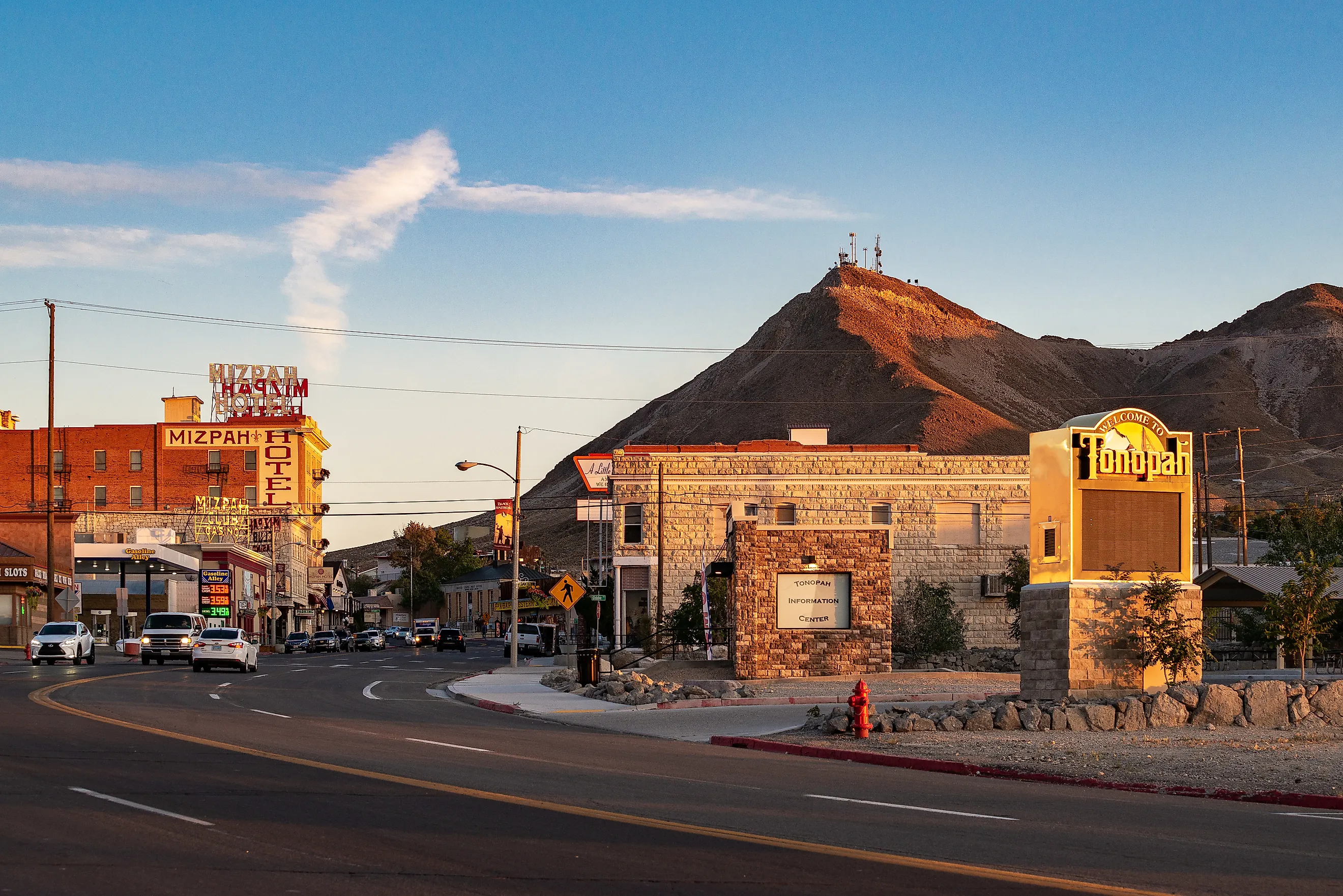
Vintage neon signs and weathered hills give Tonopah one of the most memorable backdrops in the high desert. This steep stretch along the highway centers around the towering Mizpah Hotel, the elegant Pittman Room, and legendary "Lady in Red" ghost lore. Nearby, the Tonopah Historic Mining Park, old western saloons, and the eccentric, world-famous Clown Motel blend a rich silver-boom past with roadside Americana. Visitors can explore local rock shops like High Desert Turquoise, with its unique, colorful window displays of locally mined Nevada turquoise. Afterward, travelers can grab house-smoked brisket and craft beverage at the Tonopah Brewing Company.
For an unforgettable evening, you can view the brilliant Milky Way from the Clair Blackburn Memorial Stargazing Park, located right along Nevada's premier "Park to Park in the Dark" astrotourism route. While minor highway development means seasoned astronomers often venture just a bit further down the dark desert dirt road to escape local gas station glare, the region's high altitude and remote skies still unveil thousands of stars to the naked eye. To catch the town at its liveliest, time your visit with Jim Butler Days, a lively spring festival that fills the streets with parades, mining drilling contests, and traditional street dances.
Winnemucca

Named for the respected Northern Paiute leader Chief Winnemucca, this northern Nevada town grew from a Humboldt River crossing into a railroad stop, ranching hub, and cultural crossroads. That layered history still shows along Winnemucca Boulevard and Bridge Street, where large-scale murals highlight Native heritage, Basque traditions, and the buckaroo culture that continues to shape the surrounding ranch country.
Winnemucca's downtown also leaves room for browsing, dining, and local history. Tipsy Tulip Designs adds a boutique stop for western apparel, gifts, and artisan-made pieces, while The Martin Hotel remains the town's signature dining experience. Set near the railroad tracks and operating since 1898, the former boarding house serves generous family-style Basque meals that have made it a regional destination. For more of the city's story, the Humboldt Museum traces local history, and the Winnemucca Murals & Music Festival brings outdoor concerts and public art into the heart of town.
Elko

Elko's historic Idaho Street tells the story of a resilient community shaped entirely by movement and diversity. Established in 1868 as a chaotic railroad construction camp, Elko rapidly evolved into a thriving regional hub for livestock, mineral extraction, and commerce as newcomers arrived from across the American West and beyond. Set beneath the white-capped Ruby Mountains, the local storefronts display an immersive blend of Spanish-border, Shoshone/Paiute, and Western buckaroo influences.
Downtown's storefronts carry that heritage into the present. On Commercial Street, J.M. Capriola Co. still makes custom leather saddles and western livestock gear, while nearby BJ Bull Bakery brings Cornish pasties to Idaho Street. Silver Street has its own landmark in The Star Hotel, a Basque dining institution serving family-style dinners and Picon Punch since 1910. One block south on Railroad Street, the Pioneer Hotel houses the Western Folklife Center, the organization behind the annual National Cowboy Poetry Gathering. Each winter, that event brings ranchers, poets, and rural artisans from around the world to Elko. Meanwhile, murals across the central business district keep the city's Native, Basque, and buckaroo heritage visible year-round.
Adventuring Through Nevada's Prettiest Main Streets
Exploring Nevada's prettiest downtown strips reveals more than casinos interspersed with attractive historic buildings and mountain views. Travelers willing to dive deeper might find wooden boardwalks and Victorian storefronts along with colorful murals, vintage neon, and beautifully preserved landmarks. Each community presents a distinct visual identity shaped by its history and landscape. Local art, traditional food, and annual festivals further enrich these districts, giving visitors countless reasons to linger. Together, these eleven destinations showcase some of the most beautiful and memorable main streets in the state.