The Best National Parks On The East Coast
The East Coast holds the busiest national park in the country and one of its least crowded, often within the same day's drive. Great Smoky Mountains National Park has been the most visited in the system for decades, and it drew 11.5 million people in 2025, more than the second and third most visited parks combined, according to the National Park Service. Others on this list see a fraction of that traffic. Dry Tortugas sits 70 miles past Key West and can only be reached by boat or seaplane. What ties these parks together is range: rocky northern coastline in Maine, subtropical wetland in Florida, old-growth hardwood bottomland in South Carolina, all of it protected along one coast. Here are the best national parks on the East Coast.
Shenandoah National Park, Virginia

Skyline Drive runs 105 miles down the length of Shenandoah National Park, and it is the reason most visitors know the place. Dozens of overlooks along it open onto the Shenandoah Valley, and the trailheads, campgrounds, and lodges all sit close enough that visitors rarely have to leave the ridgeline for long. Skyland Resort sits right off the drive, with rooms and a dining hall at one of the highest points in the park. The surrounding Blue Ridge Mountains carry hardwood forest, wildflower meadows, and roughly 200 bird species, along with black bear and white-tailed deer.
Hikers get more than 500 miles of trails, from short walks to multi-day backcountry routes. The White Oak Canyon Trail to Upper Falls is among the most popular, a day hike of nearly five miles through the woods to a set of waterfalls with pools deep enough to swim in. The color peaks in October, which is also when the overlooks fill up fastest.
Acadia National Park, Maine
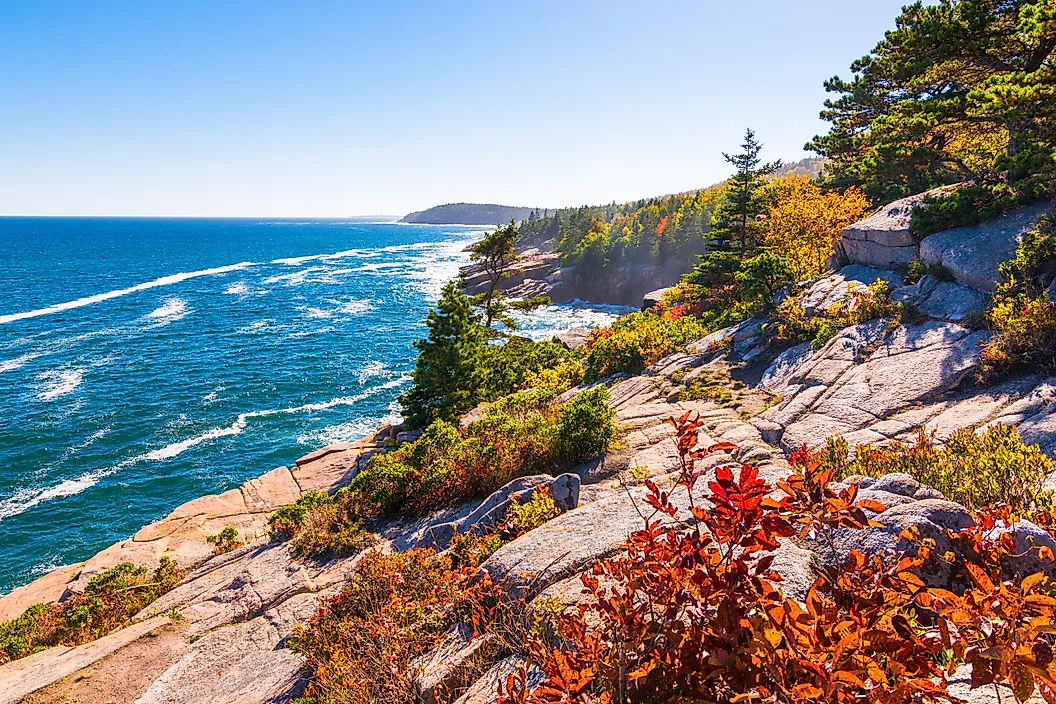
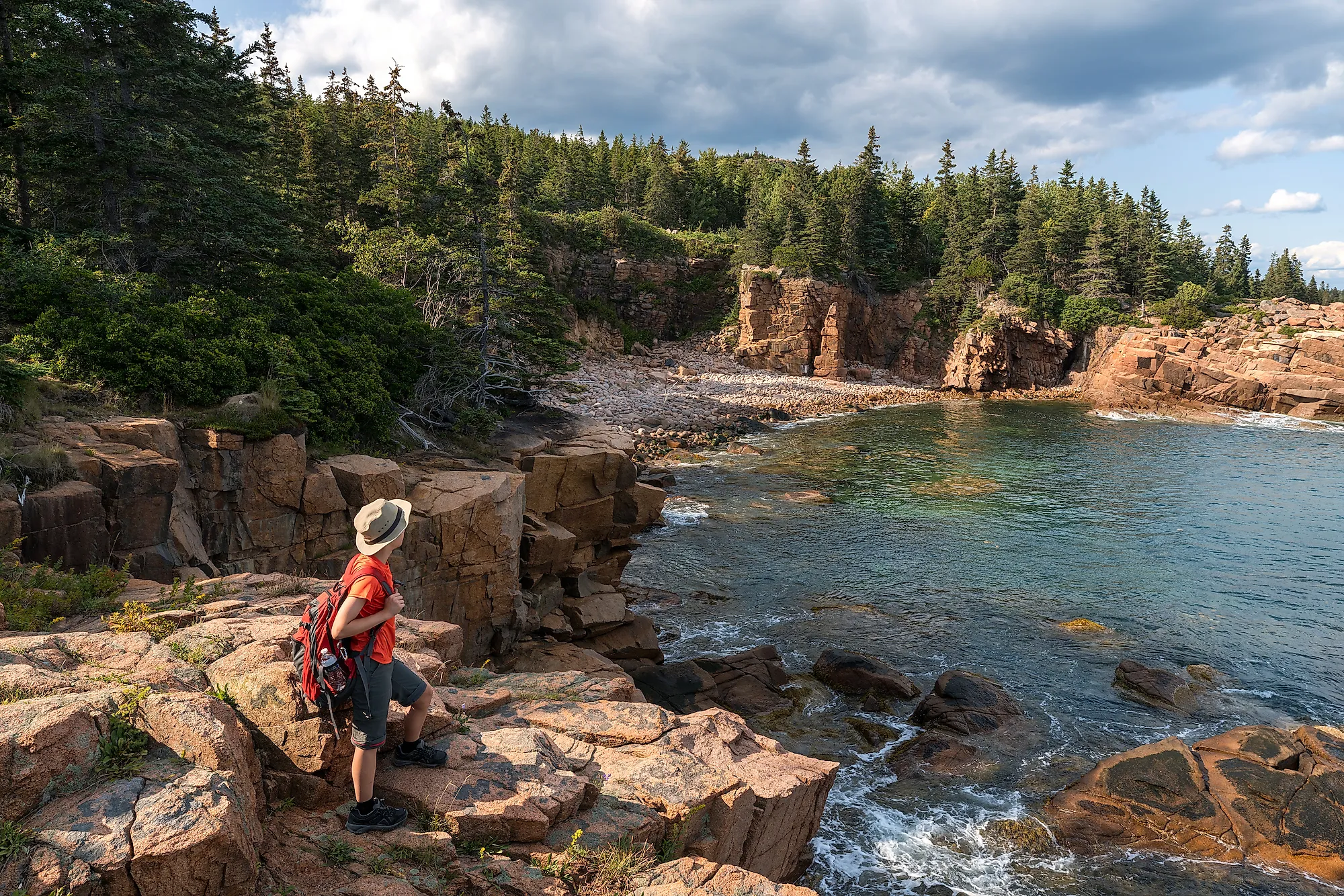
Cadillac Mountain tops out at 1,530 feet, the highest point on the Atlantic Coast, and for part of the year its summit is the first place in the United States to catch the sunrise. A paved road and several trails reach the top, where the view takes in Frenchman Bay, the offshore islands, and the surrounding peaks. Acadia National Park covers nearly 50,000 acres across Mount Desert Island, some smaller islands, and a stretch of mainland. The terrain takes in rocky shore, spruce-fir forest, lakes, and wetlands, plus more than 20 mountains that rise straight out of the Atlantic Ocean.
The 27-mile Park Loop Road runs past viewpoints and forest and out to Sand Beach, a rare sandy stretch hemmed in by granite cliffs, linking most of the park's highlights along the way. From there hikers can pick up part of the park's 120-plus miles of trails, including the Beehive Loop, a steep 1.4-mile climb over granite steps, iron ladders, and exposed ledges above the coastline. Anyone uneasy with heights will want to read the trailhead sign first. Boating, birdwatching, rock climbing, and several hundred campsites round out the park.
Great Smoky Mountains National Park, North Carolina & Tennessee
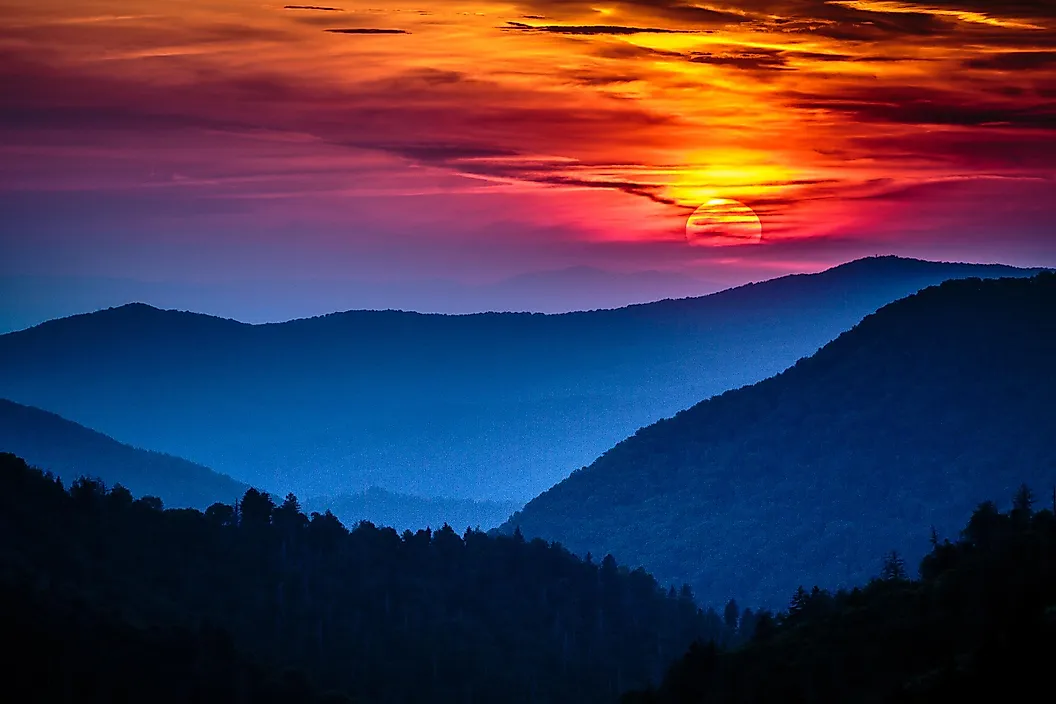
The haze that settles over these ridges is where the name comes from, a blue-gray fog that hangs on the peaks most mornings. Established in 1934, Great Smoky Mountains National Park spreads across more than 522,000 acres of North Carolina and Tennessee, protecting a large section of the southern Appalachian Mountains and a UNESCO World Heritage Site. Inside are forests, wetlands, meadows, streams, and waterfalls that support more than 200 bird species, 68 kinds of mammals, and dozens of fish, reptiles, and amphibians.
More than 800 miles of trails cut through that biodiversity, along with scenic drives like the 11-mile Cades Cove Loop Road. The John Oliver Cabin sits near the start of the loop and dates to the 1820s, the oldest of the park's preserved structures. Laurel Falls Trail stays busy year-round, a 2.6-mile out-and-back through hardwood forest to an 80-foot waterfall. Beyond the hiking, visitors fish, bike, ride horses, and, with some luck, spot a northern flying squirrel or an Indiana bat.
Everglades National Park, Florida

Everglades National Park is the largest on the East Coast, 1.5 million acres of forest, wetland, and marine habitat, and the biggest subtropical wilderness in the country. One of the densest populations of American alligators anywhere lives here, along with the Burmese python, the invasive snake that has become Florida's most notorious. Another 40 mammal species live here, plus amphibians, fish, invertebrates, and more than 350 kinds of birds, from wading birds to raptors.
Visitors get at all of it by boat, paddle, foot, and bike, with wildlife rarely far off. The Anhinga Trail is the busiest, a 0.8-mile loop over a slough where alligators, anhingas, turtles, and herons gather in plain sight, close enough that new arrivals routinely ask whether the alligators are real. They are. The 24-mile Loop Road Scenic Drive pushes deep into cypress swamp, where sightings of birds, gators, snakes, and turtles are common. Saltwater and freshwater fishing and several campgrounds are also on offer.
Congaree National Park, South Carolina

Some of the trees in Congaree National Park clear 160 feet, among the tallest hardwoods in the eastern United States and one of the highest deciduous canopies left anywhere. The park's 26,992 acres protect the largest stretch of old-growth bottomland hardwood forest in the Southeast, a small remnant of the floodplain forest that once covered the region before European settlement. An elevated 2.4-mile Boardwalk Loop runs through the heart of it without disturbing the wetlands below, and another 25-plus miles of trails carry hikers deeper in. Paddlers take Cedar Creek, campers use the designated campgrounds, and foxes, deer, and hundreds of bird species turn up year-round.
Dry Tortugas National Park, Florida

Dry Tortugas National Park reads more like the Caribbean than the mainland. The park spans 100 square miles, nearly all of it open water, with seven small islands of white sand, coral reef, and shipwrecks. It sits about 70 miles from Key West and is reachable only by ferry or seaplane. Divers and snorkelers get excellent visibility, more than 30 coral species, and no shortage of fish, and boat owners can bring their own vessels. Fishing, birdwatching, and camping are all permitted.
The draw on land is Fort Jefferson, a 19th-century coastal fortress and the largest brick masonry structure in the Americas, built from more than 16 million bricks. It went up on Garden Key starting in the 1840s to watch shipping lanes in the Gulf of Mexico. The fort was never finished, and after the Civil War it held prisoners, including the doctor who set John Wilkes Booth's broken leg. Visitors walk the ramparts and casemates today, with a small museum on site.
Biscayne National Park, Florida

Biscayne National Park is 95 percent water, which makes it the odd park where a boat is close to mandatory. Inside its boundaries are mangrove shoreline, a scatter of islands, and the northern end of the Florida Reef, one of the largest coral reef systems in the world. That mix supports more than 500 fish species along with sea turtles, manatees, sharks, American crocodiles, and over 100 kinds of tropical birds. The park is best explored by boat or kayak, and the Maritime Heritage Trail is an underwater route to six shipwrecks and a lighthouse, all of it now under coral and swarming with fish. Fishing is good, and two campgrounds are reachable only by boat.
The Best Of The East Coast's Parks
These parks make the case that the East Coast's natural range rivals its history, which is saying something for the oldest-settled part of the country. Acadia and the Great Smokies anchor the northern and southern ends of the Appalachian story, while the three Florida parks trade mountains for water, wetland, and reef. Congaree fills the gap in between with a forest most people have never heard of and few other places can match. Taken together they cover about as much ecological ground as any single coastline in the United States, and most of them stay open year-round.