11 Main Streets Where Texas Comes Alive
In Texas, Main Streets are the heart of its towns, where local character is on full display. Courthouse clocks still chime over limestone squares, pitmasters open their doors before lunch, and German brass bands take gazebo stages on summer evenings. In Lockhart, Black's Barbecue has been serving hungry customers since 1932, while Jefferson's historic General Store still pours floats at its old-fashioned soda fountain. These 11 main streets stay busy with dance halls, creekside restaurants, and storefronts that have held their own for more than a century. The route begins in the Hill Country, crosses old cattle-trail towns, and ends in the Piney Woods, with each stop offering a little piece of Texas history best explored on foot.
Fredericksburg

Fredericksburg has organized itself around one wide avenue since 1846, when German settlers sent by the Adelsverein laid out Main Street and called Hauptstrasse. The town's first public building, the octagonal Vereins-Kirche, stood at its center, and reconstruction now marks Marktplatz, where festivals and markets still gather crowds. Chain stores are not permitted in the historic district, so the limestone storefronts hold more than 150 proudly independent shops, galleries, and tasting rooms. At the east end, the National Museum of the Pacific War grew from the former Nimitz Hotel, once run by the grandfather of Fleet Admiral Chester Nimitz. The Pioneer Museum anchors the west end with three acres of original buildings, including a blacksmith shop, a one-room schoolhouse, and a Sunday House.
Boerne

Less than an hour south, Boerne shares Fredericksburg's strong German roots. Settlers founded the town in 1849 as Tusculum and renamed it in 1852 after the writer Ludwig Borne. Its Main Street, also signed as Hauptstrasse, forms the spine of the Hill Country Mile, a walking route lined with more than 80 shops and restaurants in historic limestone buildings. Cattle once rested on Main Plaza during drives north, and since 1910 a gazebo there has hosted concerts by the Boerne Village Band, founded in 1860. Facing the plaza, The Kendall, built in 1859 and long called Ye Kendall Inn, began by renting rooms to stagecoach travelers. While the Kendall Restaurant, inside the historic building serves steaks and cold signature drinks. Behind it, the route follows Cibolo Creek through River Road Park, where shaded banks offer a break in between exploring shops.
Bandera

Roughly 25 miles west of Boerne, Bandera trades boutiques for hitching rails. Polish families from Silesia settled here in the 1850s, and from 1874 to 1894 the town served as a staging area for cattle drives on the Great Western Cattle Trail. The era earned it the title Cowboy Capital of the World, and the town's Main Street still plays the part, with horses tied outside the bars on busy weekends. The Frontier Times Museum, founded in 1933, holds frontier and ranch artifacts gathered over nearly a century. Just off Main, the 11th Street Cowboy Bar fills its dance floor with live country music. The limestone Bandera County Courthouse rises over Main Street, and at the south end of town the Medina River draws waders and paddlers.
Wimberley

East across the Hill Country, Wimberley grew around a mill rather than a courthouse. William Winters built a gristmill on Cypress in 1856, and the settlement took its present name in 1880 from mill owner Pleasant Wimberley. Wimberley Square took shape beside the mill, and in 1895 Sidney Pyland opened a blacksmith shop there that became the hub of local business. Its site now holds the Wimberley Cafe, favored by locals for their all day pancakes and waffles, along with a row of locally owned shops. Limestone storefronts around the square house boutiques, galleries, and antique dealers. Cypress Creek still runs through the center of town, and several restaurants set their tables along its banks, so lunch on the square comes with the serene sound of moving water.
Marble Falls

Farther north, where the Colorado River widens into the Highland Lakes, Marble Falls runs its Main Street toward the water. Former Confederate general Adam Rankin Johnson founded the town in 1887, and granite from nearby Granite Mountain went into the Texas Capitol. Main Street was once shaded by century-old oaks, and their removal in 1924 stirred controversy in town. Today, the free Sculpture on Main program fills the sidewalks with rotating outdoor works. At 318 Main Street, the Highland Arts Guild and Gallery shows the work of local artists inside the former post office. Old Oak Square gathers vintage and handmade shops around a landmark oak, and Lake Marble Falls lies just steps from Main Street for an evening along the shore.
Salado

East of the Hill Country, Salado grew as a stop on the Chisholm Trail, where cattle drives passed from 1866 to 1885. The village dates to 1859, the same year Salado College opened as one of the earliest coeducational schools in Texas. After the railroads bypassed it, the population fell to about 200 by 1950, until the dining room at the Stagecoach Inn helped revive the Main Street in the 1940s. The inn, a former stagecoach stop, still welcomes overnight guests. Galleries, antique shops, and boutiques now line Main Street through the village arts district. The spring-fed Salado Creek flows through the center of town, with shaded banks for picnics, and the Salado Museum and College Park preserves the college's limestone ruins.
Lockhart
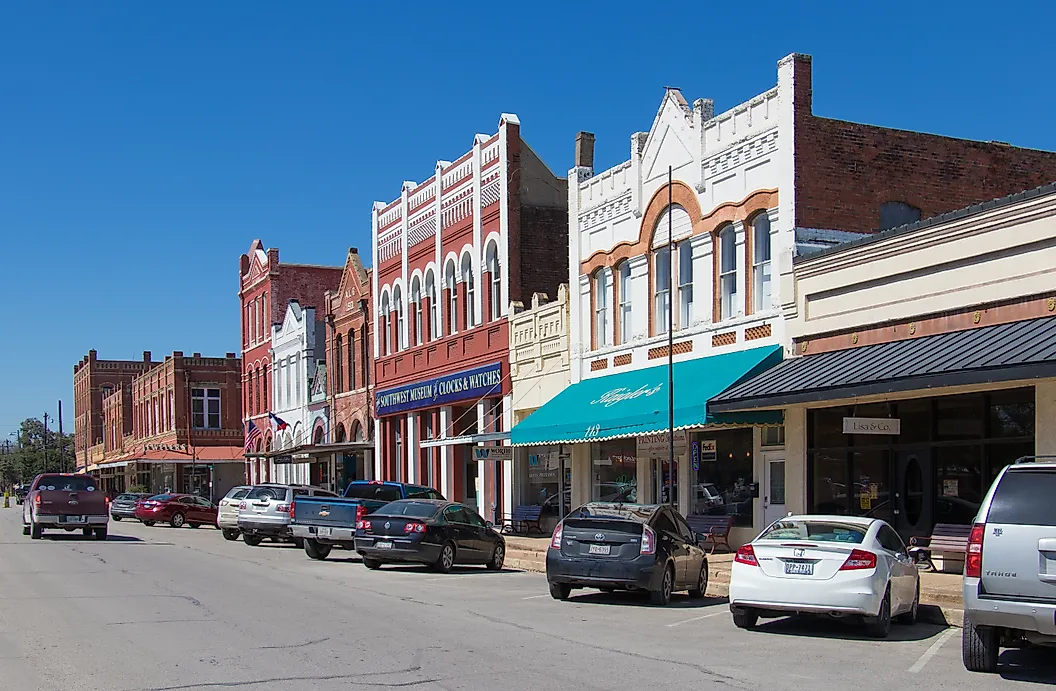
Like Salado, Lockhart owes part of its start to the Chisholm Trail, and in 1999, the Texas House of Representatives named it the Barbecue Capital of Texas. The Caldwell County Courthouse, completed in 1894 in cream limestone trimmed with red sandstone, completes the unique look of the square, and in 1978 it joined several downtown blocks on the National Register of Historic Places. On North Main Street, Black's Barbecue has served customers since 1932. It is one of the oldest barbecue restaurants in Texas, continuously owned by the same family. A short walk from the courthouse, the Dr. Eugene Clark Library is the oldest operating public library in the state. From April to August, Courthouse Nights bring live music to the courthouse lawn on the third Friday of each month.
Granbury

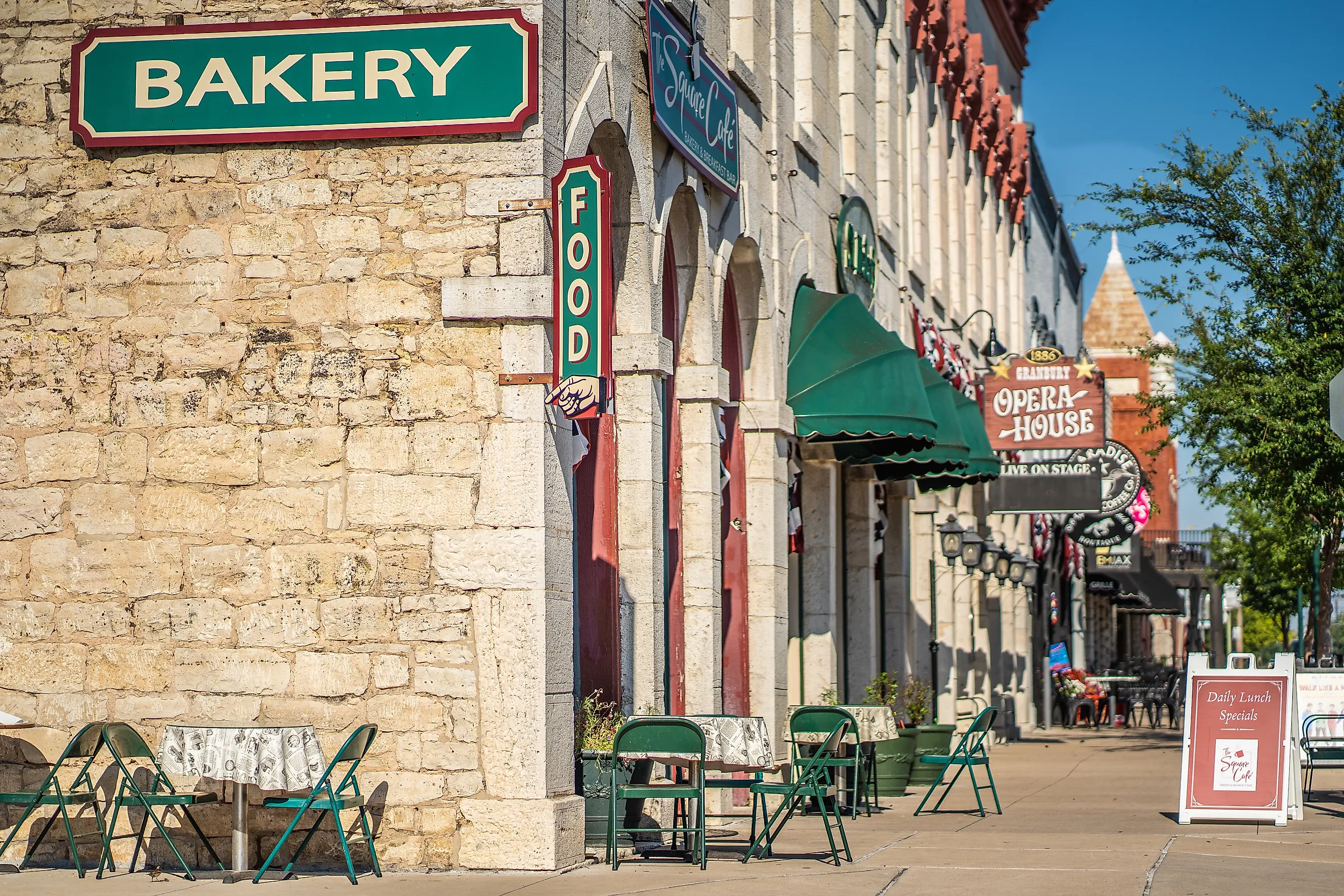
North of the Hill Country, Granbury began in 1860 with a square and a log cabin courthouse. Today the square the Second Empire Hood County Courthouse, completed in 1891, stands among two-story limestone buildings from the 1880s and 1892 that now hold shops and restaurants that can be toured, complimentary on Friday to Sunday on the Granbury Trolley. Local shows, hosted by the Granbury Theatre Company, can be enjoyed at the Granbury Opera House, originally built in 1886 and restored in 2012. Just off the northeast corner, the Hood County Jail Museum fills the 1885 jail, with upstairs cells and a gallows room that never held a hanging. On hot days, a short walk from the square offers the refreshing waters of Lake Granbury for a day of beach fun or relaxing waterfront trails.
Weatherford

Less than 30 miles north of Granbury, Weatherford gives residents plenty of reasons to linger around its courthouse square. The limestone Parker County Courthouse, completed in 1886, still rises over the square with its clock tower and red mansard roofs. Around it, storefronts that once held saloons now house antique shops, western-wear boutiques, and cafes, including Zeno's on the Square on College Avenue. In the historic district at Heritage Park, First Monday Trade Days brings hundreds of vendors selling antiques, furniture, pottery, and farm goods the weekend before the first Monday of each month. The market began more than 155 years ago as a trading day held during court sessions. Each July, the Parker County Peach Festival fills downtown with cobbler, peach ice cream, and live music.
Nacogdoches

Far to the east, in the Piney Woods, Nacogdoches claims the title of the oldest town in Texas, and its Main Street still follows the route of El Camino Real. The Charles Bright Visitor Center, a restored 1918 federal building at the center of Plaza Principal, hands out walking tour maps and displays exhibits on local history. From there, brick streets lead past antique shops, galleries, and family-owned restaurants, including Fredonia Brewery on North Mound Street. A few blocks away, the free Durst-Taylor Historic House and Gardens, built around 1835, is the second-oldest structure in town and offers exhibits on the families who once called this house home. On Saturday mornings, the Nacogdoches Farmers Market on Pearl Street sells local produce and baked goods, which can then be followed by a peaceful walk along the water on the Banita Creek Trail beginning just north of the market.
Jefferson

About 100 miles north, deeper in the Piney Woods, Jefferson was once the largest river port in Texas, and its 19th-century downtown along Austin Street still looks the part. At 223 West Austin Street, the Jefferson Historical Museum fills the floors of the 1888 federal courthouse and post office with Civil War relics, river port models, and a large model railway. On the same block, the Excelsior House Hotel, which has been in operation since the 1850s, opens its rooms and halls for guided tours on Friday and Saturday afternoons. Across the street sits the Atalanta, the 1890 private railcar of financier Jay Gould. Down the street, the Jefferson General Store still pours floats from an old-fashioned soda fountain.
Texas, Told Through Its Main Streets
These 11 main streets tell the story of Texas one block at a time. Cattle trails, river ports, mills, and German settlements decided where each town built its storefronts, and those storefronts still fill up on a Saturday. A brass band plays in Boerne, vendors keep the tradition alive for First Monday in Weatherford, and the soda fountain pours floats in Jefferson. In between, courthouse lawns host live music, creekside tables fill at lunch, and museums keep the old stories close at hand. Each town gives Texans a reason to park the truck, walk the square, and stay past supper.