2026's 10 Best Small Towns To Visit In UK
Some of the UK’s most rewarding trips begin in towns where the past still shapes the experience. Bamburgh sits beneath its great coastal castle, which looks out onto the North Sea. In Ludlow, medieval streets lead to a different castle that still hosts major events. Meanwhile, Hawes keeps centuries of cheesemaking alive in Wensleydale. Even beyond history, there are plenty of unique experiences available, such as the waterfalls in the Yorkshire Dales. These ten towns stand out by providing an itinerary of gorgeous views and landmarks that still shape daily life.
Bamburgh, Northumberland

Bamburgh is a coastal village of around 414 people on the Northumberland coast, and it is dominated by one of the most dramatic castle settings in Britain. Bamburgh Castle sits atop a basalt crag 150 feet above the North Sea, its foundations dating to around 547 AD when the Anglo-Saxon king Ida built the first fortification here. The castle passed through Norman and royal hands before William George Armstrong purchased it in 1894 and began an extensive restoration programme. Armstrong died in 1900 before the work was finished, and the restoration was completed by his great-nephew and heir in the early 1900s. The castle remains privately owned by the Armstrong family and is one of the largest inhabited castles in England.
The beach below the castle stretches for miles of clean, barely-trodden sand with views across to Holy Island and the Farne Islands. Five miles offshore, there are grey seals and seabird colonies, making boat trips from nearby Seahouses worthwhile. The RNLI Grace Darling Museum in the village tells the story of the lighthouse keeper's daughter. She rowed through a storm in 1838 to rescue survivors from a shipwreck, one of the most celebrated acts of heroism in Victorian England.
Tobermory, Isle of Mull

Tobermory is the main town on the Isle of Mull, a Hebridean island off Scotland's west coast. Its harbour front consists of brightly painted houses in red, yellow, blue, and pink, and is one of the most photographed waterfronts in Scotland. The town was founded in 1788 by the British Fisheries Society as a fishing village. Ten years later, in 1798, the Tobermory Distillery was established on the harbourside as the Ledaig Distillery, making it one of the oldest licensed distilleries in Scotland. The distillery has experienced several periods of closure and multiple changes of ownership over its history. But, today, it remains the primary historic single malt producer on Mull, producing the unpeated Tobermory and the heavily peated Ledaig.
The Mull Museum near the harbour covers the island's history from its earliest inhabitants through the Highland Clearances with a collection that rewards an hour of quiet attention. The surrounding waters of the Sound of Mull are rich in wildlife. Boat trips from Tobermory offer potential sightings of white-tailed eagles, bottlenose dolphins, harbour porpoises, and basking sharks in season.
Ludlow, Shropshire

Ludlow is one of England's most complete medieval market towns, set in the south Shropshire countryside where the River Teme runs below a sandstone castle that has been standing since 1086. Ludlow Castle, built as one of a chain of fortresses along the Welsh Marches, became a royal palace in the 15th century and the seat of the Council of Wales and the Marches under Edward IV. The Ludlow Food Festival, held every September in the castle grounds, is widely credited as Britain's first food festival. The festival was launched in 1995 and now draws over 100 local and regional producers for three days of tastings and demonstrations.
Open-air Shakespeare productions have been performed in the castle ruins over the years, a tradition going back to 1960, though the original festival ceased operations in 2012 and productions in the castle now take place through independent events and the Ludlow Fringe Festival. The Shropshire Hills National Landscape wraps around the town, with walking and cycling routes into some of the least-visited upland countryside in the English Midlands.
Stamford, Lincolnshire

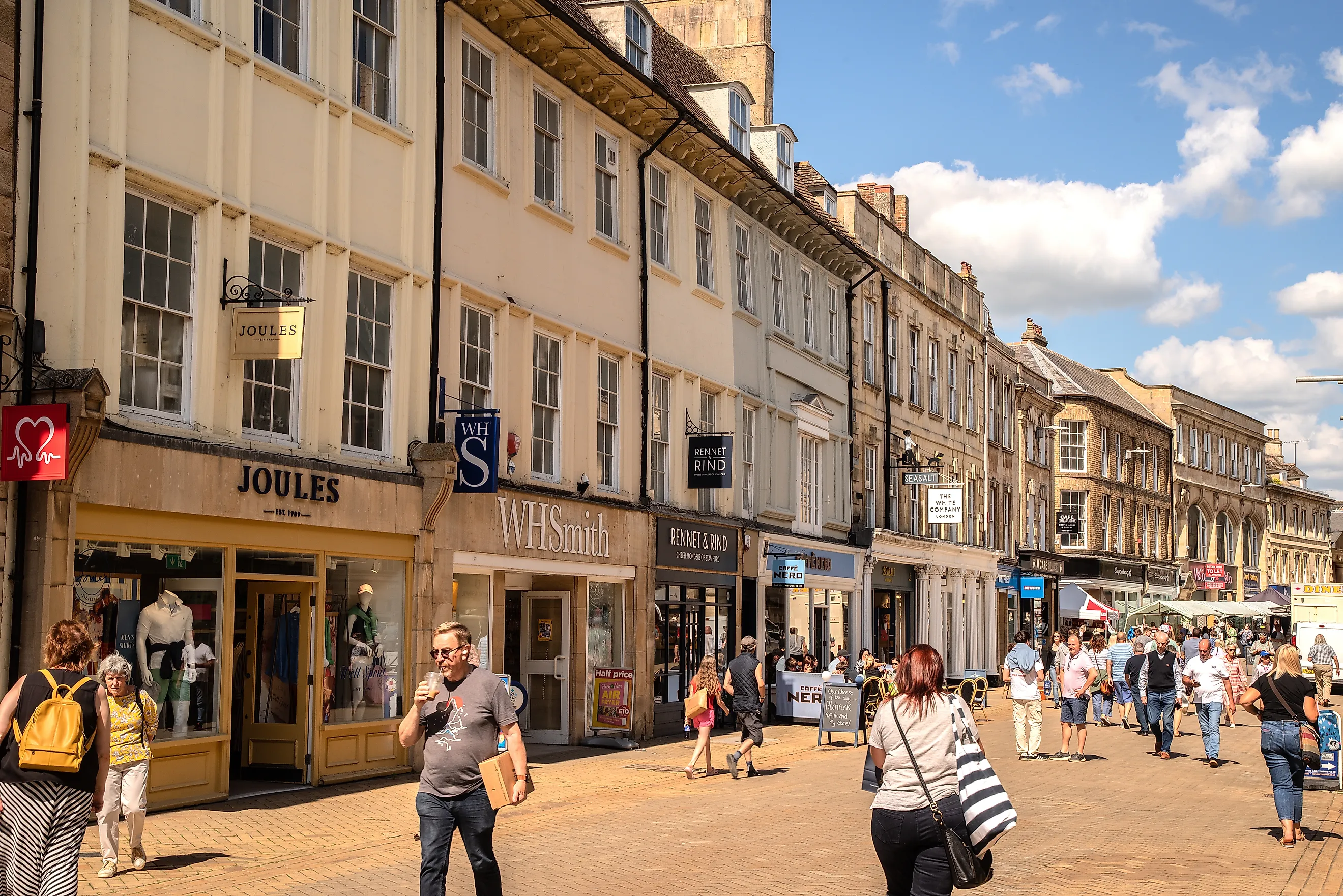
Stamford is widely regarded as the finest stone town in England, whose centre is almost entirely built from the local cream-coloured limestone. This limestone was quarried nearby and used for everything from cottages to church spires. The town was a significant medieval wool trading centre and later a coaching stop on the Great North Road,. The buildings that accumulated across those centuries have been protected with unusual care. In fact, Stamford was the first town in England to be designated a Conservation Area in 1967.
The George Hotel, a coaching inn operating since at least the 16th century on St Martin's High Street, is the kind of place where the cobbled courtyard and the gallows sign hanging over the road feel entirely natural. The Stamford Arts Centre on St Mary's Street and a strong independent retail scene give the town a daily life that goes well beyond its architectural appeal. The River Welland runs through the meadows at the edge of the old town, and Burghley House, one of the grandest Elizabethan houses in England, sits in its deer park a short walk from the town center.
Fowey, Cornwall

Fowey sits at the mouth of the River Fowey on Cornwall's south coast, its narrow streets of medieval and Georgian buildings climbing steeply from a working harbour. This harbour has been loading cargo since the 14th century. The town has an atmospheric tangle of lanes that connect the waterfront to the church of St Fimbarrus, which dates to the 15th century, and features views across the estuary.
Fowey is closely associated with Daphne du Maurier, who lived nearby at Menabilly for over 25 years. Maurier drew on the estuary and the surrounding landscape for Rebecca and My Cousin Rachel. Meanwhile, her earlier novel Jamaica Inn, set on the windswept Bodmin Moor some 20 miles north, was also written during her years in Cornwall. The Hall Walk is a four-mile circular route along the cliffs and through the woods on both sides of the estuary. It is one of the finest short coastal walks in Cornwall and crosses the river by passenger ferry at Bodinnick. The Fowey River itself is one of the best sailing and kayaking estuaries in the southwest, its deep water and sheltered channels making it popular with boats of every size.
Ambleside, Cumbria

Ambleside sits at the northern end of Lake Windermere in the Lake District, connected to the lake by a half-mile road through the village of Waterhead. The town functions as the main walking and outdoor activity hub for the northern Lake District. Stock Ghyll Force is a 70-foot waterfall in the woodland immediately behind the town center. It is reachable on foot in around 15 minutes and was admired by William Wordsworth, who lived nearby at Rydal Mount for much of his life.
The Armitt Museum on Rydal Road holds collections relating to Beatrix Potter, Wordsworth, and the natural history of the Lake District in a small but well-regarded local museum. The surrounding fells, including Loughrigg, Red Screes, and the Fairfield Horseshoe, provide walking routes ranging from gentle valley paths to full-day mountain circuits accessible directly from the town streets.
Plockton, Highland

Plockton is a small village of around 400 people on the shore of Loch Carron in the Scottish Highlands. The town is sheltered from the Atlantic by a headland and warmed by the Gulf Stream to a degree that allows palm trees to grow along its waterfront. It served as the filming location for the long-running BBC series Hamish Macbeth in the 1990s, which brought the village wider attention without noticeably changing its character.
The Plockton Inn on the harbour front hosts traditional Scottish music sessions, drawing local musicians and visitors in equal measure. Seal-watching boat trips leave from the village pier throughout the season as well. Common seals are reliably present in the loch, and the mountain walking in the surrounding Torridon landscape is among the finest and most challenging in Scotland.
Aberaeron, Ceredigion

Aberaeron is a small Georgian harbour town of around 1,400 people on Cardigan Bay in west Wales. The town was planned and built in the early 19th century around a purpose-built harbour completed in 1811 by Alban Thomas Jones Gwynne. Because the town was built to a unified plan within a short period, Aberaeron has a visual consistency of painted Georgian townhouses, wide streets, and a central square that is rare in Welsh coastal towns of its size.
The Harbourmaster Hotel on the quayside is a converted harbour master's office painted a deep blue. It is also the town's most celebrated dining and accommodation address and has won several national awards for its cooking. The Cardigan Bay waters just offshore are home to a semi-resident pod of bottlenose dolphins, and boat trips from the harbour offer good sightings throughout the summer. The town is also known locally for its honey ice cream. This specialty is sold near the harbour, which has become one of the most talked-about regional food products in mid-Wales.
Hawes, North Yorkshire

Hawes sits at 850 feet above sea level at the head of Wensleydale in the Yorkshire Dales National Park, one of England's highest market towns. The Wensleydale Creamery in the center of town has been producing Yorkshire Wensleydale cheese commercially since 1897. This is when local corn merchant Edward Chapman established production here. The tradition of cheesemaking in the valley stretches back much further, to Cistercian monks who first settled at Fors near Askrigg in 1150 and later relocated to Jervaulx Abbey. This is where the recipe for the valley's famous cheese was developed.
The Dales Countryside Museum, housed in the town's former Victorian railway station, covers life in the Yorkshire Dales from Viking times to the present through a well-designed collection of objects and interactive exhibits. The surrounding Dales landscape is crossed by walking routes in every direction, including the path to Hardraw Force, England's highest single-drop waterfall above ground, which lies a short walk from the town.
Dunkeld, Perth and Kinross

Dunkeld sits on the northern bank of the River Tay in Perthshire. The town is famous for its Cathedral, a ruined medieval church on the riverbank whose surviving stone structures date primarily from the 13th to the early 16th century,. It includes a choir from the 13th and 14th centuries, a largely 15th-century ruined nave, and a chapter house completed around 1457.
The surrounding area is known as Big Tree Country for its exceptional collection of ancient and champion trees. This includes the Parent Larch in the grounds of Dunkeld House, planted in 1738 and one of the oldest larches in Britain. The River Tay here is one of Scotland's premier salmon fishing rivers. The Hermitage, a National Trust for Scotland woodland walk a mile west of the town, follows the River Braan through towering Douglas firs to Ossian's Hall, a restored Georgian folly above the Black Linn waterfall. The town itself is compact and entirely walkable, with a cathedral street of restored 17th-century houses that forms one of the finest examples of architectural conservation in Scotland.
The towns above share no single quality except the conviction that the place they occupy is worth caring for. The castle has been kept, the harbour maintained, the cheese still made by hand, and the market still held on Tuesdays. That persistence is what separates the UK's best small towns from everywhere else, and it is more than enough reason to go looking for them.