Five of the Oldest Incorporated Towns in Texas
Nacogdoches, San Augustine, Richmond, Gonzales, and Bastrop all incorporated by the Congress of the Republic of Texas in 1837, eight years before the Lone Star State joined the United States. The Republic chartered its towns one at a time, by special act, and according to the Texas Municipal League the first of those acts — approved on June 5, 1837 — opened with Nacogdoches before running on through San Augustine, Richmond, and more than a dozen others. Gonzales was incorporated later that same year, and Bastrop that December. All five kept their courthouse squares, and several still have buildings that were standing when the charters were signed. Here’s how and when each town got its charter, and what’s worth seeing in each one if you visit.
Nacogdoches

Approved by the Congress of the Republic of Texas on June 5, 1837, the town’s incorporation was the first municipal charter the Republic issued. The settlement was already well established, growing up in the late 1700s around a stone house built on the El Camino Real de los Tejas, the royal road linking Mexico City to Louisiana. By the time the charter arrived, the town had become a gateway to trading routes to New Orleans.
That original stone house became known as the Old Stone Fort, and it was there in 1812 that soldiers of the Gutiérrez-Magee Expedition, a joint American and Mexican force, declared Texas liberated from Spanish rule. The original was dismantled in 1902, and a replica was built in 1936 on the campus of Stephen F. Austin State University using the original stones that now houses the Stone Fort Museum. Other notable pre-Republic structures include the Sterne-Hoya House Museum and Library, built in 1830, and the Durst-Taylor Historic House and Gardens of 1835, with a blacksmith shop, a smokehouse, a sugarcane mill, and an heirloom garden.

Much of downtown is listed on the National Register of Historic Places, and the red brick streets around the square make for a pleasant stroll. On the university campus, the Ruby M. Mize Azalea Garden holds more than 7,000 azaleas, the largest azalea garden in Texas. On the north side of town, Millard’s Crossing Historic Village gathers 19th- and early-20th-century buildings moved from sites across the county onto a 37-acre site.
San Augustine

The same June 1837 law that chartered Nacogdoches also incorporated San Augustine, further east along El Camino Real de los Tejas. Spanish activity here goes back to the mission of Nuestra Señora de los Dolores de los Ais, founded in 1717, abandoned two years later, and re-established in 1721. The district was known as Ayish Bayou until 1834, when the municipality of San Augustine was created and surveyed on a grid that may have been the first of its kind in Texas.
Archaeological work at Mission Dolores State Historic Site has recovered cattle and ox bones, horse trappings, broken knife blades, and gun flints. The property features a museum with interpretive displays alongside hiking trails and a campground, and the original route of the El Camino Real de los Tejas National Historic Trail passes through the grounds.

The town’s collection of Greek Revival houses includes the Ezekiel Cullen House, completed in 1839 by master builder Augustus Phelps and now runs as a museum with a collection of paintings by local artist Seymour Thomas. The town square is dominated by the San Augustine County Courthouse, built of Texas limestone in 1927. The adjacent San Augustine Jail Museum and Texana Library keeps county records and local artifacts, including exhibits on the timber industry and on Bland Lake, a recreation spot popular in the early 1900s.
Richmond

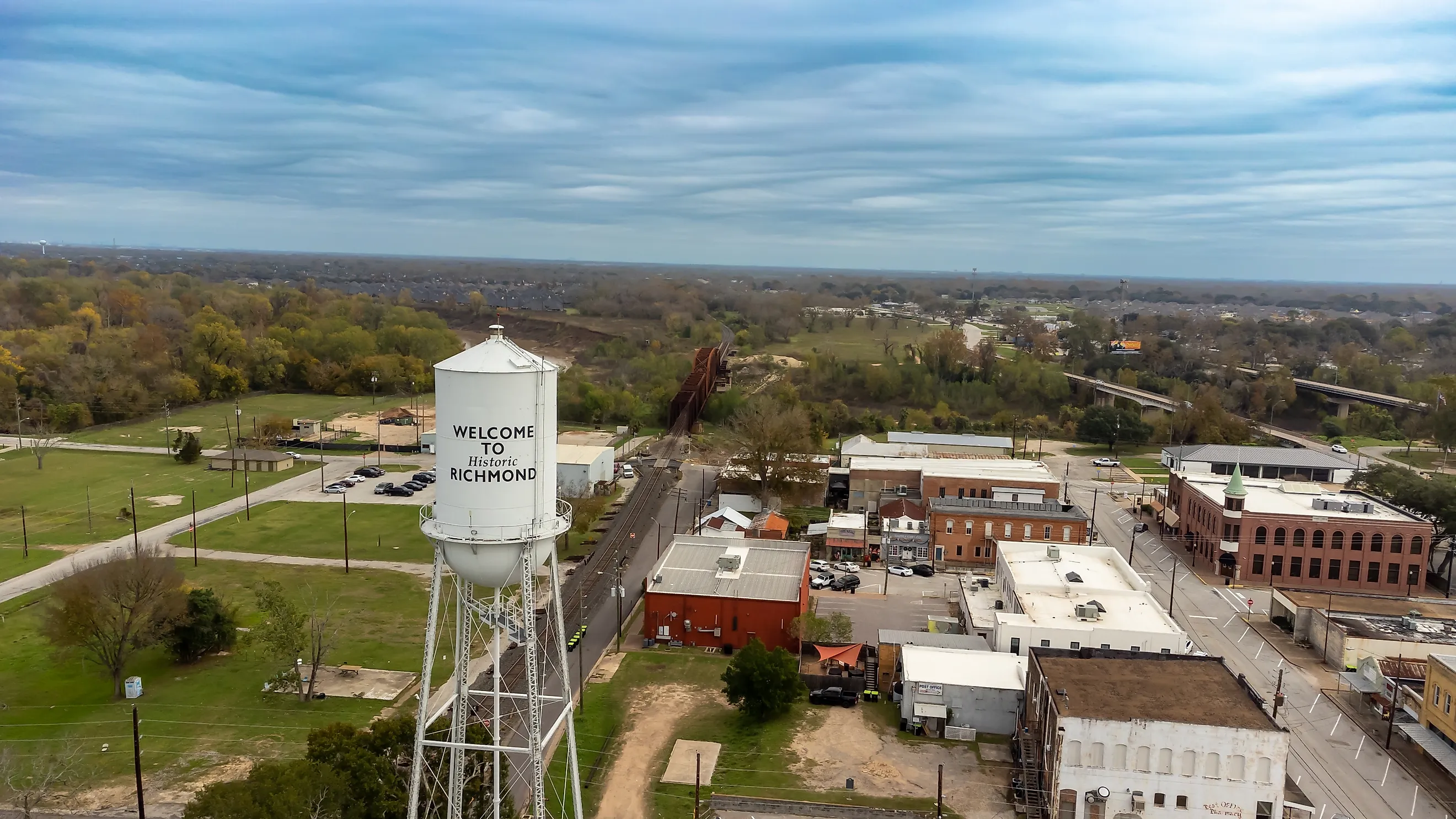
A log fort at a sharp bend in the Brazos River gave Fort Bend County its name, and Richmond its start. Members of Stephen F. Austin’s Old Three Hundred, the first families granted land in his colony, arrived in 1822 and called the place the Fort Settlement. Land promoters Robert Eden Handy and William Lusk laid out the townsite in early 1837 and were advertising lots by April. The Republic incorporated Richmond the same year, and the town became the county seat in 1838.
A visit to Morton Cemetery, in use since 1825, reveals a who’s who of important townsfolk from the past. In addition to the brick tomb of Robert Gillespie who is believed to be the first Masonic landmark in Texas, other notable gravesites include that of Mirabeau B. Lamar, second president of the Republic, and one belonging to Jane Long. The boarding-house owner and planter known as the Mother of Texas, Long ran the Veranda Hotel in Richmond from 1837. Walter Moses Burton, a formerly enslaved man elected Fort Bend County sheriff in 1869 — recognized as the first Black sheriff elected in the United States — and later a state senator, is also burried here.
A few blocks away, the Fort Bend Museum complex covers county history from Austin’s colony onward and includes heritage buildings such as the 1850s Long-Smith Cottage and the John M. and Lottie D. Moore Home, built in 1883. The downtown core is overlooked by the Fort Bend County Courthouse, completed in 1908 in Texas Renaissance style with a copper dome visible for miles.
Gonzales

Few Texas towns have a stronger claim on the state’s founding story than Gonzales. Established in 1825 as the capital of Green DeWitt’s colony, the first Anglo-American settlement west of the Colorado River, the town saw the first fighting of the Texas Revolution on October 2, 1835, when residents refused a demand from Mexico to hand over a small bronze cannon. The following February, 32 men rode from Gonzales to reinforce the Alamo, and died with the garrison on March 6, 1836.
The cannon that sparked the revolution is on display at the Gonzales Memorial Museum, and a reflecting pool leads to a granite and bronze monument of the Immortal 32, the men who answered the Alamo’s call. The museum also displays rifles, uniforms, and household goods from the town’s early settlers. Next door, the Eggleston House, a dog-run log cabin from the 1840s and one of the oldest dwellings in town, is set up with period furniture.

Downtown, the Gonzales County Jail Museum occupies an 1885 Italianate lockup by architect Eugene T. Heiner that stayed in service until 1975, with the sheriff’s and jailer’s quarters, the original cells, and rebuilt gallows open to the public. Behind it stands the red-brick Gonzales County Courthouse, completed in 1896 to a Romanesque Revival design by J. Riely Gordon. The Pioneer Village Living History Center assembles several 19th-century structures, among them a working broom factory, a blacksmith shop, and the Hamon Church.
Bastrop

Then known as Mina, Bastrop was incorporated six months after the first charters, on December 18, 1837 — the same act that restored the town’s old name. The settlement dated to 1832, and by the time it was incorporated amounted to a courthouse, a hotel, a stockade, a gunsmith’s shop, a general store, and a scattering of houses. The timber industry did the rest, and when Austin became the Republic’s capital in 1839, Bastrop’s mills supplied the lumber.

The Lost Pines is the forest behind that trade, and Bastrop State Park now protects roughly 6,600 acres of it. The Civilian Conservation Corps built the park’s core out of local stone and timber in the 1930s with notable structures including the entrance portal, bridges, an amphitheater, 12 cabins, and a refectory furnished with pieces made on site. The Bastrop County Complex fire burned across 96 percent of the park in September 2011, but the cabins survived and are still rented out, and the trails now double as a long look at how a pine forest comes back.
Downtown preservation efforts protect more than 130 structures in the historic district, including the former city hall, fire station, and jail that now house the Bastrop County Museum and Visitor Center. The Bastrop Opera House, built in 1889, has staged live productions since the 1970s, while the Bastrop County Courthouse, completed in 1883, remains in use. The Old County Jail beside it, a Second Empire building of 1891, still has a hanging hook in place on the second floor.
The Oldest Towns in Texas
The Republic of Texas incorporated its towns one at a time, by special act, and roughly eighteen received charters during 1837 alone. These five have done a great job of preserving what came with theirs. All five kept their courthouse squares, and all are compact enough to cover on foot in half a day. For anyone tracing how Texas became America’s 28th state, its oldest incorporated towns are the place to begin.