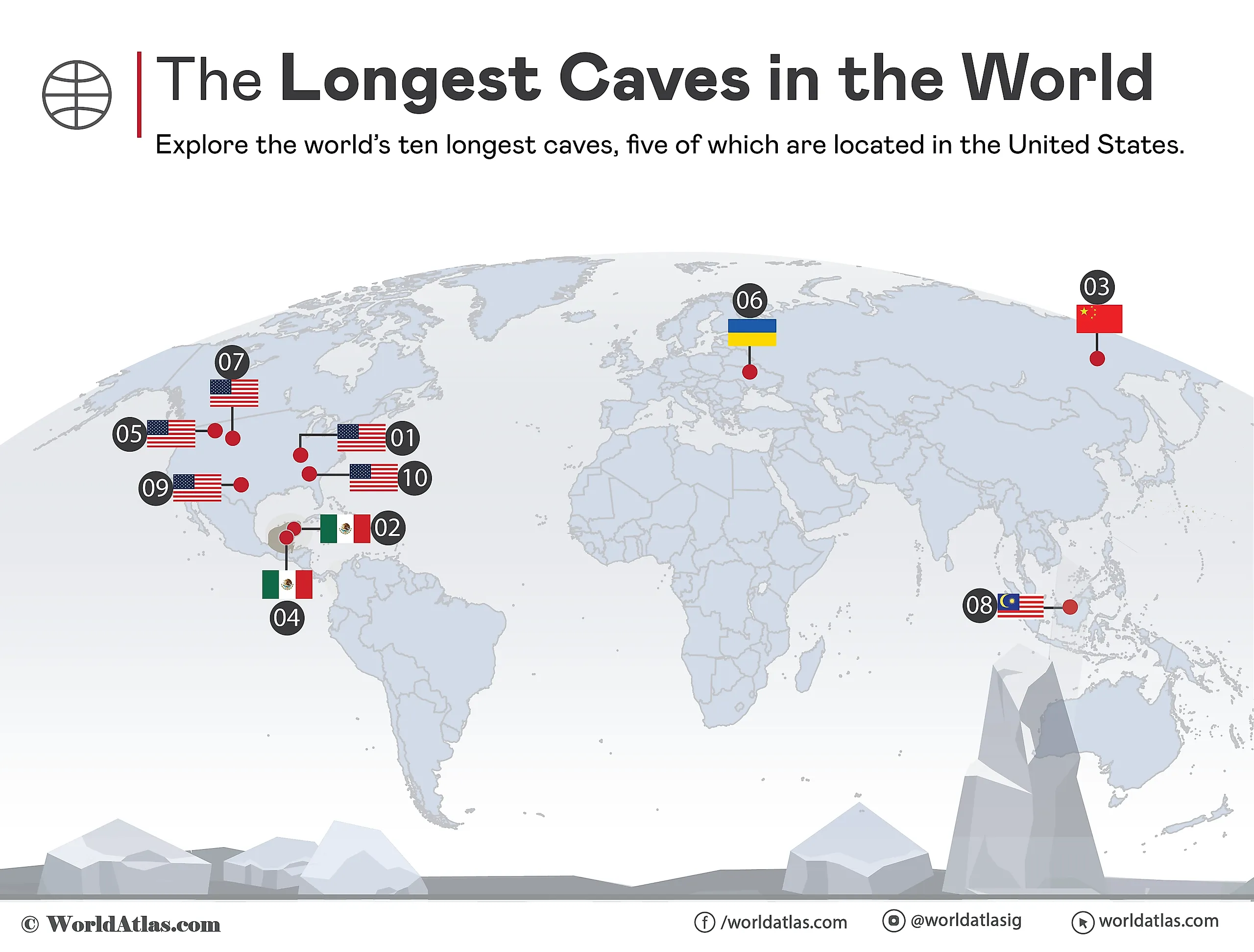
The Longest Caves in the World
The longest caves in the world all sit in areas where soluble rock dissolves under flowing groundwater. The highest concentrations show up in southern Kentucky, the Black Hills of South Dakota, and Mexico’s Yucatan Peninsula. The list keeps growing as exploration teams add new passages. Mammoth Cave alone has gone from 144 miles when the system was first connected in 1972 to 426 miles today. The ten longest caves below sit across three continents.

Mammoth Cave - 426.0 mi

Mammoth Cave National Park in south-central Kentucky preserves the longest known cave system in the world, with 426 miles of surveyed passageways and counting. The park sits in the Green River Valley over Mississippian-aged limestone capped by a sandstone layer. Surface water moves underground through sinkholes in the sandstone, dissolves the limestone below, and carves the cave system over time. Mammoth Cave features large horizontal passages, massive chambers, vertical shafts, stalactites, stalagmites, and gypsum formations. The cave hosts over 130 species of subterranean fauna, including 14 troglobites and troglophiles found nowhere else.
Native American remains, including mummified bodies likely of pre-Columbian origin, have been recovered from Mammoth Cave and nearby caves. Access to the cave is tightly controlled today, with visitors generally restricted to about 10 miles of developed passageways. Above ground, Mammoth Cave National Park also offers canoeing, hiking, fishing, wildlife viewing, and camping.
Sistema Ox Bel Ha - 336.6 mi

Sistema Ox Bel Ha, meaning “Three Paths of Water” in Yucatec Maya, is the world’s longest explored underwater cave and the second-longest cave system overall. Continued exploration has pushed its surveyed length to roughly 336 miles of submerged passages. The system sits just south of Tulum in Mexico’s Quintana Roo state, near the Sian Ka’an Biosphere Reserve. Cave divers first discovered and began mapping Ox Bel Ha in 1996.
The system has over 150 cenotes serving as entry points, including Jailhouse Cenote, Cenote Naharon, and Cenote Corazon del Paraiso. The cave’s defining feature is a freshwater layer flowing on top of near-static saltwater. The boundary between them is a halocline that shifts depth across the system. Daily tidal cycles are also visible in several cenotes. As the freshwater nears the ocean, flow speeds increase, which is why advanced cave diving training is essential for anyone exploring it.
Three prehistoric human remains have been recovered from the Naranjal subsystem. Two women (one 18 to 20 years old, the other 44 to 50) were found around 1,207 feet and 1.2 miles from the Jailhouse Cenote entrance. A 40-to-50-year-old man was found in Muknal Cave. Analysis suggests the cave was used as a burial site. The system also hosts numerous endemic species adapted to permanent darkness, making it a hotspot for scientific research and conservation.
Shuanghedong Cave Network - 274.0 mi

Located in Suiyang County in China’s Guizhou province, the Shuanghedong Cave Network is Asia’s longest cave and currently the third longest in the world at about 274 miles. It sits inside the Suiyang Shuanghedong National Geopark and connects through over 100 entrances, with waterfalls and underground rivers running through the system. The river habitats support cave shrimp, blind fish, tadpoles, salamanders, leeches, spiders, and bats. Shuanghedong was first explored in 1987. Since then, joint expeditions with teams from France and Japan have steadily added length, with new passages found nearly every year. Entry is allowed after a safety briefing at the National Geopark.
Sistema Sac Actun / Sistema Dos Ojos - 240.5 mi

Sistema Sac Actun, meaning “White Cave System” in Yucatec Maya, is the fourth longest cave system in the world at about 240 miles. The 2018 discovery of its connection to the adjacent Sistema Dos Ojos made it briefly the world’s longest underwater cave before Ox Bel Ha’s continued exploration pushed it back to second. The system lies in Quintana Roo along the Yucatan Peninsula’s Caribbean coast on a sedimentary platform of Mesozoic and Cenozoic rocks. The coastal sections are characterized by low horizontal tunnels forming mazes parallel to the coast, broken up by fracture-controlled rooms. Multiple cenotes provide access, including Cenote Sac Actun, Cenote Dos Ojos, and Cenote the Pit. Decades of scientific exploration have turned up archaeological and paleontological remains throughout the system. Hiring a local expert guide is essential for anyone planning to dive Sac Actun.
Jewel Cave - 220.3 mi

Jewel Cave National Monument, about 13 miles west of Custer in the Black Hills of southwestern South Dakota, preserves the world’s fifth-longest cave at over 220 miles of mapped passageways. The cave formed in the Mississippian Pahasapa Limestone, deposited around 350 million years ago. A succession of chambers connects through narrow passages, with the cave known for its sparkling calcite crystals or spar, stalactites, flowstone, frostwork, helictites, and hydromagnesite balloons. Around 9 bat species use the cave, with 5 as year-round residents. The ponderosa pine forest above the surface supports elk, coyotes, white-tailed deer, and a wide range of bird species.
Local prospectors Frank and Albert Michaud first discovered Jewel Cave in 1900 and tried to open it as a tourist attraction. The venture failed commercially, but President Theodore Roosevelt designated it a National Monument on February 7, 1908. Systematic exploration began in the late 1950s. The National Park Service offers three tours year-round: an hour-long scenic tour, a lantern-guided historic tour, and a four-hour wild caving tour.
Wind Cave - 168.0 mi

The first cave anywhere to be designated as a national park, Wind Cave National Park, sits about 10 miles north of Hot Springs in western South Dakota. Wind Cave itself is the United States’ third-longest and the world’s sixth-longest cave at about 168 miles. The cave is famous for two unusual features. The first is the reversible wind that flows in and out of the natural entrance, equalizing pressure between the cave and the outside air. The second is an outstanding concentration of boxwork, a rare calcite formation found in greater quantities at Wind Cave than anywhere else on Earth. Wind Cave is also considered the world’s densest cave system by passage volume per cubic mile.
The park also preserves one of the country’s largest remaining tracts of mixed-grass prairie, home to bison, pronghorn, coyotes, elk, prairie dogs, raccoons, black-footed ferrets, and many bird species. Indigenous tribes in the area knew about the cave’s opening for centuries and considered it sacred. Jesse and Tom Bingham are credited with the first recorded modern discovery, drawn to the natural opening by a loud whistling sound. The cave has been open to visitors since February 1892, and ranger-led tours run year-round.
Clearwater Cave System - 166.9 mi

Known locally as Gua Air Jernih, the Clearwater Cave System in Malaysia’s Gunung Mulu National Park is the world’s seventh-longest cave at about 167 miles. It is the longest in Southeast Asia and one of the largest interconnected cave systems by volume anywhere. The cave lies mostly beneath the western flank of the limestone peak Gunung Api, running between the Cave of the Winds and Melinau Gorge. Initial exploration came during the Royal Geographical Society’s Mulu Sarawak Expedition in 1977 and 1978, when about 15 miles of passages were surveyed. The Mulu Caves Project has continued the work over the decades.
Clearwater Cave has an underground river, part of which is navigable by boat. Visitors reach the entrance either by a 2.48-mile trail through the forest or by long boat along the Melinau River, then climb about 200 steps to the cave mouth. A clear pool at the base of the steps offers a swimming spot for those wanting it.
Optymistychna Cave - 164.4 mi

Optymistychna Cave, with 164 miles of mapped passages, is the world’s longest gypsum cave and the longest cave on the European continent. The cave sits near Korolivka village in western Ukraine’s Ternopil Oblast and is contained within an area of about 2 square kilometers in a Neogene gypsum bed under 98 feet thick. The system is sometimes called a “maze cave,” with small passages forming dense networks across several levels that often clog with mud. A limestone cap above the gypsum leaks through erosion, building the calcite speleothems found throughout.
A team of Lviv speleologists led by Myron Savchyn of the local Cyclope speleological club first discovered Optymistychna on May 8, 1966. Multiple expeditions have explored and mapped the system over the years, though active surveying has slowed in the past decade. Optymistychna was recognized as a Natural Wonder of Ukraine in 2008.
Lechuguilla Cave - 152.0 mi

The remote desert terrain of the Guadalupe Mountains in southeastern New Mexico’s Carlsbad Caverns National Park holds 152-mile-long Lechuguilla Cave, the world’s ninth-longest explored cave. It is also one of the deepest caves in the continental United States at about 1,604 feet below the surface. The cave is named after Agave lechuguilla, the native plant species growing in the canyon through which it is entered. Lechuguilla contains a wide variety of rare carbonate and sulfate speleothems, including hydromagnesite balloons, 20-foot gypsum chandeliers, 15-foot soda straws, lemon-yellow sulfur deposits, and cave pearls.
The cave formed through hypogenic processes, where hydrogen sulfide from hydrocarbons in the adjacent Delaware Basin was absorbed into oxygenated water on bedrock and oxidized into sulfur and sulfuric acid. The acidified groundwater rose into the Capitan Formation’s carbonate rock, carving the cave from below. After formation, falling aquifer levels left it hydrologically isolated from below, while the impermeable Yates Formation above isolated it from the surface. Studies have documented rare chemolithoautotrophic bacteria that feed on minerals like sulfur and iron and help shape the cave’s unusual speleothems.
Until 1986, Lechuguilla was considered an insignificant historic site in Carlsbad Caverns’ backcountry, with its 90-foot entrance pit nicknamed “Misery Hole” leading to 400 feet of dry, dead-end passages. In 1984 a group of cavers from Colorado Grotto led by Dave Allured began digging, and on May 26, 1986, they broke into the extensive passage system. As a conservation measure, access today is restricted to NPS-approved scientific researchers and exploration teams.
Fisher Ridge Cave System - 134.2 mi

The world’s tenth-longest cave at about 134 miles, the Fisher Ridge Cave System sits in Kentucky’s Hart County close to Mammoth Cave National Park. Archaic Native Americans were the earliest known visitors. In January 1981, the cave was rediscovered by a group of Michigan cavers from the Detroit Urban Grotto of the National Speleological Society.
The system has two main segments linked by a 1,000-foot crawl. The Northtown Ridge portion runs about 80 miles and includes large dry tunnels similar to the nearby Mammoth Cave system. The 50-mile Fisher Ridge section contains active streams and two mid-level trunk passages. An uninterrupted stretch of abandoned trunk passage runs about 5.5 miles from one end of the cave to the other.
The closest known passages of Fisher Ridge and Mammoth Cave come within 600 feet of each other, but no physical connection has been established. The closest gap sits high in the ridges between the two systems, where the geology is unfavorable for a passage. A drainage divide also separates much of the two systems. If a connection does exist, it is likely deep in the active base-level streams. Explorers from both systems continue searching for a link.
Caves preserve archaeological and paleontological records that open whole new chapters of Earth’s past. Whether you are a serious caver or just want to see one of these systems on a guided tour, the ten longest caves in the world are an entry point into the kind of geology and biology that exists nowhere else.
The Longest Caves in the World
| Rank | Cave System | Length (Miles) | Location |
|---|---|---|---|
| 1 | Mammoth Cave | 426.0 | near Brownsville, Kentucky, United States |
| 2 | Sistema Ox Bel Ha | 336.6 | near Tulum, Quintana Roo, Mexico |
| 3 | Shuanghedong Cave Network | 274.0 | Guizhou, China |
| 4 | Sistema Sac Actun / Sistema Dos Ojos | 240.5 | near Tulum, Quintana Roo, Mexico |
| 5 | Jewel Cave | 220.3 | near Custer, South Dakota, United States |
| 6 | Wind Cave | 168.0 | near Hot Springs, South Dakota, United States |
| 7 | Clearwater Cave System | 166.9 | near Miri, Sarawak, Malaysia |
| 8 | Optymistychna Cave | 164.4 | near Korolivka, Ukraine |
| 9 | Lechuguilla Cave | 152.0 | near Carlsbad, New Mexico, United States |
| 10 | Fisher Ridge Cave System | 134.2 | near Brownsville, Kentucky, United States |