The Day The St. Francis Dam Collapsed
Just before midnight on March 12, 1928, the St. Francis Dam catastrophically failed. Missed warning signs that pointed to failure led to one of California's greatest losses of life in the 20th century. Over 400 lives were lost, and floodwaters that charged through the towns near Los Angeles forever changed them. The collapse of the St. Francis Dam forever changed California and the laws governing dams.
The Construction Of St. Francis Dam
The St. Francis Dam was a concrete gravity-arch dam located in San Francisquito Canyon, in northern Los Angeles County. The dam was built to meet Los Angeles's growing water needs as the population boomed. The dam would create a large storage reservoir that would pair with the Los Angeles Aqueduct.
William Mulholland, a self-taught engineer, decided its location. He chose the site between the hydroelectric powerhouses, Powerhouse No. 1 and No. 2, because the topography was favorable. The dam's construction was nearly identical to that of the Mulholland Dam, with modifications to suit the site.
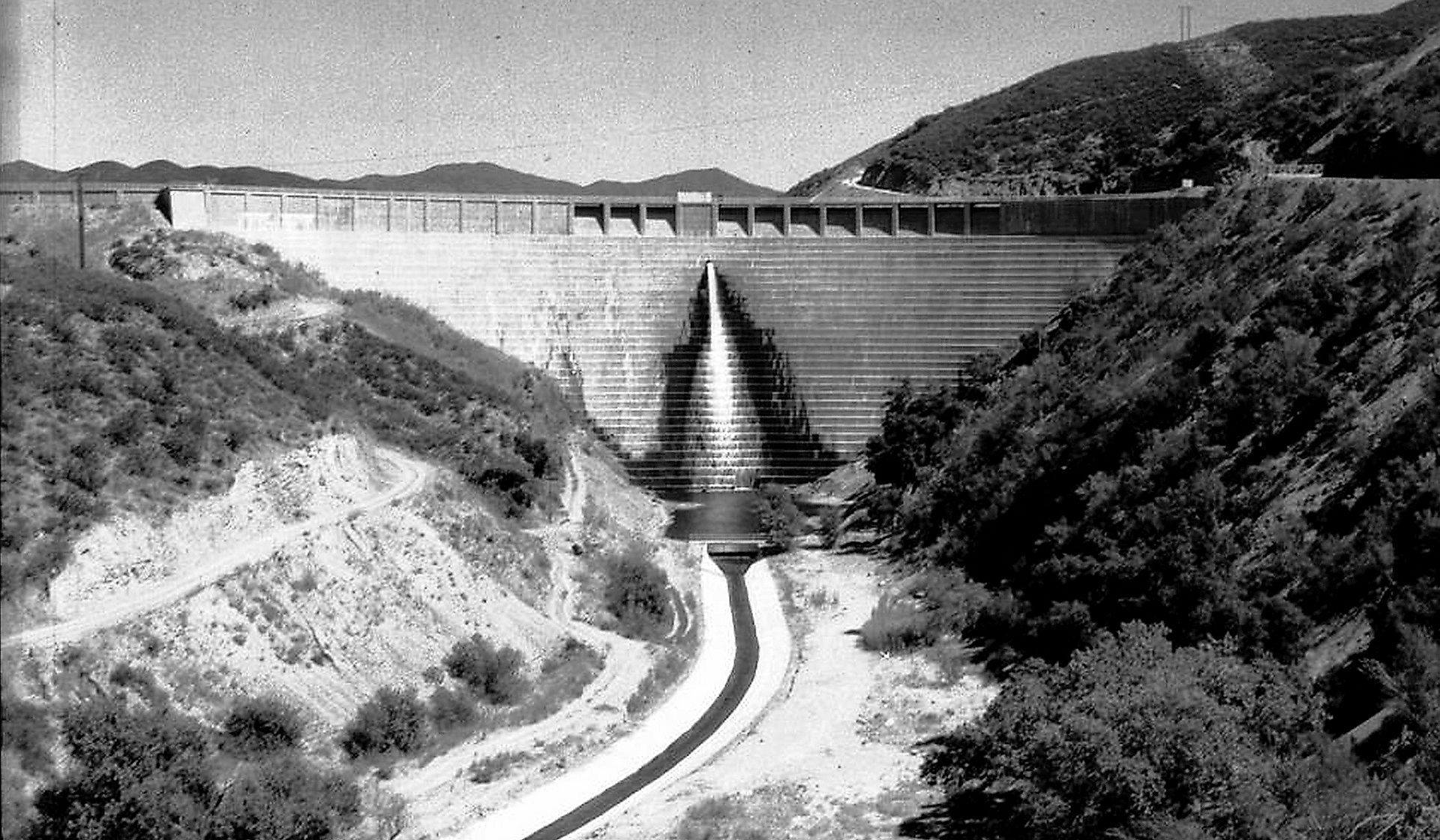
Construction began in August 1924. The dam's final dimensions were 185 feet above the stream bed, with a capacity of 38,000 acre-feet. The dam's height was 205 feet. A 588-foot wing dike would now be placed along the top ridge for added support. This would be curved, but by today's standards, the dam would be considered arched.
Knowledge of arch-gravity dams was limited at the time of construction. The dam was designed without any of the additional benefits we now know arches provide.
The dam was completed on May 4, 1926, with a stairstep face. Each step was 5 feet high, while the width of each step varied with its elevation above sea level. The width ranged from 5.5 feet near the stream-bed base to 1.45 feet at the base of the spillways and upright panels.
Warning Signs Before The Collapse

Water would begin filling the dam in March 1926. Several temperature-related contraction cracks in the dam allowed minor seepage from beneath the abutments. The most notable cracks ran down from the top, with one being 58 feet west of the outlet gates and a matching one on the east.
At the beginning of April that same year, water levels reached the inactive San Francisquito Fault line, and some seepage began. Workers were ordered to seal off the leak, but they weren't fully successful.
In late 1927, another fracture appeared, this time running diagonally upward at the western abutment toward the center section. Mulholland inspected the fracture like the others, judged it another contraction crack, and filled it with oakum and grouted it off. Another similar fracture appeared on the eastern portion of the dam, starting near the crest, running down at an angle for 65 feet before ending at the hillside.
The reservoir continued to rise steadily until early February 1928, when water levels were within one foot of the spillway. Several cracks appeared in the wing dike, and new areas of seepage began to form. During this time, more leaks appeared, and it was decided that erosion had occurred; an eight-inch concrete drain pipe was ordered. This led to water being turned into the hillside, which alarmed many.
On March 7, 1928, the reservoir was three inches below the spillway, and Mulholland ordered no water be turned toward the dam. Five days later, workers discovered a new leak in the west abutment. Concerned by the muddy runoff, Mulholland began inspecting the area. For two hours, the leak was inspected before determining it wasn't dangerous.
The Night The Dam Broke
Shortly before midnight on March 12, 1928, the ground north of Los Angeles started to rumble. Tremors weren't uncommon in the area, and many went unnoticed.
Two minutes before midnight, the dam crumbled. It unleashed a 10-story-high wall of water down the canyon. The dam broke off a significant piece of the east abutment, which investigators labeled Block 35. This created a nozzle through which water escaped the reservoir. With the existing leaks, this was enough to ensure catastrophic failure.
As the St. Francis Reservoir surged, it wrenched the dam's center away from the west abutment. A crack between the center and the west abutment had been filled. The water's force broke it open, and the west abutment gave way shortly after.
The only thing left the next morning was the center, and the mammoth crack at the base showing how close it had come to toppling over as well.
The Devastating Flood
As residents slept, nearly 52 million tons of water swept through the Santa Clara River Valley. The water devoured everything in its path. It smashed homes, uprooted entire groves, twisted railroad tracks, and took the lives of over 400 people.
It wasn't just water that swept through the valley. Large pieces of the dam came with it. The largest piece was found about three-quarters of a mile below the dam site and weighed 10,000 tons.
The flood traveled at an average speed of 18 miles per hour. It destroyed Powerhouse No. 2 and took the lives of 64 of the 67 workmen and their families who lived nearby. This cut power to much of Los Angeles, but Southern California Edison (SCE) soon repaired it. At about 12:40 a.m., the flood knocked out two of SCE's main power lines, plunging Los Angeles back into darkness.
The towns of Fillmore, Bardsdale, Castaic Junction, and Santa Paula all faced the devastation of the floodwaters. Castaic Junction was washed away first. The flood emptied both victims and debris into the Pacific Ocean around 5:30 a.m., at which point the wave was almost two miles wide and still traveling at 6 mph.
At the time of the dam breaking, there was no mass warning system in operation.
What Caused The St. Francis Dam To Collapse?

The truth is, no one is quite sure what exactly caused the St. Francis Dam to collapse. There were at least a dozen investigations into the disaster.
There is no possible way Mulholland could have known that he was building a dam on top of an ancient landslide. Once it was saturated with water, it was slippery, and that is where the eastern abutment sat.
The dam's height also played a role. Mulholland changed the dam's height twice and didn't proportionally thicken its base or properly reinforce the structure.
Mulholland took full responsibility for the failure of the dam. He said in testimony, "Whether it is good or bad, don't blame anyone else; you just fasten it on me. If there was an error in human judgment, I was the human; I won't try to fasten it on anyone else."
Mulholland's career ended on December 1, 1928, and the guilt of the dam stayed with him. After the failure, the California legislature created an updated dam safety program.
The Legacy of St. Francis Dam
This catastrophic failure ended the lives of over 400 people, most of whom were never found again. The level of disaster sparked change in order to prevent this from happening again. While the dam no longer stands, the scars remain a part of the canyon. As a result of this collapse, laws changed regarding dams moving forward, ensuring this would not happen again.